
-
 Australia
-
 Austria
-
 Belgium
-
 Brazil
-
 Canada
-
 China
China
-
 Czech Republic
-
 Denmark
-
 Finland
-
 France
-
 Germany
-
 Greece
-
 Hong Kong
-
 Hungary
-
 Iceland
-
 India
India
-
 Ireland
-
 Israel
-
 Italy
Italy
-
 Japan
Japan
-
 Korea
Korea
-
 Luxembourg
-
 Malaysia
-
 Netherlands
-
 New Zealand
-
 Norway
-
 Poland
-
 Qatar
Qatar
-
 Romania
-
 Saudi Arabia
-
 Singapore
-
 Spain
Spain
-
 Sweden
-
 Switzerland
-
 Taiwan
-
 Turkey
-
 United Kingdom
-
 United States
research use only
Oxybenzone
Cat.No.S4691
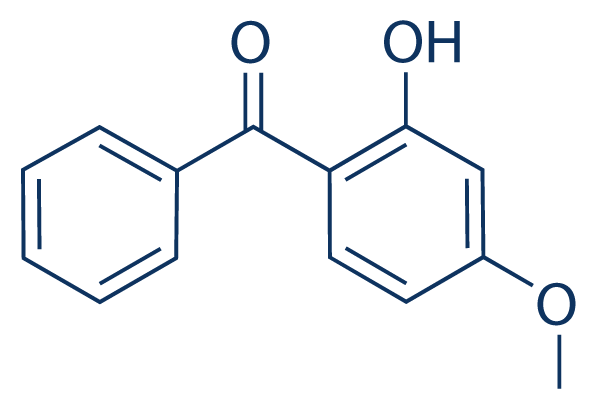
Chemical Structure
Molecular Weight: 228.24
Quality Control
Solubility
|
In vitro |
DMSO
: 45 mg/mL
(197.16 mM)
Ethanol : 45 mg/mL Water : Insoluble |
Molarity Calculator
|
In vivo |
|||||
In vivo Formulation Calculator (Clear solution)
Step 1: Enter information below (Recommended: An additional animal making an allowance for loss during the experiment)
Step 2: Enter the in vivo formulation (This is only the calculator, not formulation. Please contact us first if there is no in vivo formulation at the solubility Section.)
Calculation results:
Working concentration: mg/ml;
Method for preparing DMSO master liquid: mg drug pre-dissolved in μL DMSO ( Master liquid concentration mg/mL, Please contact us first if the concentration exceeds the DMSO solubility of the batch of drug. )
Method for preparing in vivo formulation: Take μL DMSO master liquid, next addμL PEG300, mix and clarify, next addμL Tween 80, mix and clarify, next add μL ddH2O, mix and clarify.
Method for preparing in vivo formulation: Take μL DMSO master liquid, next add μL Corn oil, mix and clarify.
Note: 1. Please make sure the liquid is clear before adding the next solvent.
2. Be sure to add the solvent(s) in order. You must ensure that the solution obtained, in the previous addition, is a clear solution before proceeding to add the next solvent. Physical methods such
as vortex, ultrasound or hot water bath can be used to aid dissolving.
Chemical Information, Storage & Stability
| Molecular Weight | 228.24 | Formula | C14H12O3 |
Storage (From the date of receipt) | |
|---|---|---|---|---|---|
| CAS No. | 131-57-7 | Download SDF | Storage of Stock Solutions |
|
|
| Synonyms | Eusolex 4360, Escalol 567, KAHSCREEN BZ-3, Benzophenone 3 | Smiles | COC1=CC(=C(C=C1)C(=O)C2=CC=CC=C2)O | ||
Mechanism of Action
| In vitro |
A dose-dependent inhibition of PGE2-production is found in the HEPM cell culture following oxybenzone exposure. Benzophenones, including oxybenzone(BP-3) are documented mutagens that increase the rate of damage to DNA, especially when exposed to sunlight. It either can act directly as genotoxicants or become genotoxicants by bioactivation via cytochrome
P450 enzymes. Oxybenzone can generate reactive oxygen species, which are potential mutagens, when applied topically to the skin followed by UV light exposure.
|
|---|---|
| In vivo |
In mice studies, oxybenzone(BP-3) exposure significantly affects fecundity, as well as inducing unexplained mortality in lactating mothers. Studies in both mice and rats demonstrate that generational exposure to oxybenzone(BP-3) reduces body weight, increases liver ([50 %) and kidney weights, induces a 30 % increase in prostate weight, a reduction in immunocompetence, and significantly increases uterine weight in juveniles. In mammals, oxybenzone(BP-3) is renowned for having estrogenic and anti-androgenic activities, causing activation of estrogen receptor proteins and inhibition of androgen receptors.
|
References |
|
Tech Support
Tel: +1-832-582-8158 Ext:3
If you have any other enquiries, please leave a message.

Products are for research use only. Not for human use. We do not sell to patients.
©Copyright 2013 Selleck Chemicals. All Rights Reserved.