
-
 Argentina
-
 Australia
-
 Austria
-
 Belgium
-
 Brazil
-
 Canada
-
 China
China
-
 Czech Republic
-
 Denmark
-
 Finland
-
 France
-
 Germany
-
 Greece
-
 Hong Kong
-
 Hungary
-
 Iceland
-
 India
India
-
 Ireland
-
 Israel
-
 Italy
Italy
-
 Japan
Japan
-
 Korea
Korea
-
 Luxembourg
-
 Malaysia
-
 Netherlands
-
 New Zealand
-
 Norway
-
 Poland
-
 Portugal
-
 Qatar
Qatar
-
 Romania
-
 Saudi Arabia
-
 Singapore
-
 Spain
Spain
-
 Sweden
-
 Switzerland
-
 Taiwan
-
 Turkey
-
 United Kingdom
-
 United States
research use only
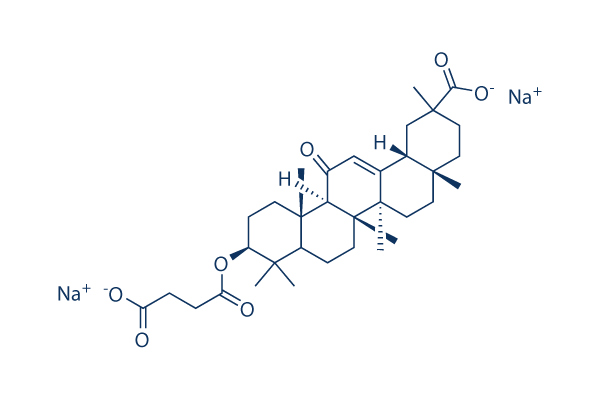
Carbenoxolone Sodium
Cat.No.S4368
Quality Control
Solubility
|
In vitro |
DMSO
: 23 mg/mL
(37.41 mM)
Ethanol : 6 mg/mL Water : Insoluble |
Molarity Calculator
|
In vivo |
|||||
In vivo Formulation Calculator (Clear solution)
Step 1: Enter information below (Recommended: An additional animal making an allowance for loss during the experiment)
Step 2: Enter the in vivo formulation (This is only the calculator, not formulation. Please contact us first if there is no in vivo formulation at the solubility Section.)
Calculation results:
Working concentration: mg/ml;
Method for preparing DMSO master liquid: mg drug pre-dissolved in μL DMSO ( Master liquid concentration mg/mL, Please contact us first if the concentration exceeds the DMSO solubility of the batch of drug. )
Method for preparing in vivo formulation: Take μL DMSO master liquid, next addμL PEG300, mix and clarify, next addμL Tween 80, mix and clarify, next add μL ddH2O, mix and clarify.
Method for preparing in vivo formulation: Take μL DMSO master liquid, next add μL Corn oil, mix and clarify.
Note: 1. Please make sure the liquid is clear before adding the next solvent.
2. Be sure to add the solvent(s) in order. You must ensure that the solution obtained, in the previous addition, is a clear solution before proceeding to add the next solvent. Physical methods such
as vortex, ultrasound or hot water bath can be used to aid dissolving.
Chemical Information, Storage & Stability
| Molecular Weight | 614.72 | Formula | C34H48Na2O7 |
Storage (From the date of receipt) | |
|---|---|---|---|---|---|
| CAS No. | 7421-40-1 | Download SDF | Storage of Stock Solutions |
|
|
| Synonyms | N/A | SMILES | CC1(C2CCC3(C(C2(CCC1OC(=O)CCC(=O)[O-])C)C(=O)C=C4C3(CCC5(C4CC(CC5)(C)C(=O)[O-])C)C)C)C.[Na+].[Na+] | ||
Read more about storage stability stock solution CAS number SMILES
Mechanism of Action
| In vitro |
Carbenoxolone induces astrocytes a reversible suppression of spontaneous action potential discharges, synaptic currents and synchronised calcium oscillations. Carbenoxolone inhibits oscillatory activity induced by the GABAA antagonist, bicuculline.Carbenoxolone causes an increase in the action potential threshold and strongly decreases the firing rate in response to a sustained depolarising current in astrocytes. Carbenoxolone (100 μM) reduces photoreceptor-to-horizontal cell synaptic transmission by 92% in the Retina. Carbenoxolone (100 μM) reduces cone Ca channel current by 37%, reduces depolarization-evoked [Ca2+] signals in fluo-4 loaded retinal slices by 57% and inhibits Ca channels in Müller cells by 52% in the Retina. Carbenoxolone abolishes the generation of full or partial ectopic spike generation, as well as spontaneous epileptiform activity in CA3 or CA1 regions of the rat hippocampal slices via closing GJ channels. |
|---|---|
| In vivo |
Carbenoxolone (400 mg/kg) decreases the duration of seizure producing protection against seizure but failing to protect against mortality.Carbenoxolone significantly increases sleeping time and decreased latency in doses of 100 mg/kg, 200 mg/kg and 300 mg/kg in mice dose dependently. Carbenoxolone (400 mg/kg) shows muscle relaxant activity and in the accelerated rotarod test, Carbenoxolone in doses of 200 mg/kg and 300 mg/kg shows a decline in motor coordination. Carbenoxolone (12.5 mg/day) leads to a significant reduction in average birth weight (20% fall) in rats. Carbenoxolone treatment lowers birthweight and induces hypertension in the offspring of rats fed a protein-replete diet. |
References |
|
Tech Support
Tel: +1-832-582-8158 Ext:3
If you have any other enquiries, please leave a message.

Products are for research use only. Not for human use. We do not sell to patients.
©Copyright 2013 Selleck Chemicals. All Rights Reserved.