
-
 Australia
-
 Austria
-
 Belgium
-
 Brazil
-
 Canada
-
 China
China
-
 Czech Republic
-
 Denmark
-
 Finland
-
 France
-
 Germany
-
 Greece
-
 Hong Kong
-
 Hungary
-
 Iceland
-
 India
India
-
 Ireland
-
 Israel
-
 Italy
Italy
-
 Japan
Japan
-
 Korea
Korea
-
 Luxembourg
-
 Malaysia
-
 Netherlands
-
 New Zealand
-
 Norway
-
 Poland
-
 Qatar
Qatar
-
 Romania
-
 Saudi Arabia
-
 Singapore
-
 Spain
Spain
-
 Sweden
-
 Switzerland
-
 Taiwan
-
 Turkey
-
 United Kingdom
-
 United States
research use only
Inulin
Cat.No.S2609
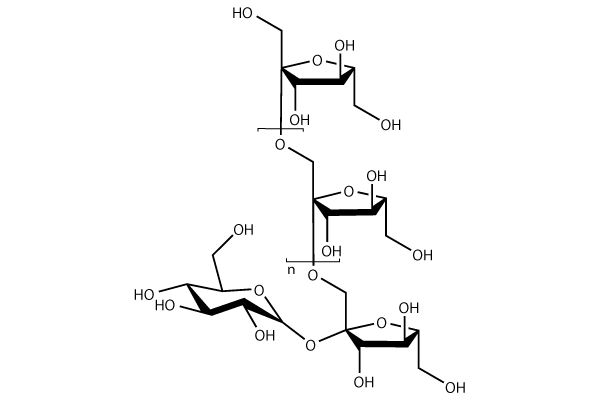
Chemical Structure
Molarity Calculator
|
In vivo |
|||||
In vivo Formulation Calculator (Clear solution)
Step 1: Enter information below (Recommended: An additional animal making an allowance for loss during the experiment)
Step 2: Enter the in vivo formulation (This is only the calculator, not formulation. Please contact us first if there is no in vivo formulation at the solubility Section.)
Calculation results:
Working concentration: mg/ml;
Method for preparing DMSO master liquid: mg drug pre-dissolved in μL DMSO ( Master liquid concentration mg/mL, Please contact us first if the concentration exceeds the DMSO solubility of the batch of drug. )
Method for preparing in vivo formulation: Take μL DMSO master liquid, next addμL PEG300, mix and clarify, next addμL Tween 80, mix and clarify, next add μL ddH2O, mix and clarify.
Method for preparing in vivo formulation: Take μL DMSO master liquid, next add μL Corn oil, mix and clarify.
Note: 1. Please make sure the liquid is clear before adding the next solvent.
2. Be sure to add the solvent(s) in order. You must ensure that the solution obtained, in the previous addition, is a clear solution before proceeding to add the next solvent. Physical methods such
as vortex, ultrasound or hot water bath can be used to aid dissolving.
Chemical Information, Storage & Stability
| Molecular Weight | Formula | C6nH10n+2O5n+1 |
Storage (From the date of receipt) | ||
|---|---|---|---|---|---|
| CAS No. | 9005-80-5 | Download SDF | Storage of Stock Solutions |
|
|
| Synonyms | N/A | Smiles | OCC1OC(OC2(CO)OC(CO)C(O)C2O)C(O)C(O)C1O | ||
Mechanism of Action
| In vitro |
Inulin causes (20 g/d and 40 g/d) a significant increase in bifidobacterial counts in feces. This compound exerts a preferential stimulatory effect on numbers of the health-promoting genus Bifidobacterium, whilst maintaining populations of potential pathogens (Escherichia coli, Clostridium) at relatively low levels. It combined with Bifidobacterium results in more potent inhibition of aberrant crypt foci (ACF) than administration of the two separately, achieving 80% inhibition of small ACF. This substance is made by a set of linear chains of fructose molecules, with a degree of polymerization (DP) ranging between 3 and 65, it can be fractionated into a slowly fermentable long-chain fraction (DP ranging from 10 to 65, average 25) or in a rapidly fermentable fraction made of oligofructose (DP ranging from 3 to 8, average 4). Long-chain inulin combined with short-chain oligofructose results in larger numbers of caecal, colonic and faecal bacteria of the Clostridium coccoides-Eubacterium rectale cluster than Control in rats, whereas OF alone does not affect this bacterial group in caecum, colon or faeces.
|
|---|---|
| In vivo |
Inulin results in an increase in caecal wt and beta-glucosidase activity and a decrease in caecal pH were observed in rats given this compound-containing diets (with or without B. longum).
|
References |
|
Clinical Trial Information
(data from https://clinicaltrials.gov, updated on 2024-05-22)
| NCT Number | Recruitment | Conditions | Sponsor/Collaborators | Start Date | Phases |
|---|---|---|---|---|---|
| NCT05254340 | Active not recruiting | Healthy |
Indiana University|National Institute of Diabetes and Digestive and Kidney Diseases (NIDDK) |
August 1 2021 | Not Applicable |
Tech Support
Tel: +1-832-582-8158 Ext:3
If you have any other enquiries, please leave a message.

Products are for research use only. Not for human use. We do not sell to patients.
©Copyright 2013 Selleck Chemicals. All Rights Reserved.