
-
 Argentina
-
 Australia
-
 Austria
-
 Belgium
-
 Brazil
-
 Canada
-
 China
China
-
 Czech Republic
-
 Denmark
-
 Finland
-
 France
-
 Germany
-
 Greece
-
 Hong Kong
-
 Hungary
-
 Iceland
-
 India
India
-
 Ireland
-
 Israel
-
 Italy
Italy
-
 Japan
Japan
-
 Korea
Korea
-
 Luxembourg
-
 Malaysia
-
 Netherlands
-
 New Zealand
-
 Norway
-
 Poland
-
 Portugal
-
 Qatar
Qatar
-
 Romania
-
 Saudi Arabia
-
 Singapore
-
 Spain
Spain
-
 Sweden
-
 Switzerland
-
 Taiwan
-
 Turkey
-
 United Kingdom
-
 United States
Dopamine Receptor Antagonist/Agonists
Other Neuronal Signaling Related Inhibitors
Isoform-selective Products
- Featured Inhibitors
- Inhibitors (13)
- Modulators (2)
- Chemicals (3)
- Agonists (20)
- Activator (1)
- Antagonists (53)
| Cat.No. | Product Name | Information | Product Use Citations | Product Validations |
|---|---|---|---|---|
| S6887 | Clozapine N-oxide (CNO chemical) | CNO (Clozapine N-oxide) is a metabolite of Clozapine (GLXC-06516) and an agonist of human muscarinic designer receptors (Designer Receptors Exclusively Activated by Designer Drugs, DREADDs). Clozapine is a potent dopamine (DA) antagonist and a selective muscarinic M4 receptor agonist.Solutions are unstable and should be fresh-prepared. |
|
|
| S5749 | Chlorpromazine (CPZ) | Chlorpromazine (CPZ) is a low-potency typical antipsychotic agent that is used to treat psychotic disorders such as schizophrenia. Chlorpromazine (CPZ) inhibits 5-HT(2A) receptor and dopamine D2 in vitro. Chlorpromazine (CPZ) also inhibits sodium channel and blocks HERG potassium channels with IC50 of 21.6 μM. |
|
|
| S4732 | MPTP Hydrochloride | MPTP hydrochloride is a dopaminergic neurotoxin and cause selective destruction of dopaminergic neurons in animal models of parkinsonism. MPTP hydrochloride induces apoptosis.MPTP hydrochloride can be used to induce animal models of Parkinson’s disease. |
|
|
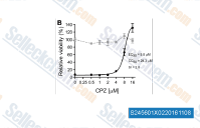
| S2456 | Chlorpromazine HCl | Chlorpromazine HCl is a dopamine and potassium channel inhibitor with IC50 of 6.1 and 16 μM for inward-rectifying K+ currents and time-independent outward currents. |
|
|
| S5856 | Trifluoperazine | Trifluoperazine (NSC-17474, RP-7623, SKF-5019) is an FDA-approved antipsychotic drug for schizophrenia. It is an inhibitor of calmodulin (CaM) and Dopamine D2 receptor with an IC50 value of 1.2 nM for D2 receptor. |
|
|
| S3201 | Trifluoperazine 2HCl | Trifluoperazine (NSC-17474, RP-7623, SKF-5019) 2HCl is a dopamine D2 receptor inhibitor with IC50 of 1.1 nM. Trifluoperazine also inhibits calmodulin (CaM). |
|
|
| S2529 | Dopamine HCl | Dopamine HCl(ASL279, NSC 173182) is a catecholamine neurotransmitter present in a wide variety of animals,And a dopamine D1-5 receptors agonist. |
|
|
| S4151 | Penfluridol | Penfluridol (TLP-607,R-16341) is a highly potent, first generation diphenylbutylpiperidine antipsychotic. |
|
|
| S4358 | Pimozide | Pimozide (Orap, R6238) is an antagonist of Dopamine Receptors with Ki of 0.83 nM, 3.0 nM and 6600 nM for dopamine D3, D2 and D1 receptors, respectively. This compound also exhibits binding affinity at 5-HT1A and α1-adrenoceptor with Ki of 310 nM and 39 nM, respectively. It is an antipsychotic drug with anti-tumor activity and suppresses STAT3 and STAT5 activity. |
|
|
| S1763 | Quetiapine (ICI-204636) fumarate | Quetiapine Fumarate (ICI-204636) is an atypical antipsychotic used in the treatment of schizophrenia, bipolar I mania, bipolar II depression, bipolar I depression and shows affinity for various neurotransmitter receptors including serotonin, dopamine, histamine, and adrenergic receptors. |
|
|
Signaling Pathway Map

Products are for research use only. Not for human use. We do not sell to patients.
©Copyright 2013 Selleck Chemicals. All Rights Reserved.