
-
 Argentina
-
 Australia
-
 Austria
-
 Belgium
-
 Brazil
-
 Canada
-
 China
China
-
 Czech Republic
-
 Denmark
-
 Finland
-
 France
-
 Germany
-
 Greece
-
 Hong Kong
-
 Hungary
-
 Iceland
-
 India
India
-
 Ireland
-
 Israel
-
 Italy
Italy
-
 Japan
Japan
-
 Korea
Korea
-
 Luxembourg
-
 Malaysia
-
 Netherlands
-
 New Zealand
-
 Norway
-
 Poland
-
 Portugal
-
 Qatar
Qatar
-
 Romania
-
 Saudi Arabia
-
 Singapore
-
 Spain
Spain
-
 Sweden
-
 Switzerland
-
 Taiwan
-
 Turkey
-
 United Kingdom
-
 United States
research use only
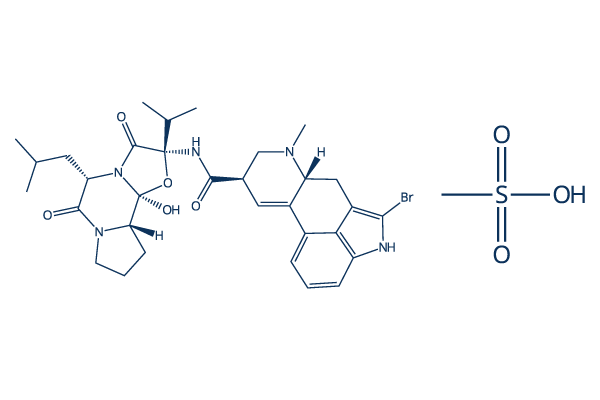
Bromocriptine Mesylate Dopamine Receptor agonist
Cat.No.S4309
Quality Control
| Related Targets | Adrenergic Receptor AChR 5-HT Receptor COX Calcium Channel Histamine Receptor GABA Receptor TRP Channel Cholinesterase (ChE) GluR |
|---|---|
| Other Dopamine Receptor Inhibitors | MPTP Hydrochloride Trifluoperazine Trifluoperazine 2HCl Penfluridol Rotundine Domperidone Sulpiride Azaperone ONC206 SCH-23390 hydrochloride |
Solubility
|
In vitro |
|
Molarity Calculator
|
In vivo |
|||||
In vivo Formulation Calculator (Clear solution)
Step 1: Enter information below (Recommended: An additional animal making an allowance for loss during the experiment)
Step 2: Enter the in vivo formulation (This is only the calculator, not formulation. Please contact us first if there is no in vivo formulation at the solubility Section.)
Calculation results:
Working concentration: mg/ml;
Method for preparing DMSO master liquid: mg drug pre-dissolved in μL DMSO ( Master liquid concentration mg/mL, Please contact us first if the concentration exceeds the DMSO solubility of the batch of drug. )
Method for preparing in vivo formulation: Take μL DMSO master liquid, next addμL PEG300, mix and clarify, next addμL Tween 80, mix and clarify, next add μL ddH2O, mix and clarify.
Method for preparing in vivo formulation: Take μL DMSO master liquid, next add μL Corn oil, mix and clarify.
Note: 1. Please make sure the liquid is clear before adding the next solvent.
2. Be sure to add the solvent(s) in order. You must ensure that the solution obtained, in the previous addition, is a clear solution before proceeding to add the next solvent. Physical methods such
as vortex, ultrasound or hot water bath can be used to aid dissolving.
Chemical Information, Storage & Stability
| Molecular Weight | 750.7 | Formula | C32H40BrN5O5.CH4O3S |
Storage (From the date of receipt) | 3 years -20°C powder |
|---|---|---|---|---|---|
| CAS No. | 22260-51-1 | Download SDF | Storage of Stock Solutions |
|
|
| Synonyms | N/A | SMILES | CC(C)CC1N2C(=O)C(NC(=O)C3CN(C)C4CC5=C(Br)[NH]C6=C5C(=CC=C6)C4=C3)(OC2(O)C7CCCN7C1=O)C(C)C.C[S](O)(=O)=O | ||
Read more about storage stability stock solution CAS number SMILES
Mechanism of Action
| Targets/IC50/Ki |
D2 receptor
12.2 nM(Ki)
D3 receptor
12.2 nM(Ki)
D4 receptor
59.7 nM(Ki)
D1 receptor
1659 nM(Ki)
D5 receptor
1691 nM(Ki)
|
|---|---|
| In vitro |
Bromocriptine dose-dependently reduces the number of OH radicals. Bromocriptine has a strong scavenging effect on the 5,5-dimethyl-1-pyrroline-N-oxide hydroxide signal produced from Fenton's reaction. Bromocriptine also attenuates the stable free radical diphenyl-p-picrylhydrazyl signal. |
| In vivo |
Bromocriptine (5 mg/kg, i.p., 7 days) completely protects against the decrease in mouse striatal dopamine and its metabolites induced by intraventricular injection of 6-hydroxydopamine after intraperitoneal administration of desipramine. Bromocriptine (2.5 mg/kg, i.p., daily for 3 days) significantly reduces autooxidation of brain homogenates collected from rats. Bromocriptine (12.5 mg/kg) produces mild dyskinesia over the course of the study that is significantly less severe than in the L-dopa-treated group in the MPTP-treated marmoset. Bromocriptine, has a lesser tendency than L-dopa to produce dyskinesia while similarly improving motor performance in drug-naive MPTP-treated marmosets. Bromocriptine (10 μM and 10 mg/kg i.p.) blocks .OH formation caused by MPTP in vitro (20 μM) and in vivo (30 mg/kg i.p.) in mice. Bromocriptine reduces an MPTP-induced increase in the activity of catalase and superoxide dismutase in substantia nigra on the seventh day. Bromocriptine blocks MPTP-induced behavioral dysfunction as well as glutathione and dopamine depletion, indicating its potent neuroprotective action. |
References |
|
Clinical Trial Information
(data from https://clinicaltrials.gov, updated on 2026-08-10)
| NCT Number | Recruitment | Conditions | Sponsor/Collaborators | Start Date | Phases |
|---|---|---|---|---|---|
| NCT05180773 | RECRUITING | Peripartum Cardiomyopathy, Postpartum |
Dennis M. McNamara, MD, MS |
2022-07-27 | PHASE4 |
| NCT07124221 | RECRUITING | Hyperprolactinemia |
Changchun GeneScience Pharmaceutical Co., Ltd. |
2025-09-12 | PHASE3 |
| NCT03575000 | NOT_YET_RECRUITING | Schizophrenia; PreDiabetes |
VA Pittsburgh Healthcare System |
2026-01-01 | PHASE4 |
| NCT06250257 | RECRUITING | Dilated Cardiomyopathy |
Jimma University |
2024-10-21 | PHASE3 |
| NCT03525002 | COMPLETED | Obesity |
University Hospital Tuebingen |
2018-05-03 | PHASE2 |
| NCT04128683 | COMPLETED | Anorexia Nervosa |
University of California, San Diego |
2020-10-20 | EARLY_PHASE1 |
Read more about Clinical Trials
Tech Support
Tel: +1-832-582-8158 Ext:3
If you have any other enquiries, please leave a message.
Signaling Pathway Map

Products are for research use only. Not for human use. We do not sell to patients.
©Copyright 2013 Selleck Chemicals. All Rights Reserved.