
-
 Argentina
-
 Australia
-
 Austria
-
 Belgium
-
 Brazil
-
 Canada
-
 China
China
-
 Czech Republic
-
 Denmark
-
 Finland
-
 France
-
 Germany
-
 Greece
-
 Hong Kong
-
 Hungary
-
 Iceland
-
 India
India
-
 Ireland
-
 Israel
-
 Italy
Italy
-
 Japan
Japan
-
 Korea
Korea
-
 Luxembourg
-
 Malaysia
-
 Netherlands
-
 New Zealand
-
 Norway
-
 Poland
-
 Qatar
Qatar
-
 Romania
-
 Saudi Arabia
-
 Singapore
-
 Spain
Spain
-
 Sweden
-
 Switzerland
-
 Taiwan
-
 Turkey
-
 United Kingdom
-
 United States
research use only
lurasidone Dopamine Receptor antagonist
Cat.No.S5714
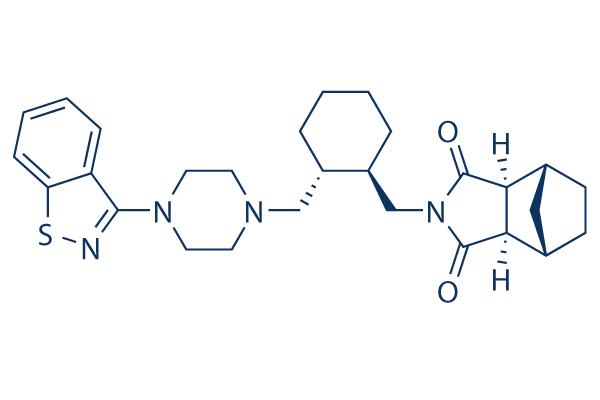
Chemical Structure
Molecular Weight: 492.68
Quality Control
| Related Targets | Adrenergic Receptor AChR 5-HT Receptor COX Calcium Channel Histamine Receptor GABA Receptor TRP Channel Cholinesterase (ChE) GluR |
|---|---|
| Other Dopamine Receptor Inhibitors | MPTP Hydrochloride Trifluoperazine Trifluoperazine 2HCl Penfluridol Rotundine Domperidone Sulpiride Azaperone ONC206 SCH-23390 hydrochloride |
Solubility
|
In vitro |
DMSO
: 7 mg/mL
(14.2 mM)
Water : Insoluble Ethanol : Insoluble |
Molarity Calculator
|
In vivo |
|||||
In vivo Formulation Calculator (Clear solution)
Step 1: Enter information below (Recommended: An additional animal making an allowance for loss during the experiment)
Step 2: Enter the in vivo formulation (This is only the calculator, not formulation. Please contact us first if there is no in vivo formulation at the solubility Section.)
Calculation results:
Working concentration: mg/ml;
Method for preparing DMSO master liquid: mg drug pre-dissolved in μL DMSO ( Master liquid concentration mg/mL, Please contact us first if the concentration exceeds the DMSO solubility of the batch of drug. )
Method for preparing in vivo formulation: Take μL DMSO master liquid, next addμL PEG300, mix and clarify, next addμL Tween 80, mix and clarify, next add μL ddH2O, mix and clarify.
Method for preparing in vivo formulation: Take μL DMSO master liquid, next add μL Corn oil, mix and clarify.
Note: 1. Please make sure the liquid is clear before adding the next solvent.
2. Be sure to add the solvent(s) in order. You must ensure that the solution obtained, in the previous addition, is a clear solution before proceeding to add the next solvent. Physical methods such
as vortex, ultrasound or hot water bath can be used to aid dissolving.
Chemical Information, Storage & Stability
| Molecular Weight | 492.68 | Formula | C28H36N4O2S |
Storage (From the date of receipt) | 3 years -20°C powder |
|---|---|---|---|---|---|
| CAS No. | 367514-87-2 | -- | Storage of Stock Solutions |
|
|
| Synonyms | SM-13496 | Smiles | C1CCC(C(C1)CN2CCN(CC2)C3=NSC4=CC=CC=C43)CN5C(=O)C6C7CCC(C7)C6C5=O | ||
Mechanism of Action
| Targets/IC50/Ki |
5-HT2A
(Cell-free assay) 0.5 nM(Ki)
5-HT7 receptor
(Cell-free assay) 0.5 nM(Ki)
D2 receptor
(Cell-free assay) 1 nM(Ki)
5-HT1A receptor
(Cell-free assay) 6.4 nM(Ki)
|
|---|---|
| In vitro |
Lurasidone is a new atypical antipsychotic in the benzoisothiazoles class of chemicals. Like most second-generation antipsychotics it is a full antagonist at dopamine D2 and serotonin 5-HT2A receptors, and is a partial agonist at 5-HT1A receptors. It has much greater affinity for 5-HT7 subtype receptors than other atypical antipsychotics. This compound also has high affinity for the 5-HT1A subtype, α2c-adrenergic receptors and low affinity for α1-adrenergic receptors. It has minimal affinity for 5-HT2C receptors and negligible affinity for histamine H1 and muscarinic receptors.
|
| In vivo |
Lurasidone is rapidly absorbed, reaching peak concentrations within 1.5–3 hours (tmax) after single and multiple oral doses. Once absorbed, it extensively distributes in tissues and rapidly enters the CNS. This compound has high binding to human plasma albumin and alpha-1-glycoprotein (≥99%). Long-term treatment of schizophrenia with this agent has been shown to reduce the risk of relapse. The elimination half-life of this chemical is about 20-40 h. Mean Cmax and area under the curve (AUC) for this drug were approximately threefold and twofold greater, respectively, in a comparison of administration with food v. fasting. Its absorption is independent of food fat content. It is metabolised primarily via CYP3A4. In animal studies, this compound penetrated the placental barrier and distributed into the fetus, and was excreted in milk during lactation.
|
References |
|
Clinical Trial Information
(data from https://clinicaltrials.gov, updated on 2024-05-22)
| NCT Number | Recruitment | Conditions | Sponsor/Collaborators | Start Date | Phases |
|---|---|---|---|---|---|
| NCT03627195 | Completed | Schizophrenia |
Sumitomo Pharma America Inc. |
June 7 2018 | Phase 1 |
| NCT02731612 | Recruiting | Bipolar Disorder |
Nazlin Walji|University of British Columbia |
May 8 2017 | Phase 3 |
| NCT02147379 | Completed | Bipolar I Disorder |
University of British Columbia |
May 2014 | Phase 3 |
| NCT02174523 | Completed | Schizophrenia |
Sumitomo Pharma (Suzhou) Co. Ltd.|Xuhui Central Hospital Shanghai |
April 2014 | Phase 1 |
Tech Support
Tel: +1-832-582-8158 Ext:3
If you have any other enquiries, please leave a message.
Signaling Pathway Map

Products are for research use only. Not for human use. We do not sell to patients.
©Copyright 2013 Selleck Chemicals. All Rights Reserved.