
-
 Argentina
-
 Australia
-
 Austria
-
 Belgium
-
 Brazil
-
 Canada
-
 China
China
-
 Czech Republic
-
 Denmark
-
 Finland
-
 France
-
 Germany
-
 Greece
-
 Hong Kong
-
 Hungary
-
 Iceland
-
 India
India
-
 Ireland
-
 Israel
-
 Italy
Italy
-
 Japan
Japan
-
 Korea
Korea
-
 Luxembourg
-
 Malaysia
-
 Netherlands
-
 New Zealand
-
 Norway
-
 Poland
-
 Portugal
-
 Qatar
Qatar
-
 Romania
-
 Saudi Arabia
-
 Singapore
-
 Spain
Spain
-
 Sweden
-
 Switzerland
-
 Taiwan
-
 Turkey
-
 United Kingdom
-
 United States
research use only
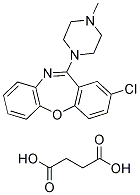
Loxapine Succinate 5-HT Receptor antagonist
Cat.No.S4086
Quality Control
Solubility
|
In vitro |
DMSO
: 89 mg/mL
(199.59 mM)
Ethanol : 2 mg/mL Water : Insoluble |
Molarity Calculator
|
In vivo |
|||||
In vivo Formulation Calculator (Clear solution)
Step 1: Enter information below (Recommended: An additional animal making an allowance for loss during the experiment)
Step 2: Enter the in vivo formulation (This is only the calculator, not formulation. Please contact us first if there is no in vivo formulation at the solubility Section.)
Calculation results:
Working concentration: mg/ml;
Method for preparing DMSO master liquid: mg drug pre-dissolved in μL DMSO ( Master liquid concentration mg/mL, Please contact us first if the concentration exceeds the DMSO solubility of the batch of drug. )
Method for preparing in vivo formulation: Take μL DMSO master liquid, next addμL PEG300, mix and clarify, next addμL Tween 80, mix and clarify, next add μL ddH2O, mix and clarify.
Method for preparing in vivo formulation: Take μL DMSO master liquid, next add μL Corn oil, mix and clarify.
Note: 1. Please make sure the liquid is clear before adding the next solvent.
2. Be sure to add the solvent(s) in order. You must ensure that the solution obtained, in the previous addition, is a clear solution before proceeding to add the next solvent. Physical methods such
as vortex, ultrasound or hot water bath can be used to aid dissolving.
Chemical Information, Storage & Stability
| Molecular Weight | 445.9 | Formula | C18H18ClN3O.C4H6O4 |
Storage (From the date of receipt) | |
|---|---|---|---|---|---|
| CAS No. | 27833-64-3 | Download SDF | Storage of Stock Solutions |
|
|
| Synonyms | NSC 759578 | SMILES | CN1CCN(CC1)C2=NC3=CC=CC=C3OC4=C2C=C(C=C4)Cl.C(CC(=O)O)C(=O)O | ||
Read more about storage stability stock solution CAS number SMILES
Mechanism of Action
| Targets/IC50/Ki |
5-HT2 (human)
6.2 nM(Ki)
5-HT2 (bovine)
6.6 nM(Ki)
5-HT2 (bovine)
6.8 nM(Ki)
D4 receptor (human)
7.5 nM(Ki)
D2 receptor (Human)
24 nM(Ki)
D2 receptor (human)
24 nM(Ki)
D1 receptor (human)
26 nM(Ki)
D2 receptor (bovine)
26 nM(Ki)
D1 receptor (bovine)
62 nM(Ki)
|
|---|---|
| In vitro |
In the presence of Loxapine, [3H]ketanserin binds to 5-HT2 receptor in Frontal cortex of brain in human and bovine with ki value of 6.2 nM and 6.6 nM, respectively. Loxapine has the rank order of potency for the various receptors appears to be as follows:5-HT2≥D4>>>D1>D2 in comparing competition experiments involving the human membranes. Loxapine 0.2 μM, 2 μM and 20 μM reduces IL-1beta secretion by LPS-activated mixed glia cultures after 1 and 3 days of exposure. Loxapine in concentrations of 0.2 μM, 2 μM and 20 μM reduces IL-2 secretion in mixed glia cultures after 1 and 3 days of exposure, and additionally Loxapine decreases IL-1beta and IL-2 secretion in LPS-induced microglia cultures in concentrations of 2 μM, 10 μM and 20 μM. |
| In vivo |
Loxapine (5 mg/kg) induces a very significant reduction (more than 50%) of serotonin (S2) receptor density after 4 weeks or 10 weeks of daily injection in the rat. Loxapine (5 mg/kg) does not change dopamine receptor density but greatly reduces serotonin receptor density by 47% in the brain of rats. Loxapine (0.3 mg/kg s.c.) induces marked catalepsy, the scores reaching the cut-off level of 45 s two to 5 hours after injection in rats. Loxapine-induced catalepsy is fully established then treated by clozapine (10 mg/kg s.c.), the high catalepsy score is reduced to a value not significantly different from vehicle-treated controls in rats. |
References |
|
Clinical Trial Information
(data from https://clinicaltrials.gov, updated on 2024-05-28)
| NCT Number | Recruitment | Conditions | Sponsor/Collaborators | Start Date | Phases |
|---|---|---|---|---|---|
| NCT05324852 | TERMINATED | Emergence Delirium |
Assistance Publique - Hôpitaux de Paris |
2023-04-09 | PHASE3 |
| NCT05324852 | Recruiting | Emergence Delirium |
Assistance Publique - Hôpitaux de Paris|Lariboisière-Saint Louis clinical research unit |
2023-04-14 | Phase 3 |
| NCT04148963 | UNKNOWN | Psychomotor Agitation; Schizophrenia; Bipolar Disorder |
Lee's Pharmaceutical Limited |
2019-12-01 | PHASE3 |
| NCT02525991 | COMPLETED | Agitation |
Ferrer Internacional S.A. |
2016-09-08 | PHASE4 |
| NCT03110900 | TERMINATED | Agitation,Psychomotor; Haloperidol Causing Adverse Effects in Therapeutic Use; Lorazepam Causing Adverse Effects in Therapeutic Use; Loxapine Causing Adverse Effects in Therapeutic Use |
University of Arkansas |
2017-09-30 | PHASE4 |
| NCT02820519 | TERMINATED | Neuropathic Pain |
University of Witten/Herdecke |
2016-06-07 | PHASE2 |
Read more about Clinical Trials
Tech Support
Tel: +1-832-582-8158 Ext:3
If you have any other enquiries, please leave a message.
Signaling Pathway Map

Products are for research use only. Not for human use. We do not sell to patients.
©Copyright 2013 Selleck Chemicals. All Rights Reserved.