
-
 Argentina
-
 Australia
-
 Austria
-
 Belgium
-
 Brazil
-
 Canada
-
 China
China
-
 Czech Republic
-
 Denmark
-
 Finland
-
 France
-
 Germany
-
 Greece
-
 Hong Kong
-
 Hungary
-
 Iceland
-
 India
India
-
 Ireland
-
 Israel
-
 Italy
Italy
-
 Japan
Japan
-
 Korea
Korea
-
 Luxembourg
-
 Malaysia
-
 Netherlands
-
 New Zealand
-
 Norway
-
 Poland
-
 Portugal
-
 Qatar
Qatar
-
 Romania
-
 Saudi Arabia
-
 Singapore
-
 Spain
Spain
-
 Sweden
-
 Switzerland
-
 Taiwan
-
 Turkey
-
 United Kingdom
-
 United States
research use only
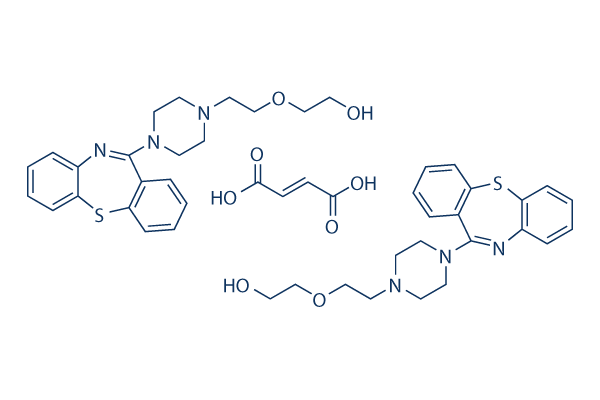
Quetiapine (ICI-204636) fumarate Dopamine Receptor antagonist
Cat.No.S1763
Quality Control
| Related Targets | Adrenergic Receptor AChR 5-HT Receptor COX Calcium Channel Histamine Receptor GABA Receptor TRP Channel Cholinesterase (ChE) GluR |
|---|---|
| Other Dopamine Receptor Inhibitors | MPTP Hydrochloride Trifluoperazine Trifluoperazine 2HCl Penfluridol Rotundine Domperidone Sulpiride Azaperone ONC206 SCH-23390 hydrochloride |
Solubility
|
In vitro |
DMSO
: 36 mg/mL
(40.76 mM)
Water : Insoluble Ethanol : Insoluble |
Molarity Calculator
|
In vivo |
|||||
In vivo Formulation Calculator (Clear solution)
Step 1: Enter information below (Recommended: An additional animal making an allowance for loss during the experiment)
Step 2: Enter the in vivo formulation (This is only the calculator, not formulation. Please contact us first if there is no in vivo formulation at the solubility Section.)
Calculation results:
Working concentration: mg/ml;
Method for preparing DMSO master liquid: mg drug pre-dissolved in μL DMSO ( Master liquid concentration mg/mL, Please contact us first if the concentration exceeds the DMSO solubility of the batch of drug. )
Method for preparing in vivo formulation: Take μL DMSO master liquid, next addμL PEG300, mix and clarify, next addμL Tween 80, mix and clarify, next add μL ddH2O, mix and clarify.
Method for preparing in vivo formulation: Take μL DMSO master liquid, next add μL Corn oil, mix and clarify.
Note: 1. Please make sure the liquid is clear before adding the next solvent.
2. Be sure to add the solvent(s) in order. You must ensure that the solution obtained, in the previous addition, is a clear solution before proceeding to add the next solvent. Physical methods such
as vortex, ultrasound or hot water bath can be used to aid dissolving.
Chemical Information, Storage & Stability
| Molecular Weight | 883.09 | Formula | C46H54N6O8S2 |
Storage (From the date of receipt) | |
|---|---|---|---|---|---|
| CAS No. | 111974-72-2 | Download SDF | Storage of Stock Solutions |
|
|
| Synonyms | ICI-204636 fumarate | SMILES | C1CN(CCN1CCOCCO)C2=NC3=CC=CC=C3SC4=CC=CC=C42.C1CN(CCN1CCOCCO)C2=NC3=CC=CC=C3SC4=CC=CC=C42.C(=CC(=O)O)C(=O)O | ||
Read more about storage stability stock solution CAS number SMILES
Mechanism of Action
| Targets/IC50/Ki |
Dopamine receptor
Histamine receptor
Adrenergic Receptor
|
|---|---|
| In vitro |
Quetiapine shows affinity for various neurotransmitter receptors including serotonin, dopamine, histamine, and adrenergic receptors and has binding characteristics at the dopamine-2 receptor similar to those of clozapine.
|
| In vivo |
Quetiapine has a preclinical profile suggestive of antipsychotic activity with a reduced tendency to cause extrapyramidal symptoms (EPS) and sustained prolactin elevation. Guetiapine alters neurotensin neurotransmission and c-fos expression in limbic but not motor brain regions. Quetiapine also demonstrates clozapine-like activity in a range of behavioral and biochemical tests and may possess neuroprotective properties. Quetiapine dose-dependently prevents schizophrenia and depression in hippocampal cell proliferation and BDNF expression caused by chronic restraint stress (CRS) in rats. Guetiapine (5 mg/kg) combined with Venlafaxine (2.5 mg/kg) increases hippocampal cell proliferation and prevents BDNF decrease in stressed rats, whereas each of the drugs exerts mild or no effects. Guetiapine produces selective effects on cortical and limbic regions of the brain and in particular on dopaminergic neurotransmission in these regions. Guetiapine produces lower levels of putamenal DA D2r occupancy than those reported for typical APDs. Quetiapine also produces preferential occupancy of temporal cortical DA D2r, 46.9%, but does not spare occupancy of substantia nigra DA D2r. Guetiapine attenuates the decrease in levels of brain-derived neurotrophic factor (BDNF) in the hippocampi of rats subjected to chronic-restraint stress. Guetiapine (10 mg/kg) reverses the stress-induced suppression of hippocampal neurogenesis, evidenced in the numbers of BrdU-labeled and pCREB-positive cells that are comparable to those in non-stressed rats but higher than those in the vehicle-treated rats.
|
References |
|
Clinical Trial Information
(data from https://clinicaltrials.gov, updated on 2026-05-26)
| NCT Number | Recruitment | Conditions | Sponsor/Collaborators | Start Date | Phases |
|---|---|---|---|---|---|
| NCT07152184 | NOT_YET_RECRUITING | Patient With Schizophrenia Spectrum Disorder; NLM Classification WM 203, Psychology:Schizophrenic Psychology; Schizophrenia Spectrum and Other Psychotic Disorders |
University Hospital, Strasbourg, France |
2026-10-01 | PHASE2 |
| NCT06433635 | ACTIVE_NOT_RECRUITING | Bipolar I Disorder; Depression |
Massachusetts General Hospital |
2024-10-01 | PHASE4 |
| NCT05085808 | WITHDRAWN | Delirium; Morality; Quality of Life; Psych; Treatment Side Effects |
University of Southern California |
2028-03-01 | PHASE4 |
| NCT07654348 | NOT_YET_RECRUITING | Bipolar Disorder II |
First Affiliated Hospital of Zhejiang University |
2026-07-01 | PHASE2 |
| NCT06062953 | RECRUITING | Psychiatric Disorders; Insomnia |
Lone Baandrup |
2023-09-18 | PHASE2; PHASE3 |
| NCT07760168 | NOT_YET_RECRUITING | Treatment Resistant Depression (TRD) |
All India Institute of Medical Sciences, Bhubaneswar |
2026-08-30 | PHASE3 |
Read more about Clinical Trials
Tech Support
Tel: +1-832-582-8158 Ext:3
If you have any other enquiries, please leave a message.
Frequently Asked Questions
Question 1:
I want to know if your recommended formulation for in vivo experiments on the website is suitable for oral administration or injection?
Answer:
It can be dissolved in 0.5% CMC Na at 30 mg/ml as a suspension and is fine for oral gavage.
Signaling Pathway Map

Products are for research use only. Not for human use. We do not sell to patients.
©Copyright 2013 Selleck Chemicals. All Rights Reserved.