
-
 Argentina
-
 Australia
-
 Austria
-
 Belgium
-
 Brazil
-
 Canada
-
 China
China
-
 Czech Republic
-
 Denmark
-
 Finland
-
 France
-
 Germany
-
 Greece
-
 Hong Kong
-
 Hungary
-
 Iceland
-
 India
India
-
 Ireland
-
 Israel
-
 Italy
Italy
-
 Japan
Japan
-
 Korea
Korea
-
 Luxembourg
-
 Malaysia
-
 Netherlands
-
 New Zealand
-
 Norway
-
 Poland
-
 Portugal
-
 Qatar
Qatar
-
 Romania
-
 Saudi Arabia
-
 Singapore
-
 Spain
Spain
-
 Sweden
-
 Switzerland
-
 Taiwan
-
 Turkey
-
 United Kingdom
-
 United States
research use only
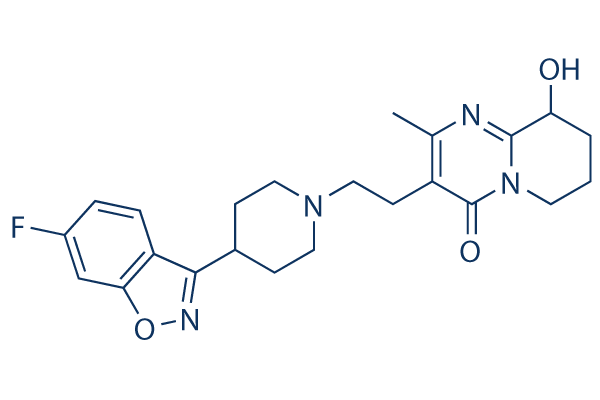
Paliperidone Dopamine Receptor antagonist
Cat.No.S1724
Quality Control
| Related Targets | Adrenergic Receptor AChR 5-HT Receptor COX Calcium Channel Histamine Receptor GABA Receptor TRP Channel Cholinesterase (ChE) GluR |
|---|---|
| Other Dopamine Receptor Inhibitors | MPTP Hydrochloride Trifluoperazine Trifluoperazine 2HCl Penfluridol Rotundine Domperidone Sulpiride Azaperone ONC206 SCH-23390 hydrochloride |
Solubility
|
In vitro |
5%TFA : 15 mg/mL
DMSO
: Insoluble
Water : Insoluble |
Molarity Calculator
|
In vivo |
|||||
In vivo Formulation Calculator (Clear solution)
Step 1: Enter information below (Recommended: An additional animal making an allowance for loss during the experiment)
Step 2: Enter the in vivo formulation (This is only the calculator, not formulation. Please contact us first if there is no in vivo formulation at the solubility Section.)
Calculation results:
Working concentration: mg/ml;
Method for preparing DMSO master liquid: mg drug pre-dissolved in μL DMSO ( Master liquid concentration mg/mL, Please contact us first if the concentration exceeds the DMSO solubility of the batch of drug. )
Method for preparing in vivo formulation: Take μL DMSO master liquid, next addμL PEG300, mix and clarify, next addμL Tween 80, mix and clarify, next add μL ddH2O, mix and clarify.
Method for preparing in vivo formulation: Take μL DMSO master liquid, next add μL Corn oil, mix and clarify.
Note: 1. Please make sure the liquid is clear before adding the next solvent.
2. Be sure to add the solvent(s) in order. You must ensure that the solution obtained, in the previous addition, is a clear solution before proceeding to add the next solvent. Physical methods such
as vortex, ultrasound or hot water bath can be used to aid dissolving.
Chemical Information, Storage & Stability
| Molecular Weight | 426.48 | Formula | C23H27FN4O3 |
Storage (From the date of receipt) | |
|---|---|---|---|---|---|
| CAS No. | 144598-75-4 | Download SDF | Storage of Stock Solutions |
|
|
| Synonyms | N/A | SMILES | CC1=C(C(=O)N2CCCC(C2=N1)O)CCN3CCC(CC3)C4=NOC5=C4C=CC(=C5)F | ||
Read more about storage stability stock solution CAS number SMILES
Mechanism of Action
| Targets/IC50/Ki |
Dopamine receptor
|
|---|---|
| In vitro |
Paliperidone significantly increases the intracellular accumulation of Rh123 and DOX in a concentration-dependent manner. This compound works finely at low concentrations (10 and 50 μM) against Aβ(25-35) and MPP(+) and solely protects SH-SY5Y from hydrogen peroxide. It completely diminishes cell reduction induced by different stressors, regardless of their dosages. This chemical is demonstrated with higher oxidative stress-scavenging properties than other APDs in several aspects, such as generated bulk glutathione, low HNE, and protein carbonyl productions. It enhances dopamine toxicity at the highest dose and is the only AP that significantly increases cell viability (8.1%) compared with cells treated with dopamine alone.
|
| In vivo |
Paliperidone normalizes prefrontal cortical basal extracellular glutamate in rats. This compound also prevents the acute MK-801-induced increase in extracellular glutamate in rats. When coadministered with Escitalopram, it restores the suppression of the NE neuronal firing rate (n = 5 rats) and the percentage of neurons exhibiting burst firing. It results in a dose-dependent decrease in bite and attack behaviors with an effective dose. This chemical results in the maximal reduction in aggressive behavior.
|
References |
|
Clinical Trial Information
(data from https://clinicaltrials.gov, updated on 2026-05-01)
| NCT Number | Recruitment | Conditions | Sponsor/Collaborators | Start Date | Phases |
|---|---|---|---|---|---|
| NCT07047651 | ACTIVE_NOT_RECRUITING | Treatment Resistant Schizophrenia; Treatment Resistant Bipolar Disorder |
Dr. Stavroula Rakitzi |
2025-06-04 | PHASE4 |
| NCT04478838 | RECRUITING | Schizophrenia and Related Disorders; Drug Administration Schedule; Drug Therapy; Antipsychotic Agents |
Centre for Addiction and Mental Health |
2022-06-06 | PHASE4 |
| NCT07493551 | RECRUITING | Schizophrenia |
CSPC Zhongnuo Pharmaceutical (Shijiazhuang) Co., Ltd. |
2024-10-09 | |
| NCT07075237 | NOT_YET_RECRUITING | Schizophrenia |
Jiangsu Province Nanjing Brain Hospital |
2025-10 | PHASE4 |
| NCT07153835 | NOT_YET_RECRUITING | Schizophrenia |
Sher-E-Bangla Medical College |
2025-09-01 | PHASE4 |
| NCT06060886 | UNKNOWN | Schizophrenia; Treatment-resistant Schizophrenia; Side Effect; Lipid Metabolism Disorders; Diabetes; NAFLD; Psychosis |
Consorcio Centro de Investigación Biomédica en Red (CIBER) |
2023-11-01 | PHASE4 |
Read more about Clinical Trials
Tech Support
Tel: +1-832-582-8158 Ext:3
If you have any other enquiries, please leave a message.
Signaling Pathway Map

Products are for research use only. Not for human use. We do not sell to patients.
©Copyright 2013 Selleck Chemicals. All Rights Reserved.