
-
 Argentina
-
 Australia
-
 Austria
-
 Belgium
-
 Brazil
-
 Canada
-
 China
China
-
 Czech Republic
-
 Denmark
-
 Finland
-
 France
-
 Germany
-
 Greece
-
 Hong Kong
-
 Hungary
-
 Iceland
-
 India
India
-
 Ireland
-
 Israel
-
 Italy
Italy
-
 Japan
Japan
-
 Korea
Korea
-
 Luxembourg
-
 Malaysia
-
 Netherlands
-
 New Zealand
-
 Norway
-
 Poland
-
 Qatar
Qatar
-
 Romania
-
 Saudi Arabia
-
 Singapore
-
 Spain
Spain
-
 Sweden
-
 Switzerland
-
 Taiwan
-
 Turkey
-
 United Kingdom
-
 United States
research use only
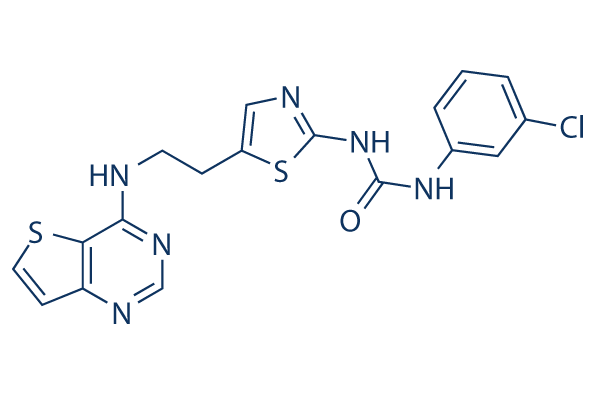
SNS-314 Aurora Kinase inhibitor
Cat.No.S1154
Quality Control
| Related Targets | CDK HSP PD-1/PD-L1 ROCK Wee1 DNA/RNA Synthesis Microtubule Associated Ras KRas Casein Kinase |
|---|---|
| Other Aurora Kinase Inhibitors | Hesperadin Barasertib-HQPA (AZD2811) Alisertib (MLN8237) Tozasertib (VX-680, MK-0457) ZM 447439 MLN8054 Danusertib (PHA-739358) MK-5108 TCS7010 (Aurora A Inhibitor I) AMG-900 |
Solubility
|
In vitro |
DMSO
: 100 mg/mL
(232.05 mM)
Water : Insoluble Ethanol : Insoluble |
Molarity Calculator
|
In vivo |
|||||
In vivo Formulation Calculator (Clear solution)
Step 1: Enter information below (Recommended: An additional animal making an allowance for loss during the experiment)
Step 2: Enter the in vivo formulation (This is only the calculator, not formulation. Please contact us first if there is no in vivo formulation at the solubility Section.)
Calculation results:
Working concentration: mg/ml;
Method for preparing DMSO master liquid: mg drug pre-dissolved in μL DMSO ( Master liquid concentration mg/mL, Please contact us first if the concentration exceeds the DMSO solubility of the batch of drug. )
Method for preparing in vivo formulation: Take μL DMSO master liquid, next addμL PEG300, mix and clarify, next addμL Tween 80, mix and clarify, next add μL ddH2O, mix and clarify.
Method for preparing in vivo formulation: Take μL DMSO master liquid, next add μL Corn oil, mix and clarify.
Note: 1. Please make sure the liquid is clear before adding the next solvent.
2. Be sure to add the solvent(s) in order. You must ensure that the solution obtained, in the previous addition, is a clear solution before proceeding to add the next solvent. Physical methods such
as vortex, ultrasound or hot water bath can be used to aid dissolving.
Chemical Information, Storage & Stability
| Molecular Weight | 430.93 | Formula | C18H15ClN6OS2 |
Storage (From the date of receipt) | |
|---|---|---|---|---|---|
| CAS No. | 1057249-41-8 | Download SDF | Storage of Stock Solutions |
|
|
| Synonyms | N/A | SMILES | C1=CC(=CC(=C1)Cl)NC(=O)NC2=NC=C(S2)CCNC3=NC=NC4=C3SC=C4 | ||
Read more about storage stability stock solution CAS number SMILES
Mechanism of Action
| Targets/IC50/Ki |
Aurora C
3 nM
Aurora A
9 nM
Aurora B
31 nM
|
|---|---|
| In vitro |
In HCT116 colorectal carcinoma cell line, with intact or depleted p53 protein levels, SNS-314 Mesylate shows enhanced efficacy when administered sequentially with other standard chemotherapeutic agents and the most profound synergies are identified for agents that activate the spindle assembly checkpoint. A recent study shows that this compound shows potent antiproliferative activity in HCT116 cells and inhibits soft agar colony formation. |
| Kinase Assay |
Aurora-A Kinase Assay
|
|
Humanized mouse Aurora A (amino acids 107-403) is expressed in E. coli as described previously. For IC50 assays, this compound is titrated three-fold in DMSO and diluted 12.5-fold into assay buffer (10 mM Tris HCl pH 7.2, 10 mM MgCl2, 0.05% NaN3, 0.01% Tween-20, and 0.1% BSA). This chemical is then diluted 4-fold into assay buffer containing Aurora A and FAM-PKAtide at final concentrations of 2 nM and 50 nM, respectively. The kinase reaction is initiated by adding ATP in assay buffer at a final concentration of 10 mM and incubated at 21 °C for 25 minutes. As a positive control, DMSO is added instead of this compound and as a negative control assay buffer is added instead of Aurora A. Both control reactions are conducted in triplicate. To detect phosphorylated PKAtide, the kinase reaction is combined with Progressive Binding Solution (1:400 Progressive Binding Reagent, 1 × Buffer A, Molecular Devices) in a 1:3 ratio. The mixture is incubated for 30 minutes at 21 °C and the plate is scanned on an Analyst AD with excitation at 485 nm and emission at 530 nm. The percent relative enzymatic activity is calculated by normalizing the mP value for each well to the average positive control. Relative enzymatic activity values are plotted as a function of the logarithm of compound concentration and IC50 values are generated in GraphPad Prism software using a sigmoidal dose-response curve-fit. IC50
|
|
| In vivo |
The sequential treatment with SNS-314 Mesylate 24 hours later produces a significant 72.5% tumor growth inhibition of HCT116 xenografts, while this compound as single agents produce no significant inhibition of HCT116 tumor growth. In the HCT116 human colon cancer xenograft model, administration of 50 and 100 mg/kg this chemical results a dose-dependent inhibition of histone H3 phosphorylation, indicating effective Aurora-B inhibition in vivo. In addition, HCT116 tumors from animals treated with this agent exhibits potent and sustained responses including reduction of phosphorylated histone H3 levels, increased caspase-3 and appearance of increased nuclear size. |
References |
|
Clinical Trial Information
(data from https://clinicaltrials.gov, updated on 2017-04-04)
| NCT Number | Recruitment | Conditions | Sponsor/Collaborators | Start Date | Phases |
|---|---|---|---|---|---|
| NCT00519662 | COMPLETED | Advanced Solid Tumors |
Sunesis Pharmaceuticals |
2007-08 | PHASE1 |
| NCT00519662 | Completed | Advanced Solid Tumors |
Sunesis Pharmaceuticals |
2007-08 | Phase 1 |
Read more about Clinical Trials
Tech Support
Tel: +1-832-582-8158 Ext:3
If you have any other enquiries, please leave a message.
Signaling Pathway Map

Products are for research use only. Not for human use. We do not sell to patients.
©Copyright 2013 Selleck Chemicals. All Rights Reserved.