
-
 Argentina
-
 Australia
-
 Austria
-
 Belgium
-
 Brazil
-
 Canada
-
 China
China
-
 Czech Republic
-
 Denmark
-
 Finland
-
 France
-
 Germany
-
 Greece
-
 Hong Kong
-
 Hungary
-
 Iceland
-
 India
India
-
 Ireland
-
 Israel
-
 Italy
Italy
-
 Japan
Japan
-
 Korea
Korea
-
 Luxembourg
-
 Malaysia
-
 Netherlands
-
 New Zealand
-
 Norway
-
 Poland
-
 Portugal
-
 Qatar
Qatar
-
 Romania
-
 Saudi Arabia
-
 Singapore
-
 Spain
Spain
-
 Sweden
-
 Switzerland
-
 Taiwan
-
 Turkey
-
 United Kingdom
-
 United States
research use only
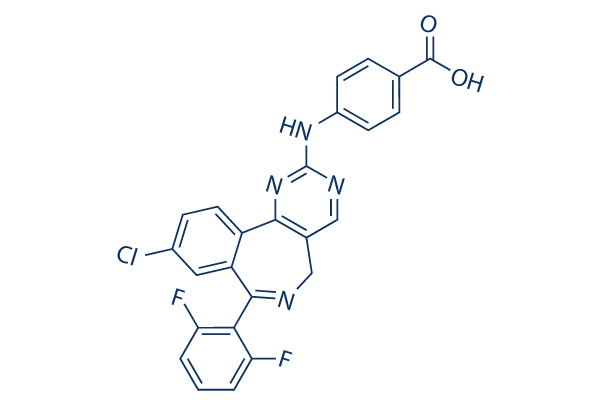
MLN8054 Aurora Kinase inhibitor
Cat.No.S1100
Quality Control
| Related Targets | CDK HSP PD-1/PD-L1 ROCK Wee1 DNA/RNA Synthesis Microtubule Associated Ras KRas Casein Kinase |
|---|---|
| Other Aurora Kinase Inhibitors | Hesperadin Barasertib-HQPA (AZD2811) Alisertib (MLN8237) Tozasertib (VX-680, MK-0457) ZM 447439 Danusertib (PHA-739358) MK-5108 TCS7010 (Aurora A Inhibitor I) AMG-900 CCT137690 |
Cell Culture, Treatment & Working Concentration
| Cell Lines | Assay Type | Concentration | Incubation Time | Formulation | Activity Description | PMID |
|---|---|---|---|---|---|---|
| Sf9 cells | Function assay | Inhibition of mouse recombinant Aurora A kinase expressed in insect Sf9 cells by radioactive flashplate assay, IC50=4 nM | ||||
| human HCT116 cells | Function assay | Inhibition of aurora kinase A autophosphorylation at T288 in human HCT116 cells by immunofluorescence analysis, IC50=0.034 μM | ||||
| human HeLa cells | Function assay | 1 h | Inhibition of Aurora A Thr288 autophosphorylation in human HeLa cells after 1 hr, IC50=0.034 μM | |||
| human H460 cells | Proliferation assay | 96 h | Antiproliferative activity against human H460 cells after 96 hrs by BrdU cell proliferation ELISA, IC50=0.11 μM | |||
| human HT-29 cells | Proliferation assay | 4 days | Antiproliferative activity against human HT-29 cells after 4 days by celltiter assay, IC50=0.15 μM | |||
| human Calu6 cells | Proliferation assay | 96 h | Antiproliferative activity against human Calu6 cells after 96 hrs by BrdU cell proliferation ELISA, IC50=0.22 μM | |||
| human SKOV3 cells | Proliferation assay | 96 h | Antiproliferative activity against human SKOV3 cells after 96 hrs by BrdU cell proliferation ELISA, IC50=0.53 μM | |||
| human MCF7 cells | Proliferation assay | 96 h | Antiproliferative activity against human MCF7 cells after 96 hrs by BrdU cell proliferation ELISA, IC50=0.67 μM | |||
| human MDAMB231 cells | Proliferation assay | 96 h | Antiproliferative activity against human MDAMB231 cells after 96 hrs by BrdU cell proliferation ELISA, IC50=0.74 μM | |||
| human PC3 cells | Proliferation assay | 96 h | Antiproliferative activity against human PC3 cells after 96 hrs by BrdU cell proliferation ELISA, IC50=0.79 μM | |||
| human SW480 cells | Proliferation assay | 96 h | Antiproliferative activity against human SW480 cells after 96 hrs by BrdU cell proliferation ELISA, IC50=0.86 μM | |||
| human DLD1 cells | Proliferation assay | 96 h | Antiproliferative activity against human DLD1 cells after 96 hrs by BrdU cell proliferation ELISA, IC50=1.43 μM | |||
| DU-145 prostate cancer cell | Function assay | 96 h | Inhibitory concentration against DU-145 prostate cancer cell proliferation over 96 hr, IC50=0.11 μM | |||
| Click to View More Cell Line Experimental Data | ||||||
Solubility
|
In vitro |
DMSO
: 95 mg/mL
(199.21 mM)
Water : Insoluble Ethanol : Insoluble |
Molarity Calculator
|
In vivo |
|||||
In vivo Formulation Calculator (Clear solution)
Step 1: Enter information below (Recommended: An additional animal making an allowance for loss during the experiment)
Step 2: Enter the in vivo formulation (This is only the calculator, not formulation. Please contact us first if there is no in vivo formulation at the solubility Section.)
Calculation results:
Working concentration: mg/ml;
Method for preparing DMSO master liquid: mg drug pre-dissolved in μL DMSO ( Master liquid concentration mg/mL, Please contact us first if the concentration exceeds the DMSO solubility of the batch of drug. )
Method for preparing in vivo formulation: Take μL DMSO master liquid, next addμL PEG300, mix and clarify, next addμL Tween 80, mix and clarify, next add μL ddH2O, mix and clarify.
Method for preparing in vivo formulation: Take μL DMSO master liquid, next add μL Corn oil, mix and clarify.
Note: 1. Please make sure the liquid is clear before adding the next solvent.
2. Be sure to add the solvent(s) in order. You must ensure that the solution obtained, in the previous addition, is a clear solution before proceeding to add the next solvent. Physical methods such
as vortex, ultrasound or hot water bath can be used to aid dissolving.
Chemical Information, Storage & Stability
| Molecular Weight | 476.86 | Formula | C25H15ClF2N4O2 |
Storage (From the date of receipt) | |
|---|---|---|---|---|---|
| CAS No. | 869363-13-3 | Download SDF | Storage of Stock Solutions |
|
|
| Synonyms | N/A | SMILES | C1C2=CN=C(N=C2C3=C(C=C(C=C3)Cl)C(=N1)C4=C(C=CC=C4F)F)NC5=CC=C(C=C5)C(=O)O | ||
Read more about storage stability stock solution CAS number SMILES
Mechanism of Action
| Targets/IC50/Ki |
Aurora A
(Sf9 cells) 4 nM
Aurora B
(Sf9 cells) 172 nM
|
|---|---|
| In vitro |
MLN8054 is an ATP-competitive, reversible inhibitor of recombinant Aurora A kinase with an IC50 of 4 nM, which shows >40-fold more selective inhibitory activity for Aurora A compared with Aurora B. In vitro, this compound exhibits the activity of growth inhibition across various cell lines from diverse tissue origins with IC50 values ranging from 0.11 μM to 1.43 μM. In addition, it selectively inhibits Aurora A over Aurora B in cultured cells, and inhibits cell proliferation by promoting G2/M accumulation and spindle defects in multiple cultured human tumor cells lines. A recent study shows that this chemical sensitizes androgen-resistant prostate cancer to radiation by inhibiting Aurora A kinase, which is associated with sustained DNA double-strand breaks.
|
| Kinase Assay |
Enzyme Assays
|
|
Recombinant murine Aurora A and Aurora B protein are expressed in Sf9 cells and purified with GST affinity chromatography. The peptide substrate for Aurora A is conjugated with biotin (Biotin-GLRRASLG). Aurora A kinase (5 nM) is assayed in 50 mM Hepes (pH 7.5)/10 mM MgCl2/5 mM DTT/0.05% Tween 20/2 μM peptide substrate/3.3 μCi/ml [γ-33P]ATP at 2 μM by using Image FlashPlates. Aurora B kinase (2 nM) is assayed with 10 μM biotinylated peptide Biotin-TKQTARKSTGGKAPR in 50 mM Tricine (pH 8.0)/2.5 mM MgCl2/5 mM DTT/10% glycerol/2% BSA/40 μCi/ml [γ-33P]ATP at 250 μM. The conditions for all other in vitro kinase assays are available upon request. This compound is run in a 226 kinase screen at a 1 μM compound concentration with an ATP concentration of 10 μM for all assays.
|
|
| In vivo |
In the HCT-116 tumor-bearing mice, MLN8054, administered orally at 3 mg/kg, 10 mg/kg, and 30 mg/kg once a day, leads to dose-dependent tumor growth inhibition (TGI: 76% and 84% for 10 mg/kg and 30 mg/kg). This compound also shows similar antitumor activity in the PC-3 tumor xenograft in nude mice. In the HCT-116 xenograft-bearing animals, it induces DNA and tubulin staining of tumor tissue in nuclear and cell body area, consistent with a senescent phenotype by increasing senescence-associated beta-galactosidase activity.
|
References |
|
Clinical Trial Information
(data from https://clinicaltrials.gov, updated on 2013-09-23)
| NCT Number | Recruitment | Conditions | Sponsor/Collaborators | Start Date | Phases |
|---|---|---|---|---|---|
| NCT00652158 | TERMINATED | Advanced Malignancies |
Millennium Pharmaceuticals, Inc. |
2006-04 | PHASE1 |
| NCT00249301 | TERMINATED | Breast Neoplasm; Colon Neoplasm; Pancreatic Neoplasm; Bladder Neoplasm |
Millennium Pharmaceuticals, Inc. |
2005-10 | PHASE1 |
| NCT00652158 | Terminated | Advanced Malignancies |
Millennium Pharmaceuticals Inc. |
2006-04 | Phase 1 |
| NCT00249301 | Terminated | Breast Neoplasm|Colon Neoplasm|Pancreatic Neoplasm|Bladder Neoplasm |
Millennium Pharmaceuticals Inc. |
2005-10 | Phase 1 |
Read more about Clinical Trials
Tech Support
Tel: +1-832-582-8158 Ext:3
If you have any other enquiries, please leave a message.
Signaling Pathway Map

Products are for research use only. Not for human use. We do not sell to patients.
©Copyright 2013 Selleck Chemicals. All Rights Reserved.