
-
 Argentina
-
 Australia
-
 Austria
-
 Belgium
-
 Brazil
-
 Canada
-
 China
China
-
 Czech Republic
-
 Denmark
-
 Finland
-
 France
-
 Germany
-
 Greece
-
 Hong Kong
-
 Hungary
-
 Iceland
-
 India
India
-
 Ireland
-
 Israel
-
 Italy
Italy
-
 Japan
Japan
-
 Korea
Korea
-
 Luxembourg
-
 Malaysia
-
 Netherlands
-
 New Zealand
-
 Norway
-
 Poland
-
 Portugal
-
 Qatar
Qatar
-
 Romania
-
 Saudi Arabia
-
 Singapore
-
 Spain
Spain
-
 Sweden
-
 Switzerland
-
 Taiwan
-
 Turkey
-
 United Kingdom
-
 United States
research use only
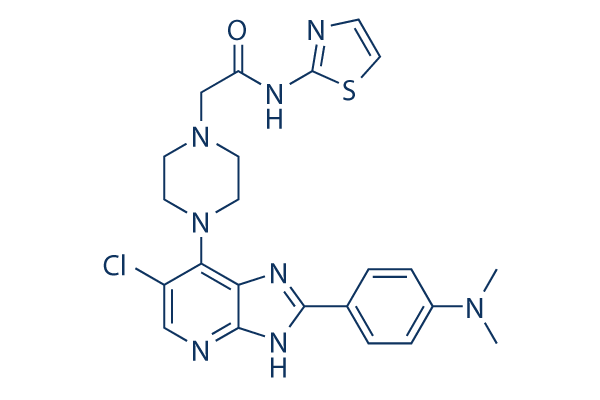
CCT129202 Aurora Kinase inhibitor
Cat.No.S1519
Quality Control
| Related Targets | CDK HSP PD-1/PD-L1 ROCK Wee1 DNA/RNA Synthesis Microtubule Associated Ras KRas Casein Kinase |
|---|---|
| Other Aurora Kinase Inhibitors | Hesperadin Barasertib-HQPA (AZD2811) Alisertib (MLN8237) Tozasertib (VX-680, MK-0457) ZM 447439 MLN8054 Danusertib (PHA-739358) MK-5108 TCS7010 (Aurora A Inhibitor I) AMG-900 |
Solubility
|
In vitro |
DMSO
: 3 mg/mL
(6.03 mM)
Water : Insoluble Ethanol : Insoluble |
Molarity Calculator
|
In vivo |
|||||
In vivo Formulation Calculator (Clear solution)
Step 1: Enter information below (Recommended: An additional animal making an allowance for loss during the experiment)
Step 2: Enter the in vivo formulation (This is only the calculator, not formulation. Please contact us first if there is no in vivo formulation at the solubility Section.)
Calculation results:
Working concentration: mg/ml;
Method for preparing DMSO master liquid: mg drug pre-dissolved in μL DMSO ( Master liquid concentration mg/mL, Please contact us first if the concentration exceeds the DMSO solubility of the batch of drug. )
Method for preparing in vivo formulation: Take μL DMSO master liquid, next addμL PEG300, mix and clarify, next addμL Tween 80, mix and clarify, next add μL ddH2O, mix and clarify.
Method for preparing in vivo formulation: Take μL DMSO master liquid, next add μL Corn oil, mix and clarify.
Note: 1. Please make sure the liquid is clear before adding the next solvent.
2. Be sure to add the solvent(s) in order. You must ensure that the solution obtained, in the previous addition, is a clear solution before proceeding to add the next solvent. Physical methods such
as vortex, ultrasound or hot water bath can be used to aid dissolving.
Chemical Information, Storage & Stability
| Molecular Weight | 497.02 | Formula | C23H25ClN8OS |
Storage (From the date of receipt) | |
|---|---|---|---|---|---|
| CAS No. | 942947-93-5 | Download SDF | Storage of Stock Solutions |
|
|
| Synonyms | N/A | SMILES | CN(C)C1=CC=C(C=C1)C2=NC3=NC=C(C(=C3N2)N4CCN(CC4)CC(=O)NC5=NC=CS5)Cl | ||
Read more about storage stability stock solution CAS number SMILES
Mechanism of Action
| Targets/IC50/Ki |
Aurora A
42 nM
Aurora B
198 nM
Aurora C
227 nM
|
|---|---|
| In vitro |
CCT129202 is an ATP-competitive inhibitor of recombinant Aurora A kinase with a Ki of 49.8 nM. This compound at 1 μM shows high selectivity for Aurora A and Aurora B with 92% and 60% inhibition, respectively. It inhibits FGFR3 slightly by 27%, and is not active against CRAF. This inhibitor also suppresses proliferation in multiple cultures of human tumor cell lines with half-maximal growth inhibition (GI50) values ranging from 0.08 μM for MV4-11 to 1.7 μM for MDA-MB-157. The effects are in association with increased expression levels of Aurora A and Aurora B leading to aberrant mitosis. Treatment with this chemical (0.7 μM) causes the accumulation of HCT116 cells with ≥4N DNA content, leading to apoptosis in a time dependent manner. Application of this agent in HCT116 cells causes decreased histone H3 phosphorylation and increased p53 protein stabilization, which are consistent with the inhibition of Aurora B and Aurora A, respectively. It induces up-regulation of p21 in HCT116, HT29 and Hela cells in a p53 dependent and independent manner, which leads to decreased phosphorylation of the Rb protein and activity of E2F in a concentration-dependent manner.
|
| Kinase Assay |
Inhibition of Aurora Kinases
|
|
NH2-terminal glutathione S-transferase (GST)-fusion recombinant human Aurora A (aa 118-403), Aurora B (full length), and Aurora C (full length) are expressed in baculovirus, purified, and used in the kinase inhibition assays. The in vitro kinase assays are performed in kinase buffer (50 mM Tris pH 7.5, 10 mM NaCl, 2.5 mM MgCl2 and 1 mM DTT) containing γ-32P-ATP, Aurora kinase and different concentrations of this compound. The reactions are incubated for 30 minutes at 30 °C and stopped by adding sample buffer. The reactions are separated on Novex Tris-Glycine gels and dried on a vacuum gel drier at 80 °C for 1 hour before exposure to Kodak-Biomax XR film. The concentration of this chemical that inhibits Aurora kinases by 50% is calculated representing IC50 value.
|
|
| In vivo |
Administration of CCT129202 at 100 mg/kg in athymic mice bearing s.c. HCT116 colon cancer xenografts causes ~50% reduction of histone H3 phosphorylation after 30 minutes of treatment, and this compound significantly inhibits tumor growth by 57.7% compared to control mice after a period of 9 days of treatment.
|
References |
Tech Support
Tel: +1-832-582-8158 Ext:3
If you have any other enquiries, please leave a message.
Signaling Pathway Map

Products are for research use only. Not for human use. We do not sell to patients.
©Copyright 2013 Selleck Chemicals. All Rights Reserved.