- Inhibitors
- Antibodies
- Compound Libraries
- New Products
- Contact Us
research use only
Cat.No.S2215
| Cell Lines | Assay Type | Concentration | Incubation Time | Formulation | Activity Description | PMID |
|---|---|---|---|---|---|---|
| Function assay | THP1 | Displacement of [3H]IN973 from gamma-secretase in human THP1 cells, acvalue. | 17932033 | |||
| GC-B | Growth Inhibition Assay | 6.25-100 μM | 24 h | DMSO | inhibits the cell growth in a dose-dependent manner | 19542446 |
| U87 | Function Assay | 2 μM | 48 h | DMSO | blocks t-AUCB-induced activation of the p38 MAPK/MAPKAPK2/Hsp27 pathway and inhibits expression of NICD1 | 24793313 |
| A549 | Growth Inhibition Assay | 10 μM | 24h | decreases the cell viability combined with PTE | 23671619 | |
| U87 | Growth Inhibition Assay | 2 μM | 48 h | DMSO | strengthens t-AUCB-induced cell growth suppression | 24793313 |
| U251 | Function Assay | 2 μM | 48 h | DMSO | blocks t-AUCB-induced activation of the p38 MAPK/MAPKAPK2/Hsp27 pathway and inhibits expression of NICD1 | 24793313 |
| U251 | Growth Inhibition Assay | 2 μM | 48 h | DMSO | strengthens t-AUCB-induced cell growth suppression | 24793313 |
| Saos-2 | Function Assay | 100 μM | 24 h | DMSO | desensitizes the cell line to cisplatin treatment | 24894297 |
| MG63 | Function Assay | 100 μM | 24 h | DMSO | desensitizes the cell line to cisplatin treatment | 24894297 |
| SHG-44 | Growth Inhibition Assay | 0.5-10 μM | 1-5 d | inhibits the cell viability at the optimal concentration of 1 μM | 25063285 | |
| A549 CD133− | Growth Inhibition Assay | 2 μM | 48 h | enhances cell growth inhibition induced by CDDP | 24502949 | |
| A549 CD133+ | Growth Inhibition Assay | 2 μM | 48 h | enhances cell growth inhibition induced by CDDP | 24502949 | |
| HT29 | Growth Inhibition Assay | 0.5-75 μM | 12/24/48 h | DMSO | inhibits the cell growth in a concentration manner | 25257945 |
| Cytotoxicity assay | SNU475 | 72 hrs | Cytotoxicity against human SNU475 cells assessed as growth inhibition after 72 hrs by SRB assay, Displacement of [3H]IN973 from gamma-secretase in human THP1 cells, acvalue.. | ChEMBL | ||
| Cytotoxicity assay | HuH7 | 72 hrs | Cytotoxicity against human HuH7 cells assessed as growth inhibition after 72 hrs by SRB assay, Cytotoxicity against human SNU475 cells assessed as growth inhibition after 72 hrs by SRB assay, Displacement of [3H]IN973 from gamma-secretase in human THP1 cells, acvalue... | ChEMBL | ||
| Cytotoxicity assay | Hep3B | 72 hrs | Cytotoxicity against human Hep3B cells assessed as growth inhibition after 72 hrs by SRB assay, Cytotoxicity against human HuH7 cells assessed as growth inhibition after 72 hrs by SRB assay, Cytotoxicity against human SNU475 cells assessed as growth inhibition after 72 hrs by SRB assay, Displacement of [3H]IN973 from gamma-secretase in human THP1 cells, acvalue.... | ChEMBL | ||
| Cytotoxicity assay | Mahlavu | 72 hrs | Cytotoxicity against human Mahlavu cells assessed as growth inhibition after 72 hrs by SRB assay, Cytotoxicity against human Hep3B cells assessed as growth inhibition after 72 hrs by SRB assay, Cytotoxicity against human HuH7 cells assessed as growth inhibition after 72 hrs by SRB assay, Cytotoxicity against human SNU475 cells assessed as growth inhibition after 72 hrs by SRB assay, Displacement of [3H]IN973 from gamma-secretase in human THP1 cells, acvalue..... | ChEMBL | ||
| Click to View More Cell Line Experimental Data | ||||||
|
In vitro |
DMSO
: 86 mg/mL
(198.86 mM)
Ethanol : 41 mg/mL Water : Insoluble |
|
In vivo |
|||||
Step 1: Enter information below (Recommended: An additional animal making an allowance for loss during the experiment)
Step 2: Enter the in vivo formulation (This is only the calculator, not formulation. Please contact us first if there is no in vivo formulation at the solubility Section.)
Calculation results:
Working concentration: mg/ml;
Method for preparing DMSO master liquid: mg drug pre-dissolved in μL DMSO ( Master liquid concentration mg/mL, Please contact us first if the concentration exceeds the DMSO solubility of the batch of drug. )
Method for preparing in vivo formulation: Take μL DMSO master liquid, next addμL PEG300, mix and clarify, next addμL Tween 80, mix and clarify, next add μL ddH2O, mix and clarify.
Method for preparing in vivo formulation: Take μL DMSO master liquid, next add μL Corn oil, mix and clarify.
Note: 1. Please make sure the liquid is clear before adding the next solvent.
2. Be sure to add the solvent(s) in order. You must ensure that the solution obtained, in the previous addition, is a clear solution before proceeding to add the next solvent. Physical methods such
as vortex, ultrasound or hot water bath can be used to aid dissolving.
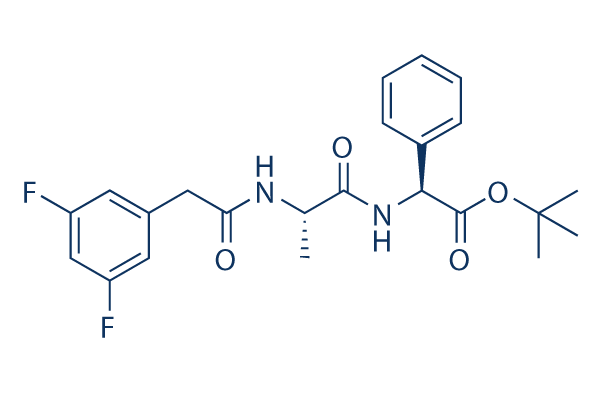
| Molecular Weight | 432.46 | Formula | C23H26F2N2O4 |
Storage (From the date of receipt) | |
|---|---|---|---|---|---|
| CAS No. | 208255-80-5 | Download SDF | Storage of Stock Solutions |
|
|
| Synonyms | GSI-IX, LY-374973 | Smiles | CC(C(=O)NC(C1=CC=CC=C1)C(=O)OC(C)(C)C)NC(=O)CC2=CC(=CC(=C2)F)F | ||
| Targets/IC50/Ki |
Notch
Aβ
(HEK 293 cells) 20 nM
|
|---|---|
| In vitro |
In human primary neuronal cultures, DAPT also shows inhibitory effects on Aβ production with IC50 of 115 nM and 200 nM respectively for Aβ total and Aβ42, which is 5-10-fold lower than is observed in HEK 293 cells. A recent study shows that this compound inhibits the proliferation of SK-MES-1 cells in a concentration-dependent manner with IC50 of 11.3 μM. In addition, it also induces caspase-dependent and caspase-independent apoptosis in lung squamous cell carcinoma cells by inhibiting Notch receptor signaling pathway.
|
| Kinase Assay |
In vitro Aβ reduction assays
|
|
Human embryonic kidney cells (American Type Culture Collection CRL-1573), transfected with the gene for APP751 (HEK 293) are used for routine Aβ reduction assays. Cells are plated in 96-well plates and allowed to adhere overnight in Dulbecco's modified Eagle medium (DMEM) supplemented with 10% heat-inactivated fetal bovine serum. DAPT are diluted from stock solutions in dimethylsulfoxide (DMSO) to yield a final concentration equal to 0.1% DMSO in media. Cells are pre-treated for 2 hours at 37 °C with this compound, media are aspirated off and fresh compound solutions applied. After an additional 2-hour treatment period, conditioned media is drawn off and analyzed by a sandwich ELISA (266–3D6) specific for total Aβ. Reduction of Aβ production is measured relative to control cells treated with 0.1% DMSO and expressed as a percentage inhibition. Data from at least six doses in duplicate are fitted to a four-parameter logistical model using XLfit software in order to determine potency. Human and PDAPP mouse neuronal cultures are grown in serum-free media to enhance their neuronal characteristics, and appeared to be greater than 90% neurons after maturation prior to use. Conditioned media to establish baseline Aβ values are collected by adding fresh media to each well and incubated for 24 hours at 37 °C in the absence of this chemical. Cultures are then treated with fresh media containing this compound at the desired range of concentrations for an additional 24 hours at 37 °C, and conditioned media collected. For the measurement of total Aβ, samples are analyzed with the same ELISA (266–3D6) as used for the HEK 293 cell assays. Analyses of samples for Aβ42 production are performed by a separate ELISA (21F12–3D6) that utilizes a capture antibody specific for the Aβ42 C-terminus. Inhibition of production for both total Aβ and Aβ42 are determined by the difference between the values for the compound treatment and baseline periods. After plotting percentage inhibition versus this compound concentration, data are analyzed with XLfit software, as above, to determine potency.
|
|
| In vivo |
DAPT administration (100mg/kg) leads to a robust and sustained pharmacodynamic effect in PDAPP mice that this compound levels in the brain exceeds 100 ng/g within 1 hour and persists up to 18 hours after administration, with peak levels of 490 ng/g observed after 3 hour. And during the period, this chemical (100 mg/kg) also reduces the cortical total Aβ and Aβ42 in a dose-dependent manner with a 50% reduction. In rat cerebral cortexes, this compound (40 mg/kg) suppresses the LPS-induced activity of γ-secretase and increases the cell apoptosis with the prolonged neuroinflammation.
|
References |
|
| Methods | Biomarkers | Images | PMID |
|---|---|---|---|
| Western blot | Snail / N-cadherin / Vimentin / E-cadherin Bax / caspase-3 / Bcl-2 NICD / Pax7 / Pax3 / MyoD / Myogenin / p21 |
|
24932308 |
| Growth inhibition assay | Cell viability |
|
27118928 |
| Immunofluorescence | CDK5 |
|
18662245 |
(data from https://clinicaltrials.gov, updated on 2024-05-22)
| NCT Number | Recruitment | Conditions | Sponsor/Collaborators | Start Date | Phases |
|---|---|---|---|---|---|
| NCT06292117 | Recruiting | Ischemic Stroke|CYP2C19 Polymorphism |
University of Virginia|American Heart Association |
April 16 2024 | -- |
| NCT06074549 | Recruiting | Coronary Artery Disease |
Elixir Medical Corporation |
March 10 2024 | -- |
| NCT06223607 | Recruiting | Baseline Thrombocytopenia |
Methodist Health System |
August 22 2022 | -- |
Tel: +1-832-582-8158 Ext:3
If you have any other enquiries, please leave a message.
Question 1:
I would like to ask if you would recommend it used in endothelial cells (e.g. both murine and human endothelial cells).
Answer:
I think this compound can be used in endothelial cells from both human and mouse, please see the following reference: http://www.ncbi.nlm.nih.gov/pubmed/19481797; http://www.ncbi.nlm.nih.gov/pmc/articles/PMC2615564/