
-
 Argentina
-
 Australia
-
 Austria
-
 Belgium
-
 Brazil
-
 Canada
-
 China
China
-
 Czech Republic
-
 Denmark
-
 Finland
-
 France
-
 Germany
-
 Greece
-
 Hong Kong
-
 Hungary
-
 Iceland
-
 India
India
-
 Ireland
-
 Israel
-
 Italy
Italy
-
 Japan
Japan
-
 Korea
Korea
-
 Luxembourg
-
 Malaysia
-
 Netherlands
-
 New Zealand
-
 Norway
-
 Poland
-
 Portugal
-
 Qatar
Qatar
-
 Romania
-
 Saudi Arabia
-
 Singapore
-
 Spain
Spain
-
 Sweden
-
 Switzerland
-
 Taiwan
-
 Turkey
-
 United Kingdom
-
 United States
research use only
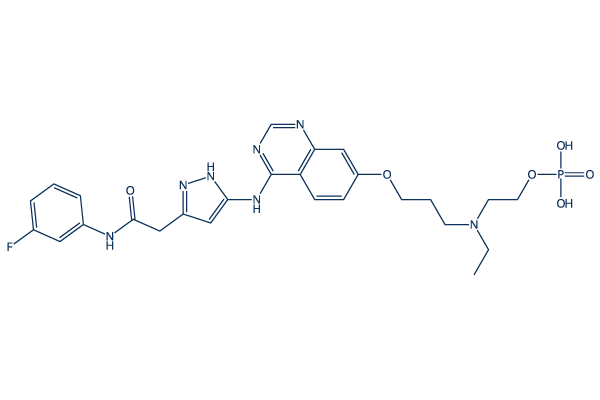
AZD1152(Barasertib) Aurora Kinase inhibitor
Cat.No.S1051
Quality Control
| Related Targets | Akt Wnt/beta-catenin PKC HSP ROCK Microtubule Associated Integrin Bcr-Abl Actin FAK |
|---|---|
| Other Aurora Kinase Inhibitors | Hesperadin Barasertib-HQPA (AZD2811) Alisertib (MLN8237) Tozasertib (VX-680, MK-0457) ZM 447439 MLN8054 Danusertib (PHA-739358) MK-5108 TCS7010 (Aurora A Inhibitor I) AMG-900 |
Solubility
|
In vitro |
DMSO
: 100 mg/mL
(170.2 mM)
Water : Insoluble Ethanol : Insoluble |
Molarity Calculator
|
In vivo |
|||||
In vivo Formulation Calculator (Clear solution)
Step 1: Enter information below (Recommended: An additional animal making an allowance for loss during the experiment)
Step 2: Enter the in vivo formulation (This is only the calculator, not formulation. Please contact us first if there is no in vivo formulation at the solubility Section.)
Calculation results:
Working concentration: mg/ml;
Method for preparing DMSO master liquid: mg drug pre-dissolved in μL DMSO ( Master liquid concentration mg/mL, Please contact us first if the concentration exceeds the DMSO solubility of the batch of drug. )
Method for preparing in vivo formulation: Take μL DMSO master liquid, next addμL PEG300, mix and clarify, next addμL Tween 80, mix and clarify, next add μL ddH2O, mix and clarify.
Method for preparing in vivo formulation: Take μL DMSO master liquid, next add μL Corn oil, mix and clarify.
Note: 1. Please make sure the liquid is clear before adding the next solvent.
2. Be sure to add the solvent(s) in order. You must ensure that the solution obtained, in the previous addition, is a clear solution before proceeding to add the next solvent. Physical methods such
as vortex, ultrasound or hot water bath can be used to aid dissolving.
Chemical Information, Storage & Stability
| Molecular Weight | 587.54 | Formula | C26H31FN7O6P |
Storage (From the date of receipt) | |
|---|---|---|---|---|---|
| CAS No. | 722543-31-9 | Download SDF | Storage of Stock Solutions |
|
|
Read more about storage stability stock solution CAS number
Mechanism of Action
| Features |
Selectivity for Aurora-B over Aurora-A.
|
|---|---|
| Targets/IC50/Ki |
Aurora B
0.36 nM
|
| In vitro |
AZD1152 (Barasertib) is a pro-drug converting to active substance AZD1152-HQPA in human plasma, which inhibits Aurora-A, Aurora B-INCENP, and Aurora C-INCENP with Kis of 687 nM, 0.36 nM, and 17.0 nM, indicating a 100-fold selectivity for Aurora-B over Aurora-A. This compound results in a dose-dependent inhibition of histone H3 phosphorylation on Ser10 in SW620 colorectal tumor cell line. It induces growth arrest of a variety of types of leukemia cells, with IC50 of 5, 12, and 8 nM for ALL PALL-2, MOLM13, MV4-11 respectively.
|
| Kinase Assay |
Affinity determination
|
|
AZD1152 (Barasertib) is incubated with Aurora A or Aurora B-INCENP and the substrate peptide. Twenty microliters of reaction mix (25 mM Tris-HCl, 12.7 mM KCl, 2.5 mM NaF, 0.6 mM dithiothreitol, 6.25 mM MnCl2, 7.5μM ATP for Aurora A assay and 15 μM for Aurora B-INCENP assay, 6.25 μM peptide substrate containing 0.2 μCi [γ33P]ATP) is then added to all test wells to start the reaction (to give a final volume of 50 μL). Plates are incubated at room temperature for 60 min, reactions are stopped by addition of 100 μL of 20% v/v orthophosphoric acid, and peptide substrate is captured on positively charged nitrocellulose P30 filtermat using a 96-well plate harvester and then assayed for incorporation of 33P with a Beta plate counter.
|
|
| In vivo |
AZD1152 (Barasertib) (2.5 mg/kg/d) significantly suppresses PhH3 by 69% in SW620 colon tumors. It (10-150 mg/kg/d) inhibits growth in a panel of human tumor xenografts including Colo205, A549, and HL-60 with inhibition rate ranging from 55% to 100%. Additional results show cells exposed to this compound end up apoptosis. It (25 mg/kg) markedly suppresses the growth and weights of AZD1152-treated tumors in MOLM13 xenografts.
|
References |
|
Clinical Trial Information
(data from https://clinicaltrials.gov, updated on 2014-07-02)
| NCT Number | Recruitment | Conditions | Sponsor/Collaborators | Start Date | Phases |
|---|---|---|---|---|---|
| NCT01354392 | COMPLETED | Lymphoma |
Oxford University Hospitals NHS Trust |
2011-09 | PHASE1; PHASE2 |
| NCT00952588 | COMPLETED | Acute Myeloid Leukemia |
AstraZeneca |
2009-07 | PHASE2; PHASE3 |
| NCT00926731 | COMPLETED | Acute Myeloid Leukemia |
AstraZeneca |
2009-06 | PHASE1 |
| NCT01019161 | COMPLETED | Acute Myeloid Leukaemia |
AstraZeneca |
2009-11 | PHASE1 |
| NCT00497991 | COMPLETED | Myeloid Leukemia |
AstraZeneca |
2006-05 | PHASE1 |
| NCT00530699 | COMPLETED | Acute Myeloid Leukaemia |
AstraZeneca |
2007-11 | PHASE1 |
Read more about Clinical Trials
Tech Support
Tel: +1-832-582-8158 Ext:3
If you have any other enquiries, please leave a message.
Signaling Pathway Map

Products are for research use only. Not for human use. We do not sell to patients.
©Copyright 2013 Selleck Chemicals. All Rights Reserved.