
-
 Australia
-
 Austria
-
 Belgium
-
 Brazil
-
 Canada
-
 China
China
-
 Czech Republic
-
 Denmark
-
 Finland
-
 France
-
 Germany
-
 Greece
-
 Hong Kong
-
 Hungary
-
 Iceland
-
 India
India
-
 Ireland
-
 Israel
-
 Italy
Italy
-
 Japan
Japan
-
 Korea
Korea
-
 Luxembourg
-
 Malaysia
-
 Netherlands
-
 New Zealand
-
 Norway
-
 Poland
-
 Qatar
Qatar
-
 Romania
-
 Saudi Arabia
-
 Singapore
-
 Spain
Spain
-
 Sweden
-
 Switzerland
-
 Taiwan
-
 Turkey
-
 United Kingdom
-
 United States
research use only
PHA-680632 Aurora Kinase inhibitor
Cat.No.S1454
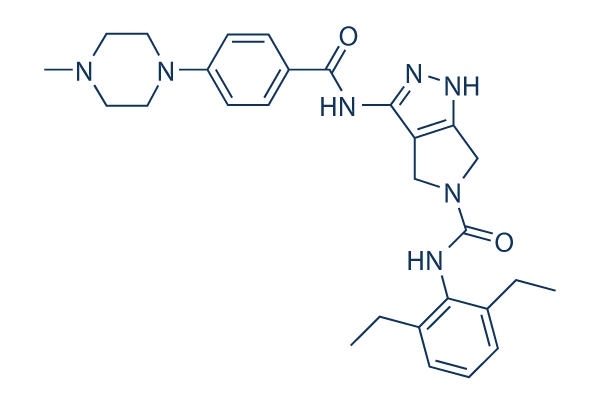
Chemical Structure
Molecular Weight: 501.62
Quality Control
| Related Targets | CDK HSP PD-1/PD-L1 ROCK Wee1 DNA/RNA Synthesis Microtubule Associated Ras KRas Casein Kinase |
|---|---|
| Other Aurora Kinase Inhibitors | Hesperadin Barasertib-HQPA (AZD2811) Alisertib (MLN8237) Tozasertib (VX-680, MK-0457) ZM 447439 MLN8054 Danusertib (PHA-739358) MK-5108 TCS7010 (Aurora A Inhibitor I) AMG-900 |
Solubility
|
In vitro |
DMSO
: 100 mg/mL
(199.35 mM)
Water : Insoluble Ethanol : Insoluble |
Molarity Calculator
|
In vivo |
|||||
In vivo Formulation Calculator (Clear solution)
Step 1: Enter information below (Recommended: An additional animal making an allowance for loss during the experiment)
Step 2: Enter the in vivo formulation (This is only the calculator, not formulation. Please contact us first if there is no in vivo formulation at the solubility Section.)
Calculation results:
Working concentration: mg/ml;
Method for preparing DMSO master liquid: mg drug pre-dissolved in μL DMSO ( Master liquid concentration mg/mL, Please contact us first if the concentration exceeds the DMSO solubility of the batch of drug. )
Method for preparing in vivo formulation: Take μL DMSO master liquid, next addμL PEG300, mix and clarify, next addμL Tween 80, mix and clarify, next add μL ddH2O, mix and clarify.
Method for preparing in vivo formulation: Take μL DMSO master liquid, next add μL Corn oil, mix and clarify.
Note: 1. Please make sure the liquid is clear before adding the next solvent.
2. Be sure to add the solvent(s) in order. You must ensure that the solution obtained, in the previous addition, is a clear solution before proceeding to add the next solvent. Physical methods such
as vortex, ultrasound or hot water bath can be used to aid dissolving.
Chemical Information, Storage & Stability
| Molecular Weight | 501.62 | Formula | C28H35N7O2 |
Storage (From the date of receipt) | |
|---|---|---|---|---|---|
| CAS No. | 398493-79-3 | Download SDF | Storage of Stock Solutions |
|
|
| Synonyms | N/A | Smiles | CCC1=C(C(=CC=C1)CC)NC(=O)N2CC3=C(C2)NN=C3NC(=O)C4=CC=C(C=C4)N5CCN(CC5)C | ||
Mechanism of Action
| Targets/IC50/Ki |
Aurora A
27 nM
Aurora C
120 nM
Aurora B
135 nM
FGFR1
390 nM
PLK1
780 nM
FLT3
820 nM
VEGFR3
1000 nM
VEGFR2
1920 nM
LCK
1950 nM
|
|---|---|
| In vitro |
PHA-680632 potently inhibits all three Aurora kinases (A, B, and C) with IC50 values of 27, 135, and 120 nM, respectively. This compound is selective for Aurora kinases, with 10- to 200-fold higher IC50 for FGFR1, FLT3, LCK, PLK1, STLK2, VEGFR2, and VEGFR3, and with IC50 higher than 10 μM for another 22 kinases. It shows potent anti-proliferative effects in a wide range of cell types with IC50 values of 0.06–7.15 μM, including HeLa, HCT116, HT29, LOVO, DU145, and NHDF cells. This chemical (0.5 μM) causes polyploidy in tumor cells. The mechanism of action of this compound is in agreement with inhibition of Aurora kinases.
This compound in association with radiation leads to additive effects in cancer cells, especially in the p53-deficient cells. Combined ionising radiation (IR) and treatment of this chemical (100–400 nM) prior to IR leads to an enhancement of radiation-induced Annexin V positive cells, micronuclei formation, and Brca1 foci formation only in HCT116 cells with deficient p53, other than the p53 wild-type counterparts.
|
| Kinase Assay |
Aurora Kinase Inhibition Assay
|
|
Inhibition of kinase activity by PHA-680632 is assessed using a scintillation proximity assay format. The biotinylated substrate is transphosphorylated by the kinase in presence of ATP traced with γ33-ATP. The phosphorylated substrate is then captured using streptavidin-coated scintillation proximity assay beads and the extent of phosphorylation is evaluated by β-counter after a 4-hour rest for the floatation of the beads on a dense 5 M CsCl solution. In particular, a peptide derived from the Chocktide sequence (LRRWSLGL) is used as substrate for Aurora A, whereas the optimized peptide Auroratide is employed for Aurora B and C. The assay is run in a robotized format on 96-well plates. The potency of this compound toward Aurora kinases is evaluated and IC50 values are determined.
|
|
| In vivo |
HA-680632 (15–60 mg/kg) inhibits tumor growth in mice xenografts models of HL60, A2780, and HCT116 cells, by reducing tumor cell proliferation and increasing apoptosis. This compound (45 mg/kg) suppresses growth of activated ras-driven mammary tumors in mouse mammary tumor virus v-Ha-ras transgenic mice and results in complete tumor stabilization and partial regression.
|
References |
|
Tech Support
Tel: +1-832-582-8158 Ext:3
If you have any other enquiries, please leave a message.
Signaling Pathway Map

Products are for research use only. Not for human use. We do not sell to patients.
©Copyright 2013 Selleck Chemicals. All Rights Reserved.