
-
 Argentina
-
 Australia
-
 Austria
-
 Belgium
-
 Brazil
-
 Canada
-
 China
China
-
 Czech Republic
-
 Denmark
-
 Finland
-
 France
-
 Germany
-
 Greece
-
 Hong Kong
-
 Hungary
-
 Iceland
-
 India
India
-
 Ireland
-
 Israel
-
 Italy
Italy
-
 Japan
Japan
-
 Korea
Korea
-
 Luxembourg
-
 Malaysia
-
 Netherlands
-
 New Zealand
-
 Norway
-
 Poland
-
 Portugal
-
 Qatar
Qatar
-
 Romania
-
 Saudi Arabia
-
 Singapore
-
 Spain
Spain
-
 Sweden
-
 Switzerland
-
 Taiwan
-
 Turkey
-
 United Kingdom
-
 United States
DNA/RNA Synthesis Inhibitors
Other DNA Damage/DNA Repair Related Inhibitors
Isoform-selective Products
| Cat.No. | Product Name | Information | Product Use Citations | Product Validations |
|---|---|---|---|---|
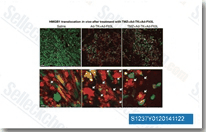
| S1237 | TMZ(Temozolomide) | TMZ(Temozolomide) is a monofunctional SN-1 alkylating agent that can modify nitrogen atoms in the DNA ring and the extracyclic oxygen group, chemically converted to MTIC and degrades to methyldiazonium cation, which transfers methyl groups to DNA at physiologic pH. A DNA damage inducer in L-1210 and L-1210/BCNU cells. Temozolomide induces apoptosis and exhibits antitumor activity. |
|
|
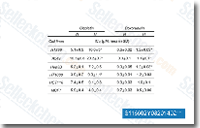
| S1166 | Cisplatin | Cisplatin is an inorganic platinum complex, which is able to inhibit DNA synthesis by conforming DNA adducts in tumor cells. Cisplatin activates ferroptosis and induces autophagy.Solutions are unstable and should be fresh-prepared.DMSO is not recommended to dissolve platinum-based drugs, which can easily lead to drug inactivation. |
|
|
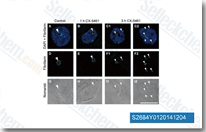
| S2684 | CX-5461 (Pidnarulex) | Pidnarulex (CX-5461) is an inhibitor of rRNA synthesis, selectively inhibits Pol I-driven transcription of rRNA with IC50 of 142 nM in HCT-116, A375, and MIA PaCa-2 cells, has no effect on Pol II, and possesses 250- to 300-fold selectivity for inhibition of rRNA transcription versus DNA replication and protein translation. |
|
|
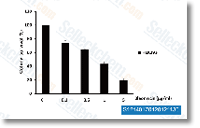
| S1214 | Bleomycin sulfate | Bleomycin sulfate is a glycopeptide antibiotic and a DNA synthesis inhibitor, as well as an anticancer agent for squamous cell carcinomas (SCC) with an IC50 of 4 nM in UT-SCC-19A cells. Bleomycin sulfate is a DNA synthesis inhibitor. Bleomycin (NSC125066) sulfate can be used to induce animal models of pulmonary fibrosis. |
|
|
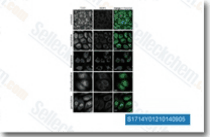
| S1149 | Gemcitabine Hydrochloride | Gemcitabine is a pyrimidine nucleoside analog antitumor drug that can inhibit DNA synthesis and repair, leading to cell autophagy and apoptosis. It is mainly used to treat various solid tumors such as pancreatic cancer and non-small cell lung cancer, and is often combined with chemotherapy to enhance efficacy. |
|
|
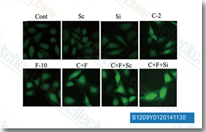
| S1209 | 5-Fluorouracil (5-FU) | 5-FU (5-Fluorouracil) is a DNA/RNA synthesis inhibitor, which interrupts nucleotide synthetic by inhibiting thymidylate synthase (TS) in tumor cells. Fluorouracil induces apoptosis and can be used in the treatment of HIV. |
|
|
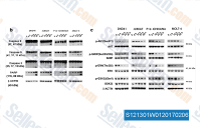
| S1213 | Nelarabine | Nelarabine (506U78,Arranon) is a purine nucleoside analog and DNA synthesis inhibitor with IC50 from 0.067-2.15 μM in tumor cells. |
|
|
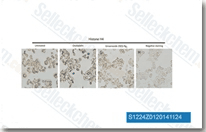
| S1224 | Oxaliplatin | Oxaliplatin is a DNA alkylating agent that activates autophagy. Oxaliplatin inhibits DNA synthesis by conforming DNA adducts in RT4, TCCSUP, A2780, HT-29, U-373MG, U-87MG, SK-MEL-2, and HT-144 cells.Solutions are unstable and should be fresh-prepared.DMSO is not recommended to dissolve platinum-based drugs, which can easily lead to drug inactivation. |
|
|
| S1714 | Gemcitabine | Gemcitabine, a nucleic acid synthesis inhibitor, is a very potent and specific deoxycytidine analogue, used as chemotherapy. Gemcitabine induces a potent p53-dependent apoptosis. |
|

|
| S1229 | Fludarabine (NSC 118218) Phosphate | Fludarabine Phosphate is an analogue of adenosine and deoxyadenosine, which is able to compete with dATP for incorporation into DNA and inhibit DNA synthesis. |
|
|
Signaling Pathway Map

Products are for research use only. Not for human use. We do not sell to patients.
©Copyright 2013 Selleck Chemicals. All Rights Reserved.