
-
 Argentina
-
 Australia
-
 Austria
-
 Belgium
-
 Brazil
-
 Canada
-
 China
China
-
 Czech Republic
-
 Denmark
-
 Finland
-
 France
-
 Germany
-
 Greece
-
 Hong Kong
-
 Hungary
-
 Iceland
-
 India
India
-
 Ireland
-
 Israel
-
 Italy
Italy
-
 Japan
Japan
-
 Korea
Korea
-
 Luxembourg
-
 Malaysia
-
 Netherlands
-
 New Zealand
-
 Norway
-
 Poland
-
 Portugal
-
 Qatar
Qatar
-
 Romania
-
 Saudi Arabia
-
 Singapore
-
 Spain
Spain
-
 Sweden
-
 Switzerland
-
 Taiwan
-
 Turkey
-
 United Kingdom
-
 United States
research use only
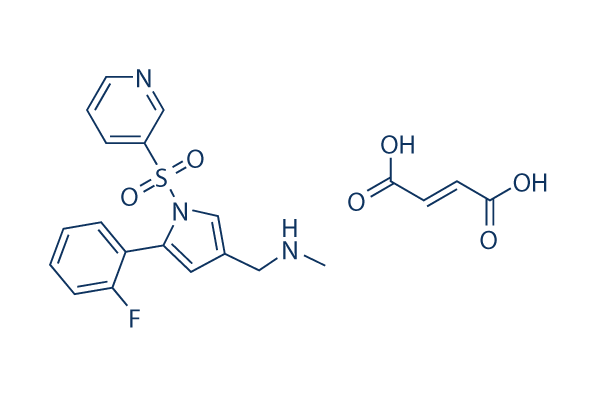
Vonoprazan Fumarate (TAK-438) Potassium Channel inhibitor
Cat.No.S8016
Quality Control
| Related Targets | CFTR CRM1 CD markers AChR Calcium Channel Sodium Channel GABA Receptor TRP Channel ATPase GluR |
|---|---|
| Other Potassium Channel Inhibitors | Nigericin TRAM-34 Nicorandil ML133 HCl Hydralazine HCl Sophocarpine Senicapoc (ICA-17043) Gliquidone Butamben PAP-1 |
Solubility
|
In vitro |
DMSO
: 92 mg/mL
(199.36 mM)
Water : Insoluble Ethanol : Insoluble |
Molarity Calculator
|
In vivo |
|||||
In vivo Formulation Calculator (Clear solution)
Step 1: Enter information below (Recommended: An additional animal making an allowance for loss during the experiment)
Step 2: Enter the in vivo formulation (This is only the calculator, not formulation. Please contact us first if there is no in vivo formulation at the solubility Section.)
Calculation results:
Working concentration: mg/ml;
Method for preparing DMSO master liquid: mg drug pre-dissolved in μL DMSO ( Master liquid concentration mg/mL, Please contact us first if the concentration exceeds the DMSO solubility of the batch of drug. )
Method for preparing in vivo formulation: Take μL DMSO master liquid, next addμL PEG300, mix and clarify, next addμL Tween 80, mix and clarify, next add μL ddH2O, mix and clarify.
Method for preparing in vivo formulation: Take μL DMSO master liquid, next add μL Corn oil, mix and clarify.
Note: 1. Please make sure the liquid is clear before adding the next solvent.
2. Be sure to add the solvent(s) in order. You must ensure that the solution obtained, in the previous addition, is a clear solution before proceeding to add the next solvent. Physical methods such
as vortex, ultrasound or hot water bath can be used to aid dissolving.
Chemical Information, Storage & Stability
| Molecular Weight | 461.46 | Formula |
C17H16FN3O2S.C4H4O4
|
Storage (From the date of receipt) | |
|---|---|---|---|---|---|
| CAS No. | 1260141-27-2 | Download SDF | Storage of Stock Solutions |
|
|
| Synonyms | N/A | SMILES | CNCC1=CN(C(=C1)C2=CC=CC=C2F)S(=O)(=O)C3=CN=CC=C3.C(=CC(=O)O)C(=O)O | ||
Read more about storage stability stock solution CAS number SMILES
Mechanism of Action
| Features |
Capable of inhibiting H+, K+-ATPase under acidic or neutral conditions.
|
|---|---|
| Targets/IC50/Ki |
H+/K+-ATPase
19 nM
|
| In vitro |
Vonoprazan Fumarate (TAK-438) is a pyrrole derivative with a chemical structure that is completely different from the P-CABs developed to date. It inhibits gastric H+, K+-ATPase activity in a concentration-dependent manner. Under neutral conditions (pH 7.5), the inhibitory activity of this compound is almost the same as that under weakly acidic conditions (pH 6.5). It does not inhibit Na+, K+-ATPase activity even at concentration 500 times higher than their IC50 values against gastric H+,K+-ATPase activity. This compound inhibits gastric H+, K+-ATPase in a K+-competitive manner with Ki of 3 nM.
|
| In vivo |
Vonoprazan Fumarate (TAK-438) inhibits basal gastric acid secretion in a dose-dependent manner, and the ID50 value is 1.26 mg/kg. Intravenous administration of this compound dose-dependently increases the pH of the gastric perfusate, and the increase in pH is sustained for 5 h after administration. At the 1 mg/kg dose, the pH plateaues 90 min after administration, and the highest pH value reached is 5.9. In addition, it shows a potent and longer-lasting inhibitory effect on the histamine-stimulated gastric acid secretion in rats and dogs. It shows significant antisecretory activity through high accumulation and slow clearance from the gastric tissue. This compound is unaffected by the gastric secretory state, unlike PPIs.
|
References |
|
Clinical Trial Information
(data from https://clinicaltrials.gov, updated on 2026-01-20)
| NCT Number | Recruitment | Conditions | Sponsor/Collaborators | Start Date | Phases |
|---|---|---|---|---|---|
| NCT07352098 | NOT_YET_RECRUITING | Helicobacter |
Yueyue Li |
2026-02-01 | |
| NCT07757919 | NOT_YET_RECRUITING | HELICOBACTER PYLORI INFECTIONS |
Qilu Hospital of Shandong University |
2026-09-01 | PHASE4 |
| NCT06783257 | NOT_YET_RECRUITING | Peptic Ulcer Bleeding |
Shandong New Time Pharmaceutical Co., LTD |
2025-02 | PHASE2 |
| NCT07275632 | RECRUITING | Delayed Graft Function; Kidney Transplantation |
First Affiliated Hospital of Chongqing Medical University |
2025-12-10 | PHASE1; PHASE2 |
| NCT06901375 | UNKNOWN | Helicobacter Pylori Infection |
Nanjing First Hospital, Nanjing Medical University |
2025-05 | EARLY_PHASE1 |
| NCT06340724 | COMPLETED | Helicobacter Pylori Infection |
Nanjing First Hospital, Nanjing Medical University |
2024-02-15 | PHASE3 |
Read more about Clinical Trials
Tech Support
Tel: +1-832-582-8158 Ext:3
If you have any other enquiries, please leave a message.
Signaling Pathway Map

Products are for research use only. Not for human use. We do not sell to patients.
©Copyright 2013 Selleck Chemicals. All Rights Reserved.