
-
 Argentina
-
 Australia
-
 Austria
-
 Belgium
-
 Brazil
-
 Canada
-
 China
China
-
 Czech Republic
-
 Denmark
-
 Finland
-
 France
-
 Germany
-
 Greece
-
 Hong Kong
-
 Hungary
-
 Iceland
-
 India
India
-
 Ireland
-
 Israel
-
 Italy
Italy
-
 Japan
Japan
-
 Korea
Korea
-
 Luxembourg
-
 Malaysia
-
 Netherlands
-
 New Zealand
-
 Norway
-
 Poland
-
 Portugal
-
 Qatar
Qatar
-
 Romania
-
 Saudi Arabia
-
 Singapore
-
 Spain
Spain
-
 Sweden
-
 Switzerland
-
 Taiwan
-
 Turkey
-
 United Kingdom
-
 United States
research use only
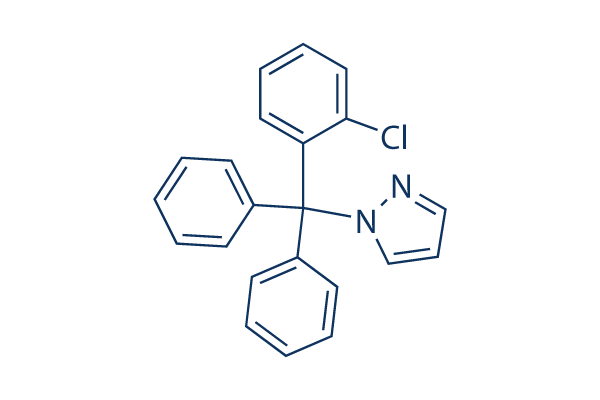
TRAM-34 Potassium Channel inhibitor
Cat.No.S1160
Quality Control
| Related Targets | CFTR CRM1 CD markers AChR Calcium Channel Sodium Channel GABA Receptor TRP Channel ATPase GluR |
|---|---|
| Other Potassium Channel Inhibitors | Nigericin Nicorandil ML133 HCl Hydralazine HCl Sophocarpine Senicapoc (ICA-17043) Gliquidone Butamben PAP-1 E-4031 dihydrochloride |
Solubility
|
In vitro |
cyclohexane : 8 mg/mL
DMSO
: 0.4 mg/mL
(1.15 mM)
Water : Insoluble |
Molarity Calculator
|
In vivo |
|||||
In vivo Formulation Calculator (Clear solution)
Step 1: Enter information below (Recommended: An additional animal making an allowance for loss during the experiment)
Step 2: Enter the in vivo formulation (This is only the calculator, not formulation. Please contact us first if there is no in vivo formulation at the solubility Section.)
Calculation results:
Working concentration: mg/ml;
Method for preparing DMSO master liquid: mg drug pre-dissolved in μL DMSO ( Master liquid concentration mg/mL, Please contact us first if the concentration exceeds the DMSO solubility of the batch of drug. )
Method for preparing in vivo formulation: Take μL DMSO master liquid, next addμL PEG300, mix and clarify, next addμL Tween 80, mix and clarify, next add μL ddH2O, mix and clarify.
Method for preparing in vivo formulation: Take μL DMSO master liquid, next add μL Corn oil, mix and clarify.
Note: 1. Please make sure the liquid is clear before adding the next solvent.
2. Be sure to add the solvent(s) in order. You must ensure that the solution obtained, in the previous addition, is a clear solution before proceeding to add the next solvent. Physical methods such
as vortex, ultrasound or hot water bath can be used to aid dissolving.
Chemical Information, Storage & Stability
| Molecular Weight | 344.84 | Formula | C22H17ClN2 |
Storage (From the date of receipt) | |
|---|---|---|---|---|---|
| CAS No. | 289905-88-0 | Download SDF | Storage of Stock Solutions |
|
|
| Synonyms | Triarylmethane-34 | SMILES | C1=CC=C(C=C1)C(C2=CC=CC=C2)(C3=CC=CC=C3Cl)N4C=CC=N4 | ||
Read more about storage stability stock solution CAS number SMILES
Mechanism of Action
| Features |
Has a therapeutic profile similar to clotrimazole, but TRAM-34 has a superior safety profile.
|
|---|---|
| Targets/IC50/Ki |
IKCa1 (KCa3.1)
20 nM(Kd)
|
| In vitro |
Unlike clotrimazole, TRAM-34 selectively inhibits IKCa1 without blocking cytochrome P450 enzyme (CYP3A4). This compound potently inhibits cloned IKCa1 channel in IKCa1-transfected COS-7 cells as well as native IK currents in human T lymphocytes and T84 cells with Kd of 20 nM, 25 nM, and 22 nM, respectively, more potently than clotrimazole with Kd of 70 nM, 100 nM, and 90 nM, respectively. It exhibits 200- to 1,500-fold selectivity over other ion channels such as KV, BKCa, SKCa, Na+, CRAC and Cl- channels. This chemical significantly inhibits anti-CD3 Ab or PKC-activator PMA plus calcium-ionophore ionomycin induced activation of human T lymphocytes with IC50 of 295-910 nM and 85-830 nM, respectively. It (5 μM) does not inhibit cell viability of human T lymphocytes or several cell lines. This compound significantly inhibits EGF-induced IKCa1 up-regulation, and EGF-stimulated proliferation of A7r5 cells with IC50 of 8 nM. This chemical treatment inhibits proliferation of human endometrial cancer (EC) cells, and blocks EC cell cycle at G0/G1 phase. Inhibition of the IKCa1 channel by this compound (1-30 μM) leads to dose-dependent suppression of the proliferation but not apoptosis of LNCaP and PC-3 prostate cancer (PCa) cells, involving an increase of p21Cip1 and cell arrest in the G1 cycle.
|
| Kinase Assay |
Electrophysiology
|
|
The human IKCa1 is cloned and expressed in COS-7 cells. Cells are studied in the whole-cell configuration of the patch-clamp technique. The holding potential is 280 mV. The internal pipette solution contains: 145 mM K+ aspartate, 2 mM MgCl2, 10 mM Hepes, 10 mM K2EGTA, and 8.5 mM CaCl2 (1 μM free Ca2+), pH 7.2, 290-310 mOsm. To reduce currents from the native chloride channels in COS-7 cells, Na+ aspartate Ringer is used as an external solution: 160 mM Na+ aspartatey/4.5 mM KCl/2 mM CaCl2/1 mM MgCl2/5 mM Hepes, pH 7.4/290-310 mOsm. IKCa currents in COS-7 cells are elicited by 200-ms voltage ramps from -120 mV to 40 mV applied every 10 seconds and the reduction of slope conductance at -80 mV by this compound taken as a measure of channel block.
|
|
| In vivo |
TRAM-34 treatment at ~500-1,000 times the channel-blocking dose (0.5 mg/kg/day) for 7 days is nontoxic to mice. Administration of this compound at 120 mg/kg/day significantly reduces intimal hyperplasia by ~40% in a rat model of balloon catheter injury (BCI). Consistent with its in vitro role in inhibiting the proliferation of EC cells, this chemical treatment at 30 μM slows the development of HEC-1-A tumor in vivo.
|
References |
|
Tech Support
Tel: +1-832-582-8158 Ext:3
If you have any other enquiries, please leave a message.
Signaling Pathway Map

Products are for research use only. Not for human use. We do not sell to patients.
©Copyright 2013 Selleck Chemicals. All Rights Reserved.