
-
 Argentina
-
 Australia
-
 Austria
-
 Belgium
-
 Brazil
-
 Canada
-
 China
China
-
 Czech Republic
-
 Denmark
-
 Finland
-
 France
-
 Germany
-
 Greece
-
 Hong Kong
-
 Hungary
-
 Iceland
-
 India
India
-
 Ireland
-
 Israel
-
 Italy
Italy
-
 Japan
Japan
-
 Korea
Korea
-
 Luxembourg
-
 Malaysia
-
 Netherlands
-
 New Zealand
-
 Norway
-
 Poland
-
 Portugal
-
 Qatar
Qatar
-
 Romania
-
 Saudi Arabia
-
 Singapore
-
 Spain
Spain
-
 Sweden
-
 Switzerland
-
 Taiwan
-
 Turkey
-
 United Kingdom
-
 United States
research use only
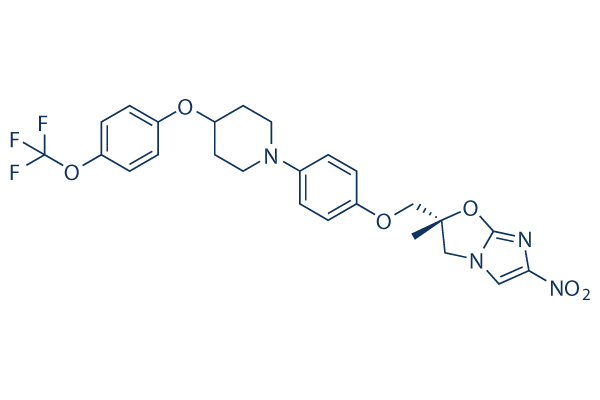
Delamanid Bacterial chemical
Cat.No.S5007
Quality Control
| Related Targets | Integrase Antibiotics Anti-infection Fungal Antiviral COVID-19 Parasite Reverse Transcriptase HIV HCV Protease |
|---|---|
| Other Bacterial Inhibitors | BTZ043 Racemate Teicoplanin Pefloxacin Mesylate Ceftiofur Solithromycin 6-Methoxydihydrosanguinarine Proanthocyanidins Flagelin 22 Taurolidine Skatole |
Solubility
|
In vitro |
DMSO
: 100 mg/mL
(187.09 mM)
Water : Insoluble Ethanol : Insoluble |
Molarity Calculator
|
In vivo |
|||||
In vivo Formulation Calculator (Clear solution)
Step 1: Enter information below (Recommended: An additional animal making an allowance for loss during the experiment)
Step 2: Enter the in vivo formulation (This is only the calculator, not formulation. Please contact us first if there is no in vivo formulation at the solubility Section.)
Calculation results:
Working concentration: mg/ml;
Method for preparing DMSO master liquid: mg drug pre-dissolved in μL DMSO ( Master liquid concentration mg/mL, Please contact us first if the concentration exceeds the DMSO solubility of the batch of drug. )
Method for preparing in vivo formulation: Take μL DMSO master liquid, next addμL PEG300, mix and clarify, next addμL Tween 80, mix and clarify, next add μL ddH2O, mix and clarify.
Method for preparing in vivo formulation: Take μL DMSO master liquid, next add μL Corn oil, mix and clarify.
Note: 1. Please make sure the liquid is clear before adding the next solvent.
2. Be sure to add the solvent(s) in order. You must ensure that the solution obtained, in the previous addition, is a clear solution before proceeding to add the next solvent. Physical methods such
as vortex, ultrasound or hot water bath can be used to aid dissolving.
Chemical Information, Storage & Stability
| Molecular Weight | 534.48 | Formula | C25H25F3N4O6 |
Storage (From the date of receipt) | |
|---|---|---|---|---|---|
| CAS No. | 681492-22-8 | -- | Storage of Stock Solutions |
|
|
| Synonyms | OPC-67683 | SMILES | CC1(CN2C=C(N=C2O1)[N+](=O)[O-])COC3=CC=C(C=C3)N4CCC(CC4)OC5=CC=C(C=C5)OC(F)(F)F | ||
Read more about storage stability stock solution CAS number SMILES
Mechanism of Action
| In vitro |
Delamanid potently inhibits the synthesis of mycolic acid, a long-chain fatty acid of the M. tuberculosis (mycobacterium tuberculosis) cell wall. This compound at concentrations of less than 5 μM shows no inhibitory effects on the efflux ABC transporters P-gp, BCRP, and BSEP or on the hepatic or renal SLC transporters OATPs, OCTs, and OATs. It is not metabolized by NADPH-dependent reactions, including those catalyzed by CYP enzymes, in human or animal liver microsomes. Also, this chemical has no inhibitory effects on the metabolism of exogenous CYP substrate compounds by eight CYP isoforms (CYP1A2, CYP2A6, CYP2B6, CYP2C8/9, CYP2C19, CYP2D6, CYP2E1, and CYP3A), even at a concentration of 100 μmol/liter, well above the therapeutic concentration. |
|---|---|
| In vivo |
The water solubility of delamanid is poor and its absorption is increased more than two-fold by coadministration with food. The absolute bioavailability is unknown but estimated to be between 25% and 47%. In vivo, this compound is more than 99% protein bound, with a high volume of distribution (Vz/F of 2100 L) and a half-life of 30-38 hours. It is excreted primarily in the stool, with less than 5% excretion in the urine. It is thought to be primarily metabolized by albumin, with secondary contributions from P450 enzymes, primarily CYP3A4. Animal studies indicate that this chemical is excreted in breast milk. |
References |
|
Clinical Trial Information
(data from https://clinicaltrials.gov, updated on 2026-06-30)
| NCT Number | Recruitment | Conditions | Sponsor/Collaborators | Start Date | Phases |
|---|---|---|---|---|---|
| NCT07675954 | NOT_YET_RECRUITING | Rifampicin-Resistant Tuberculosis |
Seoul National University Hospital |
2026-10-01 | PHASE3 |
| NCT07198685 | NOT_YET_RECRUITING | Treat to Target; Treatment Duration |
Wuhan Pulmonary Hospital |
2025-09-30 | |
| NCT07126639 | NOT_YET_RECRUITING | Efficacy and Safety |
Wuhan Pulmonary Hospital |
2025-09-01 | |
| NCT03828201 | ACTIVE_NOT_RECRUITING | Tuberculosis, Multidrug-Resistant |
Boston University |
2022-06-07 | PHASE2 |
| NCT06649721 | ACTIVE_NOT_RECRUITING | Drug-resistant Tuberculosis; Pulmonary Tuberculosis; Rifampin-resistant Tuberculosis |
Huashan Hospital |
2024-11-27 | PHASE3 |
| NCT06114628 | RECRUITING | Pulmonary Tuberculosis |
University College, London |
2024-01-09 | PHASE2 |
Read more about Clinical Trials
Tech Support
Tel: +1-832-582-8158 Ext:3
If you have any other enquiries, please leave a message.

Products are for research use only. Not for human use. We do not sell to patients.
©Copyright 2013 Selleck Chemicals. All Rights Reserved.