
-
 Argentina
-
 Australia
-
 Austria
-
 Belgium
-
 Brazil
-
 Canada
-
 China
China
-
 Czech Republic
-
 Denmark
-
 Finland
-
 France
-
 Germany
-
 Greece
-
 Hong Kong
-
 Hungary
-
 Iceland
-
 India
India
-
 Ireland
-
 Israel
-
 Italy
Italy
-
 Japan
Japan
-
 Korea
Korea
-
 Luxembourg
-
 Malaysia
-
 Netherlands
-
 New Zealand
-
 Norway
-
 Poland
-
 Portugal
-
 Qatar
Qatar
-
 Romania
-
 Saudi Arabia
-
 Singapore
-
 Spain
Spain
-
 Sweden
-
 Switzerland
-
 Taiwan
-
 Turkey
-
 United Kingdom
-
 United States
research use only
BTZ043 Racemate Bacterial chemical
Cat.No.S1097
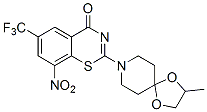
Quality Control
| Related Targets | Integrase Antibiotics Anti-infection Fungal Antiviral COVID-19 Parasite Reverse Transcriptase HIV HCV Protease |
|---|---|
| Other Bacterial Inhibitors | Teicoplanin Pefloxacin Mesylate Ceftiofur Solithromycin 6-Methoxydihydrosanguinarine Proanthocyanidins Flagelin 22 Taurolidine Skatole Berberine Sulfate |
Solubility
|
In vitro |
DMSO
: 22 mg/mL
(50.99 mM)
Water : Insoluble Ethanol : Insoluble |
Molarity Calculator
|
In vivo |
|||||
In vivo Formulation Calculator (Clear solution)
Step 1: Enter information below (Recommended: An additional animal making an allowance for loss during the experiment)
Step 2: Enter the in vivo formulation (This is only the calculator, not formulation. Please contact us first if there is no in vivo formulation at the solubility Section.)
Calculation results:
Working concentration: mg/ml;
Method for preparing DMSO master liquid: mg drug pre-dissolved in μL DMSO ( Master liquid concentration mg/mL, Please contact us first if the concentration exceeds the DMSO solubility of the batch of drug. )
Method for preparing in vivo formulation: Take μL DMSO master liquid, next addμL PEG300, mix and clarify, next addμL Tween 80, mix and clarify, next add μL ddH2O, mix and clarify.
Method for preparing in vivo formulation: Take μL DMSO master liquid, next add μL Corn oil, mix and clarify.
Note: 1. Please make sure the liquid is clear before adding the next solvent.
2. Be sure to add the solvent(s) in order. You must ensure that the solution obtained, in the previous addition, is a clear solution before proceeding to add the next solvent. Physical methods such
as vortex, ultrasound or hot water bath can be used to aid dissolving.
Chemical Information, Storage & Stability
| Molecular Weight | 431.39 | Formula | C17H16F3N3O5S |
Storage (From the date of receipt) | |
|---|---|---|---|---|---|
| CAS No. | 957217-65-1 | Download SDF | Storage of Stock Solutions |
|
|
| Synonyms | N/A | SMILES | CC1COC2(O1)CCN(CC2)C3=NC(=O)C4=C(S3)C(=CC(=C4)C(F)(F)F)[N+](=O)[O-] | ||
Read more about storage stability stock solution CAS number SMILES
Mechanism of Action
| Features |
Greater activity against M. tuberculosis than EMB.
|
|---|---|
| Targets/IC50/Ki |
DprE1
|
| In vitro |
By targeting decaprenylphosphoryl-β-D-ribose 2'-epimerase, BTZ043 abolishes the formation of decaprenylphosphoryl arabinose, leading to cell lysis and death of Mycobacterium tuberculosis. BTZ043 displays similar activity against all clinical isolates of M. tuberculosis, including multidrug-resistant and extensively drug-resistant strains. BTZ043 displays significant activity against M. tuberculosis H37Rv and Mycobacterium smegmatis with MIC of 1 ng/mL (2.3 nM) and 4 ng/mL (9.2 nM), respectively, which is more potent than those of the existing tuberculosis (TB) drugs isoniazid (INH) and ethambutol (EMB) with MIC of 0.02-0.2 μg/mL and 1-5 μg/mL, respectively. BTZ043 is less effective in two different model systems (auxotrophy and starvation) involving metabolically inert M. tuberculosis, indicating that BTZ043 blocks a step in active metabolism similar to isoniazid (INH). BTZ043 treatment in M. smegmatis cells decreases the growth rate rapidly followed by a swelling of the poles and lysis of the cells after a few hours, which is similar but delayed in M. tuberculosis. BTZ043 (1/4 MIC 0.375 ng/mL) in combination with TMC207 (1/4 MIC 20 ng/mL) has a stronger cidal effect on M. tuberculosis but not BTZ-resistant M. tuberculosis mutant than TMC207 alone at a concentration of 80 ng/mL.
|
| In vivo |
In a mouse model of chronic tuberculosis, administration of BTZ043 at 37.5 mg/kg or 300 mg/kg for 4 weeks reduces the bacterial burden in the lungs and spleens by 1 and 2 logs, respectively.
|
References |
|
Tech Support
Tel: +1-832-582-8158 Ext:3
If you have any other enquiries, please leave a message.

Products are for research use only. Not for human use. We do not sell to patients.
©Copyright 2013 Selleck Chemicals. All Rights Reserved.