
-
 Argentina
-
 Australia
-
 Austria
-
 Belgium
-
 Brazil
-
 Canada
-
 China
China
-
 Czech Republic
-
 Denmark
-
 Finland
-
 France
-
 Germany
-
 Greece
-
 Hong Kong
-
 Hungary
-
 Iceland
-
 India
India
-
 Ireland
-
 Israel
-
 Italy
Italy
-
 Japan
Japan
-
 Korea
Korea
-
 Luxembourg
-
 Malaysia
-
 Netherlands
-
 New Zealand
-
 Norway
-
 Poland
-
 Portugal
-
 Qatar
Qatar
-
 Romania
-
 Saudi Arabia
-
 Singapore
-
 Spain
Spain
-
 Sweden
-
 Switzerland
-
 Taiwan
-
 Turkey
-
 United Kingdom
-
 United States
HCV
Other Microbiology Related Inhibitors
| Cat.No. | Product Name | Information | Product Use Citations | Product Validations |
|---|---|---|---|---|
| S8133 | Resiquimod (R-848) | Resiquimod (R-848, S28463) is an immune response modifier that acts as a potent TLR 7/TLR 8 agonist, inducing the upregulation of cytokines such as TNF-α, IL-6 and IFN-α. This compound reduces hepatitis C virus (HCV) infection. Phase 2. |
|
|
| S4434 | Ledipasvir acetone | Ledipasvir (GS-5885) acetone is the active ingredient of Ledipasvir. Ledipasvir is a potent, oral active inhibitor of the hepatitis C virus (HCV) NS5A with EC50 of 31 pM and 4 pM against GT1a and GT1b replicon, respectively. | ||
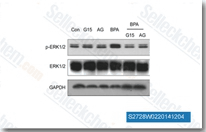
| S2728 | AG-1478 | AG-1478 is a selective EGFR inhibitor with IC50 of 3 nM in cell-free assays, almost no activity on HER2-Neu, PDGFR, Trk, Bcr-Abl and InsR. This compound inhibits encephalomyocarditis virus (EMCV) and hepatitis c virus (HCV) by targeting phosphatidylinositol 4-kinase IIIα (PI4KA). |
|
|
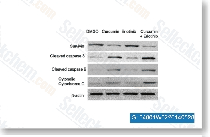
| S1848 | Curcumin (Diferuloylmethane) | Curcumin (Diferuloylmethane, Natural Yellow 3, Turmeric yellow) is the principal curcuminoid of the popular Indian spice turmeric, which is a member of the ginger family (Zingiberaceae). It is an inhibitor of p300 histone acetylatransferase(IC50~25 μM)and Histone deacetylase (HDAC); activates Nrf2 pathway and supresses the activation of NF-κB. Curcumin induces mitophagy, autophagy, apoptosis, and cell cycle arrest with antitumor activity. Curcumin reduces renal damage associated with rhabdomyolysis by decreasing ferroptosis-mediated cell death. Curcumin exhibits anti-infective properties against various human pathogens like the influenza virus, hepatitis C virus, HIV and so on. |
|
|
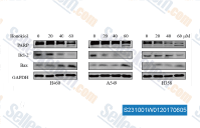
| S2310 | Honokiol | Honokiol is the active principle of magnolia extract that inhibits Akt-phosphorylation and promotes ERK1/2 phosphorylation. This compound causes G0/G1 phase arrest, induces apoptosis, and autophagy via the ROS/ERK1/2 signaling pathway. It inhibits hepatitis C virus (HCV) infection. Phase 3. |
|
|
| S1384 | Mizoribine | Mizoribine is an imidazole nucleoside and an immunosuppressant that inhibits HCV RNA replication with IC50 of ~ 100 μM for anti-HCV activity. This compound is a selective inhibitor of inosine-5'-monophosphate dehydrogenase (IMPDH) and guanosine monophosphate synthetase. It also inhibits SARS-CoV. |
|
|
| S9669 | U-18666A | U18666A (U18) is an inhibitor of intra-cellular cholesterol transport that inhibits dengue virus entry and replication. |
|
|
| S6689 | Merimepodib | Merimepodib (Merimempodib, MMPD, VI-21,497, VX-497) is a potent, specific, and reversible inosine monophosphate dehydrogenase(IMPDH) inhibitor with antiviral activity against hepatitis C virus (HCV) and a variety of DNA and RNA viruses in vitro. This compound is an immunosuppressive agent. |
|
|
| S0349 | Inarigivir soproxil | Inarigivir soproxil (GS 9992, SB 9200) is an oral agonist of innate immunity that is believed to act via the activation of the RIG-I and NOD2 pathways. This compound has broad-spectrum antiviral activity against RNA viruses with EC50 of 2.2 μM and 1.0 μM for HCV 1a and HCV 1b. |
|
|
| E6581 | Mipomersen | Mipomersen (ISIS 301012 free base) is an antisense oligonucleotide inhibitor of apolipoprotein B-100 (apoB-100) that causes selective degradation of apoB-100 mRNA, thereby inhibiting protein translation. This leads to reductions in low-density lipoprotein cholesterol (LDL-C) and other apoB-containing lipoprotein levels. Mipomersen is used as an adjunct treatment for homozygous familial hypercholesterolemia (FH). |

Products are for research use only. Not for human use. We do not sell to patients.
©Copyright 2013 Selleck Chemicals. All Rights Reserved.