
-
 Argentina
-
 Australia
-
 Austria
-
 Belgium
-
 Brazil
-
 Canada
-
 China
China
-
 Czech Republic
-
 Denmark
-
 Finland
-
 France
-
 Germany
-
 Greece
-
 Hong Kong
-
 Hungary
-
 Iceland
-
 India
India
-
 Ireland
-
 Israel
-
 Italy
Italy
-
 Japan
Japan
-
 Korea
Korea
-
 Luxembourg
-
 Malaysia
-
 Netherlands
-
 New Zealand
-
 Norway
-
 Poland
-
 Portugal
-
 Qatar
Qatar
-
 Romania
-
 Saudi Arabia
-
 Singapore
-
 Spain
Spain
-
 Sweden
-
 Switzerland
-
 Taiwan
-
 Turkey
-
 United Kingdom
-
 United States
research use only
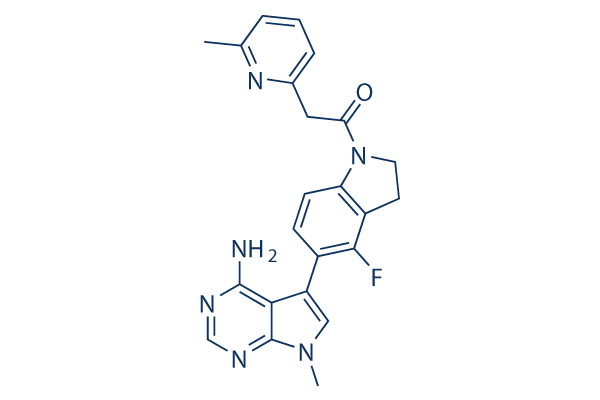
GSK2656157 PERK inhibitor
Cat.No.S7033
Quality Control
| Related Targets | Bcl-2 Caspase PD-1/PD-L1 Ferroptosis p53 Apoptosis related Synthetic Lethality STAT TNF-alpha Ras |
|---|---|
| Other PERK Inhibitors | GSK2606414 ISRIB (trans-isomer) Azoramide CCT020312 BTdCPU Sal003 AMG PERK 44 MK-28 |
Cell Culture, Treatment & Working Concentration
| Cell Lines | Assay Type | Concentration | Incubation Time | Formulation | Activity Description | PMID |
|---|---|---|---|---|---|---|
| human A549 cells | Function assay | 1 h | Inhibition of thapsigargin-induced autophosphorylation of PERK in human A549 cells preincubated for 1 hr followed by thapsigargin-induction measured after 1 hr by Western blotting analysis, IC50=0.03 μM | 24900593 | ||
| Click to View More Cell Line Experimental Data | ||||||
Solubility
|
In vitro |
DMSO
: 10.3 mg/mL
(24.73 mM)
Ethanol : 10 mg/mL Water : Insoluble |
Molarity Calculator
|
In vivo |
|||||
In vivo Formulation Calculator (Clear solution)
Step 1: Enter information below (Recommended: An additional animal making an allowance for loss during the experiment)
Step 2: Enter the in vivo formulation (This is only the calculator, not formulation. Please contact us first if there is no in vivo formulation at the solubility Section.)
Calculation results:
Working concentration: mg/ml;
Method for preparing DMSO master liquid: mg drug pre-dissolved in μL DMSO ( Master liquid concentration mg/mL, Please contact us first if the concentration exceeds the DMSO solubility of the batch of drug. )
Method for preparing in vivo formulation: Take μL DMSO master liquid, next addμL PEG300, mix and clarify, next addμL Tween 80, mix and clarify, next add μL ddH2O, mix and clarify.
Method for preparing in vivo formulation: Take μL DMSO master liquid, next add μL Corn oil, mix and clarify.
Note: 1. Please make sure the liquid is clear before adding the next solvent.
2. Be sure to add the solvent(s) in order. You must ensure that the solution obtained, in the previous addition, is a clear solution before proceeding to add the next solvent. Physical methods such
as vortex, ultrasound or hot water bath can be used to aid dissolving.
Chemical Information, Storage & Stability
| Molecular Weight | 416.45 | Formula | C23H21FN6O |
Storage (From the date of receipt) | |
|---|---|---|---|---|---|
| CAS No. | 1337532-29-2 | Download SDF | Storage of Stock Solutions |
|
|
| Synonyms | N/A | SMILES | CC1=NC(=CC=C1)CC(=O)N2CCC3=C2C=CC(=C3F)C4=CN(C5=NC=NC(=C45)N)C | ||
Read more about storage stability stock solution CAS number SMILES
Mechanism of Action
| Features |
Orally bioavailable PERK-selective inhibitor that functions independent of eIF2α phosphorylation.
|
|---|---|
| Targets/IC50/Ki |
PERK
(Cell-free assay) 0.9 nM
|
| In vitro |
Pretreatment of cells with GSK2656157 results in inhibition of PERK activation as well as decreases in the downstream substrates, phospho-eIF2a, ATF4, and CHOP with an IC50 in the range of 10-30 nM. Cells that are exposed to 1 mM this compound before UPR induction are able to block this effect on de novo protein synthesis. Five of 84 UPR-related genes (DDIT3, HERPUD1, PPP1R15A, C/EBP-beta, and ERN1) are down regulated more than 4-fold by this chemical. In the absence of exogeneous UPR inducers, this compound has no significant effect on the growth of any of these cells with IC50 range of 6–25 mM. Thus, this compound can be used to evaluate the biologic function of PERK in various biologic contexts.
|
| Kinase Assay |
Kinase assay
|
|
Inhibitory potency of GSK2656157 is measured using recombinant GST-PERK (536–1116 amino acids) with 6-His-full-length human eIF2a as a substrate. Kinase selectivity of this compound is evaluated using 27 kinases at GSK as well as a panel of 300 kinases.
|
|
| In vivo |
Complete inhibition of phospho-PERK Thr980 is observed through 8 hours after a single 50 mg/kg oral dose of GSK2656157. Treatment of mice with 50 or 150 mg/kg twice daily dosing of this compound results in dose-dependent inhibition of tumor growth in four models; reaching 54–114% tumor growth inhibition at the 150 mg/kg, twice daily dose. Altered amino acid metabolism, decreased blood vessel density, and vascular perfusion are potential mechanisms for the observed antitumor effect. Treatment of mice with this chemical results in inhibition of tumor growth in multiple human tumor xenografts.
|
References |
Tech Support
Tel: +1-832-582-8158 Ext:3
If you have any other enquiries, please leave a message.

Products are for research use only. Not for human use. We do not sell to patients.
©Copyright 2013 Selleck Chemicals. All Rights Reserved.