
-
 Argentina
-
 Australia
-
 Austria
-
 Belgium
-
 Brazil
-
 Canada
-
 China
China
-
 Czech Republic
-
 Denmark
-
 Finland
-
 France
-
 Germany
-
 Greece
-
 Hong Kong
-
 Hungary
-
 Iceland
-
 India
India
-
 Ireland
-
 Israel
-
 Italy
Italy
-
 Japan
Japan
-
 Korea
Korea
-
 Luxembourg
-
 Malaysia
-
 Netherlands
-
 New Zealand
-
 Norway
-
 Poland
-
 Portugal
-
 Qatar
Qatar
-
 Romania
-
 Saudi Arabia
-
 Singapore
-
 Spain
Spain
-
 Sweden
-
 Switzerland
-
 Taiwan
-
 Turkey
-
 United Kingdom
-
 United States
RIP kinase
Other Apoptosis Related Inhibitors
Isoform-selective Products
| Cat.No. | Product Name | Information | Product Use Citations | Product Validations |
|---|---|---|---|---|
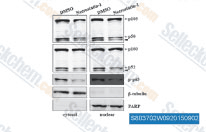
| S8037 | Necrostatin-1 (Nec-1) | Necrostatin-1 (Nec-1) is a specific RIP1 (RIPK1) inhibitor and inhibits TNF-α-induced necroptosis with EC50 of 490 nM in 293T cells. Necrostatin-1 also blocks IDO and suppresses autophagy and apoptosis. |
|
|
| S8641 | Necrostatin 2 racemate (Nec-1s) | Necrostatin 2 racemate (Nec-1s, 7-Cl-O-Nec1, Necrostatin-1 stable, Necrostatin 1S) is a stable variant of Necrostatin-1. This compound is a more specific RIPK1 inhibitor lacking the IDO-targeting effect, with >1000-fold more selective for RIPK1 than for any other kinase out of 485 human kinases. |
|
|
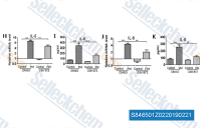
| S8465 | GSK872 | GSK'872 is a potent and selective RIP3 kinase inhibitor which binds RIP3 kinase domain with high affinity (IC50=1.8 nM) and inhibits kinase activity with IC50 of 1.3 nM. It has minimal cross-reactivity. |
|
|
| S9733 | Mito-TEMPO | Mito-TEMPO (MT), a mitochondria-targeted superoxide dismutase mimetic, protects against the early phase of acetaminophen (APAP) hepatotoxicity by inhibiting peroxynitrite formation. Mito-TEMPO treatment inhibits APAP-induced RIP3 kinase expression. |
|
|
| S8642 | GSK'963 | GSK'963 is a chiral small-molecule inhibitor of RIP1 kinase (RIPK1) with an IC50 of 29 nM in FP binding assays. It is >10 000-fold selective for RIP1 over 339 other kinases. |
|
|
| S6511 | RIPA-56 | RIPA-56 is a highly-potent, selective, and metabolically stable RIP1 (RIPK1) inhibitor. |
|
|
| S8484 | GSK2982772 | GSK2982772 is an ATP competitive receptor-interacting protein-1 (RIP1) kinase (RIPK1) inhibitor with the IC50 value of 16 nM. It has exquisite kinase specificity and excellent activity in blocking many TNF-dependent cellular responses. |
|
|
| S8261 | GSK583 | GSK583 is a highly potent and selective inhibitor of RIP2 kinase with IC50 of 5 nM. This compound also inhibits both TNF-α and IL-6 production with IC50 of ~200 nM in explant cultures. |
|
|
| S3238 | Resibufogenin | Resibufogenin (Bufogenin, Recibufogenin), a component of huachansu with anticancer effect, triggers necroptosis through upregulating receptor-interacting protein kinase 3 (RIP3) and phosphorylating mixed lineage kinase domain-like protein at Ser358. This compound exerts cytotoxic effect by inducing reactive oxygen species (ROS) accumulation. It induces apoptosis and caspase-3 and caspase-8 activity. This chemical increases Bax/Bcl-2 expression, and suppresses cyclin D1, cyclin E, PI3K, p-AKT, p-GSK3β and β-catenin protein expression. |
|
|
| S6078 | ICCB-19 hydrochloride | ICCB-19 hydrochloride is an inhibitor of TNFRSF1A Associated Via Death Domain (TRADD) with IC50 of 1.12 μM and 2.01 μM for protecting Velcade-induced apoptosis in Jurkat cells and protecting RDA in MEFs, respectively. ICCB-19 indirectly inhibits Receptor-interacting serine/threonine-protein kinase 1 (RIPK1). ICCB-19 effectively induces autophagy. |
|
|

Products are for research use only. Not for human use. We do not sell to patients.
©Copyright 2013 Selleck Chemicals. All Rights Reserved.