
-
 Argentina
-
 Australia
-
 Austria
-
 Belgium
-
 Brazil
-
 Canada
-
 China
China
-
 Czech Republic
-
 Denmark
-
 Finland
-
 France
-
 Germany
-
 Greece
-
 Hong Kong
-
 Hungary
-
 Iceland
-
 India
India
-
 Ireland
-
 Israel
-
 Italy
Italy
-
 Japan
Japan
-
 Korea
Korea
-
 Luxembourg
-
 Malaysia
-
 Netherlands
-
 New Zealand
-
 Norway
-
 Poland
-
 Portugal
-
 Qatar
Qatar
-
 Romania
-
 Saudi Arabia
-
 Singapore
-
 Spain
Spain
-
 Sweden
-
 Switzerland
-
 Taiwan
-
 Turkey
-
 United Kingdom
-
 United States
Cuproptosis
Other Apoptosis Related Inhibitors
| Cat.No. | Product Name | Information | Product Use Citations | Product Validations |
|---|---|---|---|---|
| S2776 | CPI-613 (Devimistat) | Devimistat (CPI-613), a lipoate analog, inhibits mitochondrial enzymes pyruvate dehydrogenase (PDH) and α-ketoglutarate dehydrogenase in NCI-H460 cell line, disrupts tumor cell mitochondrial metabolism. CPI-613 induces apoptosis in pancreatic cancer cells. Phase 2. |
|
|
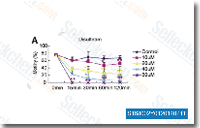
| S1680 | Tetraethylthiuram disulfide (Disulfiram) | Disulfiram is a specific inhibitor of aldehyde-dehydrogenase (ALDH) with IC50 of 0.15 μM and 1.45 μM for hALDH1 and hALDH2, respectively. Disulfiram is used for the treatment of chronic alcoholism by producing an acute sensitivity to alcohol. Disulfiram induces apoptosis. Disulfiram is also an inhibitor of pore formation by gasdermin D (GSDMD). |
|
|
| E1166 | Tetrathiomolybdate (TM) | Tetrathiomolybdate (TM) is used in the clinic for the treatment of Wilson’s disease by inducing dimerization of the metal-binding domain of the cellular copper efflux protein ATP7B (WLN4) through a unique sulfur-bridged Mo2S6O2 cluster. |
|
|
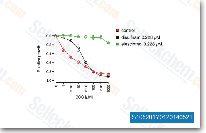
| S1052 | Elesclomol (STA-4783) | Elesclomol (STA-4783) is a novel potent oxidative stress inducer that elicits pro-apoptosis events among tumor cells. Phase 3.Elesclomol specifically binds ferredoxin 1 (FDX1) α2/α3 helices and β5 strand and inhibits FDX1-mediated Fe-S cluster biosynthesis.Elesclomol (STA-4783) is a potent copper ionophore and can be used in the research of copper-dependent cell death (cuproptosis). |
|
|
| S8615 | Sodium Dichloroacetate (DCA) | DCA (Sodium dichloroacetate), a specific inhibitor of pyruvate dehydrogenase kinase (PDK) with IC50 values of 183 and 80 μM for PDK2 and PDK4 respectively, has been shown to derepress Na+-K+-2Cl- cotransporter and a mitochondrial potassium-ion channel axis. Sodium dichloroacetate increases reactive oxygen species (ROS) generation, triggers apoptosis in cancer cells, and inhibits tumor growth. |
|
|
| S2987 | 4-Methyl-2-oxovaleric acid | 4-Methyl-2-oxovaleric acid (Ketoleucine, 4-MOV, KIC, 4-Methyl-2-oxopentanoic acid, alpha-Ketoisocaproic acid, alpha-ketoisocaproate, 2-Oxoisohexanoate) is released by Astrocytes to neurons and can be reaminated by aminotransferase to leucine. 4-Methyl-2-oxovaleric acid reduces the rate of protein degradation in skeletal muscle. 4-Methyl-2-oxovaleric acid acts as an uncoupler of oxidative phosphorylation (OXPHOS) and as a metabolic inhibitor possibly through its inhibitory effect on alpha-ketoglutarate dehydrogenase (oxoglutarate dehydrogenase complex, OGDC) activity. |
|
|
| E4674 | Cu(II)GTSM | Cu(II)GTSM is a potent cell-permeable inhibitor of GSK3β that also inhibits Aβ oligomers and reduces tau phosphorylation. It shows potential as an anticancer and antimicrobial agent and may restore cognitive function by inhibiting neurotoxic Aβ trimers and phosphorylated tau. | ||
| S2949 | KPLH1130 | KPLH1130 is a specific inhibitor of pyruvate dehydrogenase kinase (PDK) that blocks macrophage polarization and attenuates proinflammatory responses. |

Products are for research use only. Not for human use. We do not sell to patients.
©Copyright 2013 Selleck Chemicals. All Rights Reserved.