
-
 Argentina
-
 Australia
-
 Austria
-
 Belgium
-
 Brazil
-
 Canada
-
 China
China
-
 Czech Republic
-
 Denmark
-
 Finland
-
 France
-
 Germany
-
 Greece
-
 Hong Kong
-
 Hungary
-
 Iceland
-
 India
India
-
 Ireland
-
 Israel
-
 Italy
Italy
-
 Japan
Japan
-
 Korea
Korea
-
 Luxembourg
-
 Malaysia
-
 Netherlands
-
 New Zealand
-
 Norway
-
 Poland
-
 Portugal
-
 Qatar
Qatar
-
 Romania
-
 Saudi Arabia
-
 Singapore
-
 Spain
Spain
-
 Sweden
-
 Switzerland
-
 Taiwan
-
 Turkey
-
 United Kingdom
-
 United States
OXPHOS
Other Apoptosis Related Inhibitors
| Cat.No. | Product Name | Information | Product Use Citations | Product Validations |
|---|---|---|---|---|
| S8731 | IACS-010759 (IACS-10759) | IACS-010759 (IACS-10759) is a potent and selective oxidative phosphorylation inhibitor (IC50 < 10 nM) that blocks cellular respiration through inhibition of complex I. |
|
|
| S9736 | ME-344 | ME-344 is a synthetic metabolite of NV-128, a potent inhibitor of mitochondrial oxidative phosphorylation (OXPHOS) complex I, disrupting ATP generation and oxygen consumption. It also inhibits mTOR by downregulating the AKT/mTOR pathway, exhibiting anticancer activity by inhibiting cell growth and viability in leukemia cell lines with IC50 values of 70–260 nM. |
|
|
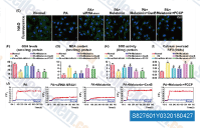
| S8276 | FCCP | FCCP (Trifluoromethoxy carbonylcyanide phenylhydrazone, Carbonyl cyanide 4-(trifluoromethoxy)phenylhydrazone) is a potent uncoupler of oxidative phosphorylation in mitochondria that disrupts ATP synthesis by transporting protons across cell membranes. |
|
|
| S6494 | CCCP (Carbonyl cyanide 3-chlorophenylhydrazone) | CCCP (Carbonyl cyanide m-chlorophenyl hydrazone, Carbonyl cyanide 3-chlorophenylhydrazone), an oxidative phosphorylation inhibitor, is a protonophore mitochondrial uncoupler that increases membrane permeability to protons, leading to a disruption in the mitochondrial membrane potential. Carbonyl cyanide 3-chlorophenylhydrazone (CCCP), the protonophore, can inhibits STING-mediated IFN-β production via disrupting mitochondrial membrane potential (MMP). |
|
|
| S8828 | Gboxin | Gboxin is an inhibitor of oxidative phosphorylation in cancer cells. This compound inhibits the activity of F0F1 ATP synthase. It specifically inhibits the growth of primary mouse and human glioblastoma cells but not that of mouse embryonic fibroblasts or neonatal astrocytes. |
|
|
| S0096 | S-Gboxin | S-Gboxin, a functional analogue of Gboxin, is an oxidative phosphorylation (OXPHOS) inhibitor which inhibits growth of mouse and human glioblastoma (GBM) with IC50 of 470 nM. |
|
|
| S2987 | 4-Methyl-2-oxovaleric acid | 4-Methyl-2-oxovaleric acid (Ketoleucine, 4-MOV, KIC, 4-Methyl-2-oxopentanoic acid, alpha-Ketoisocaproic acid, alpha-ketoisocaproate, 2-Oxoisohexanoate) is released by Astrocytes to neurons and can be reaminated by aminotransferase to leucine. 4-Methyl-2-oxovaleric acid reduces the rate of protein degradation in skeletal muscle. 4-Methyl-2-oxovaleric acid acts as an uncoupler of oxidative phosphorylation (OXPHOS) and as a metabolic inhibitor possibly through its inhibitory effect on alpha-ketoglutarate dehydrogenase (oxoglutarate dehydrogenase complex, OGDC) activity. |
|
|
| S8943 | VLX600 | VLX600 is a novel iron-chelating inhibitor of oxidative phosphorylation (OXPHOS), potentiates the effect of radiation in tumor spheroids in a synergistic manner. This compound shows enhanced cytotoxic activity under conditions of nutrient starvation. It induces autophagy and mitochondrial inhibition with antitumor activity. |
|
|
| E4709 | MS-L6 | MS-L6(Agn-PC-0N3ahi, NSC34338) is a potent inhibitor of OXPHOS, targeting electron transport chain complexes I (ETC-I), combining inhibition of NADH oxidation and uncoupling effect, on the respiratory chain. It exhibits potent antitumor efficacy. | ||
| E5927New | Mito-LND (Mito-Lonidamine) | Mito-LND (Mito-Lonidamine) is a mitochondria-targeted derivative of lonidamine conjugated with a triphenylphosphonium cation that selectively accumulates in cancer cell mitochondria due to their high membrane potential. It potently inhibits oxidative phosphorylation (OXPHOS) by disrupting respiratory complexes I and II, stimulating ROS production and Prx3 oxidation while suppressing AKT/mTOR/p70S6K signaling. | ||

Products are for research use only. Not for human use. We do not sell to patients.
©Copyright 2013 Selleck Chemicals. All Rights Reserved.