
-
 Argentina
-
 Australia
-
 Austria
-
 Belgium
-
 Brazil
-
 Canada
-
 China
China
-
 Czech Republic
-
 Denmark
-
 Finland
-
 France
-
 Germany
-
 Greece
-
 Hong Kong
-
 Hungary
-
 Iceland
-
 India
India
-
 Ireland
-
 Israel
-
 Italy
Italy
-
 Japan
Japan
-
 Korea
Korea
-
 Luxembourg
-
 Malaysia
-
 Netherlands
-
 New Zealand
-
 Norway
-
 Poland
-
 Portugal
-
 Qatar
Qatar
-
 Romania
-
 Saudi Arabia
-
 Singapore
-
 Spain
Spain
-
 Sweden
-
 Switzerland
-
 Taiwan
-
 Turkey
-
 United Kingdom
-
 United States
research use only
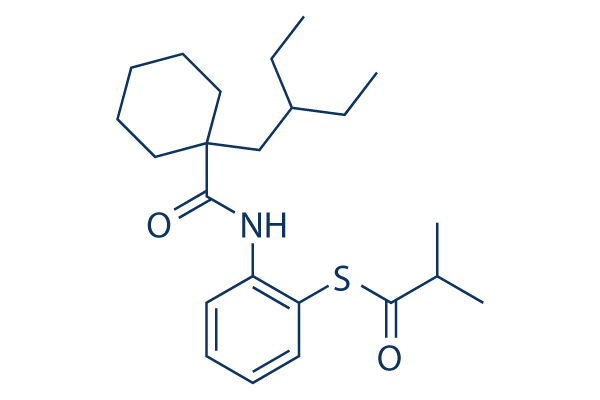
Dalcetrapib (JTT-705) CETP inhibitor
Cat.No.S2772
Quality Control
| Related Targets | Dehydrogenase HSP Transferase P450 (e.g. CYP17) PDE phosphatase PPAR Vitamin Carbohydrate Metabolism Mitochondrial Metabolism |
|---|---|
| Other CETP Inhibitors | Anacetrapib (MK-0859) Torcetrapib Obicetrapib Evacetrapib (LY2484595) |
Solubility
|
In vitro |
DMSO
: 78 mg/mL
(200.21 mM)
Ethanol : 78 mg/mL Water : Insoluble |
Molarity Calculator
|
In vivo |
|||||
In vivo Formulation Calculator (Clear solution)
Step 1: Enter information below (Recommended: An additional animal making an allowance for loss during the experiment)
Step 2: Enter the in vivo formulation (This is only the calculator, not formulation. Please contact us first if there is no in vivo formulation at the solubility Section.)
Calculation results:
Working concentration: mg/ml;
Method for preparing DMSO master liquid: mg drug pre-dissolved in μL DMSO ( Master liquid concentration mg/mL, Please contact us first if the concentration exceeds the DMSO solubility of the batch of drug. )
Method for preparing in vivo formulation: Take μL DMSO master liquid, next addμL PEG300, mix and clarify, next addμL Tween 80, mix and clarify, next add μL ddH2O, mix and clarify.
Method for preparing in vivo formulation: Take μL DMSO master liquid, next add μL Corn oil, mix and clarify.
Note: 1. Please make sure the liquid is clear before adding the next solvent.
2. Be sure to add the solvent(s) in order. You must ensure that the solution obtained, in the previous addition, is a clear solution before proceeding to add the next solvent. Physical methods such
as vortex, ultrasound or hot water bath can be used to aid dissolving.
Chemical Information, Storage & Stability
| Molecular Weight | 389.59 | Formula | C23H35NO2S |
Storage (From the date of receipt) | |
|---|---|---|---|---|---|
| CAS No. | 211513-37-0 | Download SDF | Storage of Stock Solutions |
|
|
| Synonyms | RO4607381 | SMILES | CCC(CC)CC1(CCCCC1)C(=O)NC2=CC=CC=C2SC(=O)C(C)C | ||
Read more about storage stability stock solution CAS number SMILES
Mechanism of Action
| Targets/IC50/Ki |
rhCETP
0.2 μM
|
|---|---|
| In vitro |
Dalcetrapib (JTT-705) modulates CETP activity and induces a conformational change in CETP when added to human plasma. CETP-induced pre-β-HDL formation in human plasma is unchanged by this compound at ≤3 µM and increased at 10 µM. It statistically and significantly increases pre-β-HDL formation. Dalcetrapib achieves 50% inhibition of CETP activity in human plasma at a concentration of 9 μM. It also inhibits the CETP activity of media in HepG2 in a dose-dependent manner.
|
| Kinase Assay |
Inhibition of rhCETP and C13S CETP-mediated transfer of CE from HDL to LDL
|
|
The inhibitory potency (IC50) of Dalcetrapib (JTT-705) to decrease CE transfer from HDL to LDL by rhCETP and C13S CETP is measured using a scintillation proximity assay kit. Briefly, [3H]CE-labeled HDL donor particles are incubated in the presence of purified CETP proteins (final concentration 0.5 µg/mL) and biotinylated LDL acceptor particles for 3 hours at 37 °C. Subsequently, streptavidin-coupled polyvinyltoluene beads containing liquid scintillation cocktail binding selectively to biotinylated LDL are added, and the amount of [3H]CE molecules transferred to LDL is measured by β counting.
|
|
| In vivo |
Treatment with Dalcetrapib (JTT-705) leads to significant increases in HDL-C levels. In hamsters injected with [3H]cholesterol-labeled autologous macrophages, it significantly increases fecal elimination of both [3H]neutral sterols and [3H]bile acids. This compound also increases plasma HDL-[3H]cholesterol. It has 95% inhibition of CETP activity in male Japanese white rabbits at an oral dose of 30 mg/kg. When given at oral doses of 30 mg/kg or 100 mg/kg once a day for 3 days to male Japanese white rabbits, it increases the plasma HDL cholesterol level by 27% and 54%, respectively. Treatment with this compound markedly increases serum levels of HDL-C. The ratio of HDL2-C to HDL3-C is significantly higher in Dalcetrapib–treated rabbits than in control rabbits at 5 and 7 months, indicating that the inhibition of CETP activity by it changes the distribution of HDL subfractions and preferentially increases HDL2-C levels. Its treatment increases serum paraoxonase activity and HDL-associated platelet-activating factor acetylhydrolase activity, but decreases the plasma lysophosphatidylcholine concentration.
|
References |
|
Clinical Trial Information
(data from https://clinicaltrials.gov, updated on 2024-05-22)
| NCT Number | Recruitment | Conditions | Sponsor/Collaborators | Start Date | Phases |
|---|---|---|---|---|---|
| NCT04676867 | Completed | Covid19 |
DalCor Pharmaceuticals|The Montreal Health Innovations Coordinating Center (MHICC)|Covance |
2021-01-11 | Phase 2 |
| NCT01363999 | Completed | Healthy Volunteer |
Hoffmann-La Roche |
2011-06 | Phase 1 |
Read more about Clinical Trials
Tech Support
Tel: +1-832-582-8158 Ext:3
If you have any other enquiries, please leave a message.
Signaling Pathway Map

Products are for research use only. Not for human use. We do not sell to patients.
©Copyright 2013 Selleck Chemicals. All Rights Reserved.