
-
 Argentina
-
 Australia
-
 Austria
-
 Belgium
-
 Brazil
-
 Canada
-
 China
China
-
 Czech Republic
-
 Denmark
-
 Finland
-
 France
-
 Germany
-
 Greece
-
 Hong Kong
-
 Hungary
-
 Iceland
-
 India
India
-
 Ireland
-
 Israel
-
 Italy
Italy
-
 Japan
Japan
-
 Korea
Korea
-
 Luxembourg
-
 Malaysia
-
 Netherlands
-
 New Zealand
-
 Norway
-
 Poland
-
 Portugal
-
 Qatar
Qatar
-
 Romania
-
 Saudi Arabia
-
 Singapore
-
 Spain
Spain
-
 Sweden
-
 Switzerland
-
 Taiwan
-
 Turkey
-
 United Kingdom
-
 United States
research use only
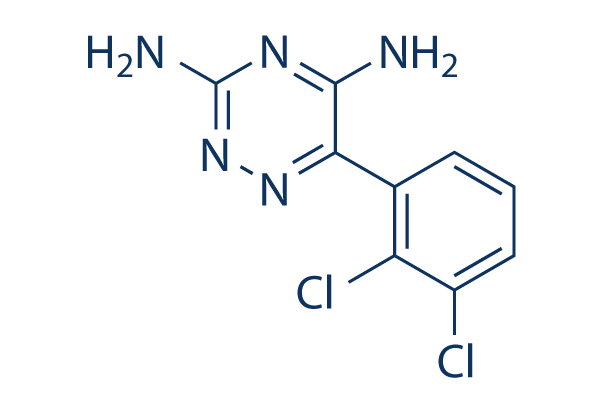
Lamotrigine Sodium Channel inhibitor
Cat.No.S3024
Quality Control
| Related Targets | CFTR CRM1 CD markers AChR Calcium Channel Potassium Channel GABA Receptor TRP Channel ATPase GluR |
|---|---|
| Other Sodium Channel Inhibitors | Camostat Mesilate A-803467 cariporide GS967 Veratramine Tolperisone HCl Bulleyaconi cine A Vinpocetine Tenapanor PF-06869206 |
Solubility
|
In vitro |
DMSO
: 10 mg/mL
(39.04 mM)
Ethanol : 3 mg/mL Water : Insoluble |
Molarity Calculator
|
In vivo |
|||||
In vivo Formulation Calculator (Clear solution)
Step 1: Enter information below (Recommended: An additional animal making an allowance for loss during the experiment)
Step 2: Enter the in vivo formulation (This is only the calculator, not formulation. Please contact us first if there is no in vivo formulation at the solubility Section.)
Calculation results:
Working concentration: mg/ml;
Method for preparing DMSO master liquid: mg drug pre-dissolved in μL DMSO ( Master liquid concentration mg/mL, Please contact us first if the concentration exceeds the DMSO solubility of the batch of drug. )
Method for preparing in vivo formulation: Take μL DMSO master liquid, next addμL PEG300, mix and clarify, next addμL Tween 80, mix and clarify, next add μL ddH2O, mix and clarify.
Method for preparing in vivo formulation: Take μL DMSO master liquid, next add μL Corn oil, mix and clarify.
Note: 1. Please make sure the liquid is clear before adding the next solvent.
2. Be sure to add the solvent(s) in order. You must ensure that the solution obtained, in the previous addition, is a clear solution before proceeding to add the next solvent. Physical methods such
as vortex, ultrasound or hot water bath can be used to aid dissolving.
Chemical Information, Storage & Stability
| Molecular Weight | 256.09 | Formula | C9H7Cl2N5 |
Storage (From the date of receipt) | |
|---|---|---|---|---|---|
| CAS No. | 84057-84-1 | Download SDF | Storage of Stock Solutions |
|
|
| Synonyms | BW-430C,LTG | SMILES | C1=CC(=C(C(=C1)Cl)Cl)C2=C(N=C(N=N2)N)N | ||
Read more about storage stability stock solution CAS number SMILES
Mechanism of Action
| Targets/IC50/Ki |
Sodium channel
5-HT (human platelets)
240 μM
5-HT (rat brain synaptosomes)
474 μM
|
|---|---|
| In vitro |
Lamotrigine stabilises presynaptic neuronal membranes by blockade of voltage-dependent sodium channels, thus preventing the release of excitatory neurotransmitters, particularly glutamate and aspartate. In rat cerebral cortex tissue incubated with veratrine 10 mg/L, this compound is twice as potent in inhibiting the release of glutamate and aspartate (ED 50 = 5.38 mg/L for each) than the release of GABA (ED50 = 11.2 mg/L), and is much less potent in inhibiting acetylcholine release (ED50 = 25.6 mg/L) when cortical slices is exposed to veratrine 75 mg/L. Basal glutamate release is unaffected . This chemical inhibits high-frequency sustained repetitive firing of sodium-dependent action potentials, indicating a direct effect on voltage-activated sodium channels. It does not induce PCP-like central nervous system (CNS) effects, does not act by direct inhibition at the NMDA receptor, and would be expected to be devoid of the undesirable effects associated with NMDA blockade. |
| In vivo |
In mice and rats, lamotrigine prevents MES- and pentetrazol-induced hindlimb extension, suggesting an antiepileptic profile in animals. These effects peak 1 hour after this compound administration and persist for more than 24 hours. This chemical is active in the electrically evoked EEG after-discharge test, which is thought to indicate activity against both simple and complex partial seizures. After-discharge duration is reduced dose-dependently by this compound in rats at intravenous doses >5 mg/kg. |
References |
|
Clinical Trial Information
(data from https://clinicaltrials.gov, updated on 2026-08-25)
| NCT Number | Recruitment | Conditions | Sponsor/Collaborators | Start Date | Phases |
|---|---|---|---|---|---|
| NCT06929273 | RECRUITING | Bipolar Disorder Type I With Mania |
Bristol-Myers Squibb |
2025-07-18 | PHASE3 |
| NCT06184581 | RECRUITING | Bipolar II Disorder |
University Hospital Bispebjerg and Frederiksberg |
2024-05-08 | PHASE4 |
| NCT07140913 | RECRUITING | Mania; Bipolar Disorder |
Bristol-Myers Squibb |
2025-10-08 | PHASE3 |
| NCT06729970 | COMPLETED | Healthy Volunteers |
Karuna Therapeutics, Inc., a Bristol Myers Squibb company |
2024-12-26 | PHASE1 |
| NCT05881928 | UNKNOWN | Epilepsy; Lamotrigine; Sodium Valproate Adverse Reaction |
Assiut University |
2024-07-29 | PHASE4 |
| NCT05420350 | UNKNOWN | Meniere Disease; Ménière's Vertigo; Vertigo, Intermittent; Vertigo, Aural |
Dent Neuroscience Research Center |
2020-12-16 | PHASE2 |
Read more about Clinical Trials
Tech Support
Tel: +1-832-582-8158 Ext:3
If you have any other enquiries, please leave a message.
Signaling Pathway Map

Products are for research use only. Not for human use. We do not sell to patients.
©Copyright 2013 Selleck Chemicals. All Rights Reserved.