
-
 Argentina
-
 Australia
-
 Austria
-
 Belgium
-
 Brazil
-
 Canada
-
 China
China
-
 Czech Republic
-
 Denmark
-
 Finland
-
 France
-
 Germany
-
 Greece
-
 Hong Kong
-
 Hungary
-
 Iceland
-
 India
India
-
 Ireland
-
 Israel
-
 Italy
Italy
-
 Japan
Japan
-
 Korea
Korea
-
 Luxembourg
-
 Malaysia
-
 Netherlands
-
 New Zealand
-
 Norway
-
 Poland
-
 Portugal
-
 Qatar
Qatar
-
 Romania
-
 Saudi Arabia
-
 Singapore
-
 Spain
Spain
-
 Sweden
-
 Switzerland
-
 Taiwan
-
 Turkey
-
 United Kingdom
-
 United States
research use only
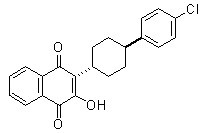
Atovaquone Fungal inhibitor
Cat.No.S3079
Quality Control
| Related Targets | Integrase Bacterial Antibiotics Anti-infection Antiviral COVID-19 Parasite Reverse Transcriptase HIV HCV Protease |
|---|---|
| Other Fungal Inhibitors | Cycloheximide Tolnaftate Manogepix (E1210) Amorolfine HCl Isavuconazole Juglone Bifonazole Thimerosal Pseudolaric Acid B Butylparaben |
Solubility
|
In vitro |
DMSO
: 11 mg/mL
(29.98 mM)
Water : Insoluble Ethanol : Insoluble |
Molarity Calculator
|
In vivo |
|||||
In vivo Formulation Calculator (Clear solution)
Step 1: Enter information below (Recommended: An additional animal making an allowance for loss during the experiment)
Step 2: Enter the in vivo formulation (This is only the calculator, not formulation. Please contact us first if there is no in vivo formulation at the solubility Section.)
Calculation results:
Working concentration: mg/ml;
Method for preparing DMSO master liquid: mg drug pre-dissolved in μL DMSO ( Master liquid concentration mg/mL, Please contact us first if the concentration exceeds the DMSO solubility of the batch of drug. )
Method for preparing in vivo formulation: Take μL DMSO master liquid, next addμL PEG300, mix and clarify, next addμL Tween 80, mix and clarify, next add μL ddH2O, mix and clarify.
Method for preparing in vivo formulation: Take μL DMSO master liquid, next add μL Corn oil, mix and clarify.
Note: 1. Please make sure the liquid is clear before adding the next solvent.
2. Be sure to add the solvent(s) in order. You must ensure that the solution obtained, in the previous addition, is a clear solution before proceeding to add the next solvent. Physical methods such
as vortex, ultrasound or hot water bath can be used to aid dissolving.
Chemical Information, Storage & Stability
| Molecular Weight | 366.84 | Formula | C22H19ClO3 |
Storage (From the date of receipt) | |
|---|---|---|---|---|---|
| CAS No. | 95233-18-4 | Download SDF | Storage of Stock Solutions |
|
|
| Synonyms | Atavaquone | SMILES | C1CC(CCC1C2=CC=C(C=C2)Cl)C3=C(C4=CC=CC=C4C(=O)C3=O)O | ||
Read more about storage stability stock solution CAS number SMILES
Mechanism of Action
| In vitro |
Atovaquone (atavaquone) is a chemical compound that belongs to the class of naphthalenes. This compound is a hydroxy-1,4-naphthoquinone, an analog of ubiquinone, with antipneumocystic activity. It is an anti-protozoal mitochondrial electron transport inhibitor; Antimalarial; Antipneumocystic, and has also been used to treat toxoplasmosis. This chemical acts by inhibiting the cytochrome bc(1) complex via interactions with the Rieske iron-sulfur protein and cytochrome b in the ubiquinol oxidation pocket.
|
|---|---|
| In vivo |
Atovaquone is a unique naphthoquinone with broad-spectrum antiprotozoal activity. It is effective for the treatment and prevention of Pneumocystis carinii pneumonia (PCP), this compound is effective in combination with proguanil for the treatment and prevention of malaria, and it is effective in combination with azithromycin for the treatment of babesiosis.
|
References |
|
Clinical Trial Information
(data from https://clinicaltrials.gov, updated on 2026-01-21)
| NCT Number | Recruitment | Conditions | Sponsor/Collaborators | Start Date | Phases |
|---|---|---|---|---|---|
| NCT07357103 | NOT_YET_RECRUITING | Pneumocystis; Pneumocystis Infection; Pneumocystis Carinii Infection; Pneumocystis Carinii; Infection, Resulting From HIV Disease; Pneumocystis Jirovecii Pneumonia; Pneumocystis Jirovecii Infection; Pneumocystosis Associated With AIDS; Pneumocystosis; Pneumonia (Etiology) |
McGill University Health Centre/Research Institute of the McGill University Health Centre |
2026-03 | PHASE4 |
| NCT06624371 | RECRUITING | High-grade Glioma; Medulloblastoma; Diffuse Intrinsic Pontine Glioma; Diffuse Midline Glioma, H3 K27M-Mutant |
Emory University |
2025-03-28 | PHASE1 |
| NCT05998135 | RECRUITING | Ovarian High Grade Serous Adenocarcinoma; Platinum-Resistant Ovarian Carcinoma |
Emory University |
2023-11-09 | PHASE2 |
| NCT06294912 | COMPLETED | Malaria |
Merck Sharp & Dohme LLC |
2024-04-18 | PHASE1 |
| NCT05974267 | COMPLETED | Malaria Infection |
Merck Healthcare KGaA, Darmstadt, Germany, an affiliate of Merck KGaA, Darmstadt, Germany |
2023-11-28 | PHASE2 |
| NCT04648033 | COMPLETED | Locally Advanced Non-Small Cell Lung Cancer |
University of Oxford |
2020-12-07 | PHASE1 |
Read more about Clinical Trials
Tech Support
Tel: +1-832-582-8158 Ext:3
If you have any other enquiries, please leave a message.

Products are for research use only. Not for human use. We do not sell to patients.
©Copyright 2013 Selleck Chemicals. All Rights Reserved.