
-
 Argentina
-
 Australia
-
 Austria
-
 Belgium
-
 Brazil
-
 Canada
-
 China
China
-
 Czech Republic
-
 Denmark
-
 Finland
-
 France
-
 Germany
-
 Greece
-
 Hong Kong
-
 Hungary
-
 Iceland
-
 India
India
-
 Ireland
-
 Israel
-
 Italy
Italy
-
 Japan
Japan
-
 Korea
Korea
-
 Luxembourg
-
 Malaysia
-
 Netherlands
-
 New Zealand
-
 Norway
-
 Poland
-
 Portugal
-
 Qatar
Qatar
-
 Romania
-
 Saudi Arabia
-
 Singapore
-
 Spain
Spain
-
 Sweden
-
 Switzerland
-
 Taiwan
-
 Turkey
-
 United Kingdom
-
 United States
research use only
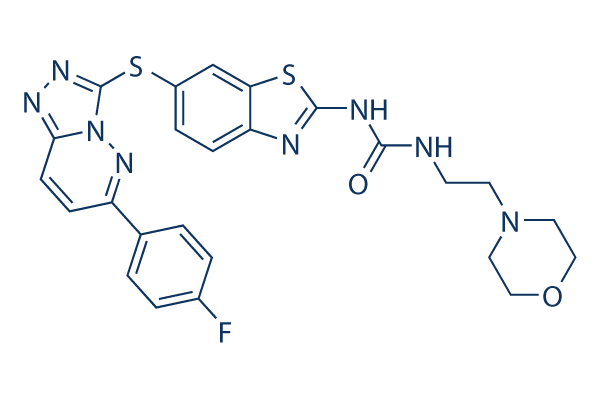
SAR125844 c-Met inhibitor
Cat.No.S7564
Quality Control
| Related Targets | EGFR VEGFR FGFR PDGFR Src MEK CSF-1R FLT3 HER2 c-Kit |
|---|---|
| Other c-Met Inhibitors | Tepotinib (EMD-1214063) Dihexa SGX-523 PHA-665752 Foretinib (GSK1363089, XL880) SU11274 BMS-777607 JNJ-38877605 Tivantinib PF-04217903 |
Solubility
|
In vitro |
DMSO
: 11 mg/mL
(19.97 mM)
Water : ˂1 mg/mL Ethanol : ˂1 mg/mL |
Molarity Calculator
|
In vivo |
|||||
In vivo Formulation Calculator (Clear solution)
Step 1: Enter information below (Recommended: An additional animal making an allowance for loss during the experiment)
Step 2: Enter the in vivo formulation (This is only the calculator, not formulation. Please contact us first if there is no in vivo formulation at the solubility Section.)
Calculation results:
Working concentration: mg/ml;
Method for preparing DMSO master liquid: mg drug pre-dissolved in μL DMSO ( Master liquid concentration mg/mL, Please contact us first if the concentration exceeds the DMSO solubility of the batch of drug. )
Method for preparing in vivo formulation: Take μL DMSO master liquid, next addμL PEG300, mix and clarify, next addμL Tween 80, mix and clarify, next add μL ddH2O, mix and clarify.
Method for preparing in vivo formulation: Take μL DMSO master liquid, next add μL Corn oil, mix and clarify.
Note: 1. Please make sure the liquid is clear before adding the next solvent.
2. Be sure to add the solvent(s) in order. You must ensure that the solution obtained, in the previous addition, is a clear solution before proceeding to add the next solvent. Physical methods such
as vortex, ultrasound or hot water bath can be used to aid dissolving.
Chemical Information, Storage & Stability
| Molecular Weight | 550.63 | Formula | C25H23FN8O2S2 |
Storage (From the date of receipt) | 3 years -20°C powder |
|---|---|---|---|---|---|
| CAS No. | 1116743-46-4 | -- | Storage of Stock Solutions |
|
|
| Synonyms | N/A | SMILES | C1COCCN1CCNC(=O)NC2=NC3=C(S2)C=C(C=C3)SC4=NN=C5N4N=C(C=C5)C6=CC=C(C=C6)F | ||
Read more about storage stability stock solution CAS number SMILES
Mechanism of Action
| Targets/IC50/Ki |
MET H1094Y
(Cell-free assay) 0.22 nM
MET Y1235D
(Cell-free assay) 1.7 nM
WT MET
(Cell-free assay) 4.2 nM
MET M1250T
(Cell-free assay) 6.5 nM
TRKA/NTRK1
(Cell-free assay) 39 nM
PDGFRα-V561D
(Cell-free assay) 55 nM
MET L1195V
(Cell-free assay) 65 nM
MET D1228H
(Cell-free assay) 81 nM
AXL
(Cell-free assay) 87 nM
MER
(Cell-free assay) 105 nM
MET Y1230H
(Cell-free assay) 204 nM
|
|---|---|
| In vitro |
SAR125844 is an ATP-competitive and reversible inhibitor. The biochemical selectivity of this compound is documented in a panel of 275 human kinases and against tubulin. It is moderately active on RON, a close structural homolog of MET, with IC50 value of approximately 740 nmol/L, suggesting that this inhibitor is highly (>100-fold) selective for the MET kinase over RON. Minimal inhibitory activity is identified on 5 additional kinases with IC50 values below 300 nmol/L, including TRKA/NTRK1 (39 nmol/L), TRKB/NTRK2 (280 nmol/L), PDGFRα-V561D (55 nmol/L), AXL (87 nmol/L), and MER (105 nmol/L). Biochemical activities on Aurora A and Aurora B are detected with IC50 values of 320 and 820 nmol/L, respectively, but these activities do not translate into cellular activity as demonstrated by the lack of antiproliferative activity in tumor cell lines without MET gene amplification. No activity on tubulin is detected up to 25 μmol/L of this chemical. It inhibits MET autophosphorylation in cell-based assays in the nanomolar range, and promotes low nanomolar proapoptotic and antiproliferative activities selectively in cell lines with MET gene amplification or pathway addiction. |
| In vivo |
In PK studies in mice, the oral bioavailability of SAR125844 is low (∼2%), in line with its moderate Caco-2 permeability. In female SCID mice bearing xenograft tumors based on the MET-amplified Hs 746T human gastric tumor cell line, a single intravenous administration at 20 mg/kg is performed. plasma exposure of this compound (area under the curve (AUC)) is 6190 h·ng/mL, the clearance moderate (CL = 3.1 L/h/kg), and the volume of distribution is large (Vss = 4.2 L/kg). A rapid and sustained uptake of this chemical in tumor tissue is observed, associated with a slower decrease of concentration from tumor tissue compared to the plasma concentration. The clearances of this agent in mice, rats, and dogs are moderate. The plasma terminal elimination half-life (t1/2) is moderate (rats and dogs) to long (mice). The volume of distribution at steady state is moderate in dogs and large in rodents. In two MET-amplified human gastric tumor xenograft models, SNU-5 and Hs 746T, intravenous treatment with this compound leads to potent, dose- and time-dependent inhibition of the MET kinase and to significant impact on downstream PI3K/AKT and RAS/MAPK pathways. Daily or every-2-days intravenous treatment of this chemical promots a dose-dependent tumor regression in MET-amplified human gastric cancer models at tolerated doses without treatment-related body weight loss. |
References |
|
Clinical Trial Information
(data from https://clinicaltrials.gov, updated on 2024-05-22)
| NCT Number | Recruitment | Conditions | Sponsor/Collaborators | Start Date | Phases |
|---|---|---|---|---|---|
| NCT02435121 | Completed | Neoplasm Malignant |
Sanofi |
2015-11 | Phase 2 |
| NCT01657214 | Completed | Neoplasm Malignant |
Sanofi |
2012-09 | Phase 1 |
| NCT01391533 | Completed | Malignant Solid Tumors |
Sanofi |
2011-07 | Phase 1 |
Read more about Clinical Trials
Tech Support
Tel: +1-832-582-8158 Ext:3
If you have any other enquiries, please leave a message.
Signaling Pathway Map

Products are for research use only. Not for human use. We do not sell to patients.
©Copyright 2013 Selleck Chemicals. All Rights Reserved.