
-
 Argentina
-
 Australia
-
 Austria
-
 Belgium
-
 Brazil
-
 Canada
-
 China
China
-
 Czech Republic
-
 Denmark
-
 Finland
-
 France
-
 Germany
-
 Greece
-
 Hong Kong
-
 Hungary
-
 Iceland
-
 India
India
-
 Ireland
-
 Israel
-
 Italy
Italy
-
 Japan
Japan
-
 Korea
Korea
-
 Luxembourg
-
 Malaysia
-
 Netherlands
-
 New Zealand
-
 Norway
-
 Poland
-
 Qatar
Qatar
-
 Romania
-
 Saudi Arabia
-
 Singapore
-
 Spain
Spain
-
 Sweden
-
 Switzerland
-
 Taiwan
-
 Turkey
-
 United Kingdom
-
 United States
research use only
SGX-523 c-Met inhibitor
Cat.No.S1112
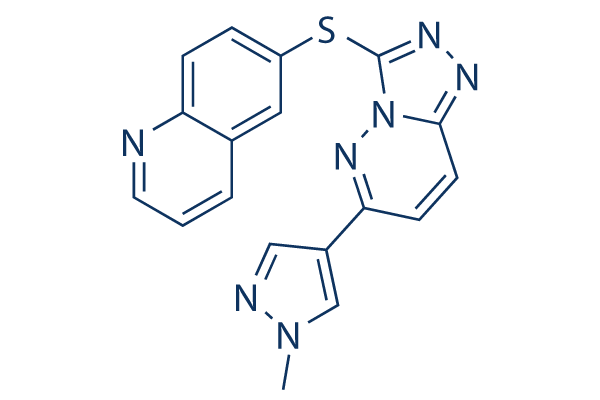
Chemical Structure
Molecular Weight: 359.41
Quality Control
| Related Targets | EGFR VEGFR FGFR PDGFR Src MEK CSF-1R FLT3 HER2 c-Kit |
|---|---|
| Other c-Met Inhibitors | Tepotinib (EMD-1214063) Dihexa PHA-665752 Foretinib (GSK1363089, XL880) SU11274 BMS-777607 JNJ-38877605 Tivantinib PF-04217903 Savolitinib (AZD6094) |
Solubility
|
In vitro |
DMSO
: 2 mg/mL
(5.56 mM)
Water : Insoluble Ethanol : Insoluble |
Molarity Calculator
|
In vivo |
|||||
In vivo Formulation Calculator (Clear solution)
Step 1: Enter information below (Recommended: An additional animal making an allowance for loss during the experiment)
Step 2: Enter the in vivo formulation (This is only the calculator, not formulation. Please contact us first if there is no in vivo formulation at the solubility Section.)
Calculation results:
Working concentration: mg/ml;
Method for preparing DMSO master liquid: mg drug pre-dissolved in μL DMSO ( Master liquid concentration mg/mL, Please contact us first if the concentration exceeds the DMSO solubility of the batch of drug. )
Method for preparing in vivo formulation: Take μL DMSO master liquid, next addμL PEG300, mix and clarify, next addμL Tween 80, mix and clarify, next add μL ddH2O, mix and clarify.
Method for preparing in vivo formulation: Take μL DMSO master liquid, next add μL Corn oil, mix and clarify.
Note: 1. Please make sure the liquid is clear before adding the next solvent.
2. Be sure to add the solvent(s) in order. You must ensure that the solution obtained, in the previous addition, is a clear solution before proceeding to add the next solvent. Physical methods such
as vortex, ultrasound or hot water bath can be used to aid dissolving.
Chemical Information, Storage & Stability
| Molecular Weight | 359.41 | Formula | C18H13N7S |
Storage (From the date of receipt) | |
|---|---|---|---|---|---|
| CAS No. | 1022150-57-7 | Download SDF | Storage of Stock Solutions |
|
|
| Synonyms | N/A | Smiles | CN1C=C(C=N1)C2=NN3C(=NN=C3SC4=CC5=C(C=C4)N=CC=C5)C=C2 | ||
Mechanism of Action
| Targets/IC50/Ki |
c-Met
(Cell-free assay) 4 nM
|
|---|---|
| In vitro |
SGX-523 belongs to the class of c-Met/hepatocyte growth factor receptor (HGFR) tyrosine kinase inhibitors. This compound stabilizes MET in a unique inactive conformation that is inaccessible to other protein kinases, suggesting an explanation for its selectivity. It potently inhibits the purified MET catalytic domain but not the closely related receptor tyrosine kinase RON. This chemical indicates ATP-competitive inhibition with higher apparent affinity for the less active, unphosphorylated form of MET [MET-KD(0P), with a Ki of 2.7 nM] versus the more active phospho-enzyme [MET-KD(3P), with a Ki of 23 nM], a phenomenon consistent with preferential binding to an inactive enzyme conformation. It inhibits MET-mediated signaling, cell proliferation and cell migration at nanomolar concentrations but had no effect on signaling dependent on other protein kinases, including the closely related RON, even at micromolar concentrations.
|
| Kinase Assay |
Kinase assays
|
|
Initial rate constants are measured at 21 °C in the presence of 100 mM HEPES (pH 7.5), 0.3 mg/mL poly(Glu-Tyr) peptide substrate, 10 mM MgCl2, 1 mg/mL bovine serum albumin, 5% DMSO, 20 nM MET-KD and various concentrations of ATP and SGX523. Total reaction volumes (20 μL) are quenched with 20 μL Kinase-Glo detection buffer. Luminescence is detected in a plate-reading luminometer and the results are analyzed by nonlinear regression.
|
|
| In vivo |
SGX523 significantly retards the growth of preestablished GTL16 tumors when administered orally at doses of ≥10 mg/kg twice daily. This compound potently inhibits U87MG tumor growth; at 30 mg/kg dosed twice daily, it leads to clear regression of U87MG tumors. This chemical, dosed twice daily at 30 mg/kg, also retards the growth of H441 tumors with concomitant reduction in tumor MET autophosphorylation levels. Its inhibition of MET in vivo is associated with the dose-dependent inhibition of growth of tumor xenografts derived from human glioblastoma, lung and gastric cancers, confirming the dependence of these tumors on MET catalytic activity.
|
References |
Tech Support
Tel: +1-832-582-8158 Ext:3
If you have any other enquiries, please leave a message.
Signaling Pathway Map

Products are for research use only. Not for human use. We do not sell to patients.
©Copyright 2013 Selleck Chemicals. All Rights Reserved.