
-
 Argentina
-
 Australia
-
 Austria
-
 Belgium
-
 Brazil
-
 Canada
-
 China
China
-
 Czech Republic
-
 Denmark
-
 Finland
-
 France
-
 Germany
-
 Greece
-
 Hong Kong
-
 Hungary
-
 Iceland
-
 India
India
-
 Ireland
-
 Israel
-
 Italy
Italy
-
 Japan
Japan
-
 Korea
Korea
-
 Luxembourg
-
 Malaysia
-
 Netherlands
-
 New Zealand
-
 Norway
-
 Poland
-
 Portugal
-
 Qatar
Qatar
-
 Romania
-
 Saudi Arabia
-
 Singapore
-
 Spain
Spain
-
 Sweden
-
 Switzerland
-
 Taiwan
-
 Turkey
-
 United Kingdom
-
 United States
research use only
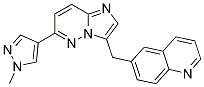
NVP-BVU972 c-Met inhibitor
Cat.No.S2761
Quality Control
| Related Targets | EGFR VEGFR FGFR PDGFR Src MEK CSF-1R FLT3 HER2 c-Kit |
|---|---|
| Other c-Met Inhibitors | Tepotinib (EMD-1214063) Dihexa SGX-523 PHA-665752 Foretinib (GSK1363089, XL880) SU11274 BMS-777607 JNJ-38877605 Tivantinib PF-04217903 |
Solubility
|
In vitro |
DMSO
: 68 mg/mL
(199.77 mM)
Ethanol : 68 mg/mL Water : Insoluble |
Molarity Calculator
|
In vivo |
|||||
In vivo Formulation Calculator (Clear solution)
Step 1: Enter information below (Recommended: An additional animal making an allowance for loss during the experiment)
Step 2: Enter the in vivo formulation (This is only the calculator, not formulation. Please contact us first if there is no in vivo formulation at the solubility Section.)
Calculation results:
Working concentration: mg/ml;
Method for preparing DMSO master liquid: mg drug pre-dissolved in μL DMSO ( Master liquid concentration mg/mL, Please contact us first if the concentration exceeds the DMSO solubility of the batch of drug. )
Method for preparing in vivo formulation: Take μL DMSO master liquid, next addμL PEG300, mix and clarify, next addμL Tween 80, mix and clarify, next add μL ddH2O, mix and clarify.
Method for preparing in vivo formulation: Take μL DMSO master liquid, next add μL Corn oil, mix and clarify.
Note: 1. Please make sure the liquid is clear before adding the next solvent.
2. Be sure to add the solvent(s) in order. You must ensure that the solution obtained, in the previous addition, is a clear solution before proceeding to add the next solvent. Physical methods such
as vortex, ultrasound or hot water bath can be used to aid dissolving.
Chemical Information, Storage & Stability
| Molecular Weight | 340.38 | Formula | C20H16N6 |
Storage (From the date of receipt) | |
|---|---|---|---|---|---|
| CAS No. | 1185763-69-2 | Download SDF | Storage of Stock Solutions |
|
|
| Synonyms | N/A | SMILES | CN1C=C(C=N1)C2=NN3C(=NC=C3CC4=CC5=C(C=C4)N=CC=C5)C=C2 | ||
Read more about storage stability stock solution CAS number SMILES
Mechanism of Action
| Targets/IC50/Ki |
Met
14 nM
|
|---|---|
| In vitro |
NVP-BVU972 potently inhibits MET kinase but displays low inhibition against other kinases including the most closely related kinase RON with IC50 values of more than 1000 nM. This compound also suppresses constitutive MET phosphorylation in GTL-16 cells or HGF-stimulated MET phosphorylation in A549 cells with IC50 values of 7.3 nM and 22 nM, respectively. It potently prevents the growth of the MET gene amplified cell lines GTL-16, MKN-45 and EBC-1 with IC50 values of 66 nM, 82 nM and 32 nM, respectively. In line with their high frequency in the this compound screen, Y1230 and D1228 mutations give rise to dramatic shifts in the measured IC50 values for it in BaF3 cell line. Resistance triggered by V1155L is more limited to this chemical. A dose-dependent reduction in TPR-MET phosphorylation when applying it to BaF3 cells expressing wild-type TPR-MET. Both Y1230H and D1228A mutations abrogated the effect of this compound but not AMG 458. However, F1200I and L1195V interferes with the potency of it to prevent TPR-MET phosphorylation.
|
| Kinase Assay |
TR-FRET biochemical assay with MET wild type and mutants
|
|
Enzyme activity is measured in a time resolved fluorescence resonance energy transfer (TR-FRET) assay, detecting tyrosine phosphorylation with a Eu-labelled anti-phospho-tyrosine antibody (fluorescence donor) and Allophycocyanin conjugated to Streptavidin (fluorescence acceptor) which binds to a biotin on the substrate peptide. For each variant, Km concentrations for ATP are determined in the absence of this compound, and the ATP concentration in the kinase reaction is set to Km (4 μM for MET wt, 1 μM for MET Y1230H and MET F1200I). It is dissolved and diluted in DMSO and assayed in quadruplicate. Kinase reactions are carried out in 50 mM Tris-HCl pH 7.5, 8 mM MgCl2, 4 mM MnCl2, 0.05 % Tween 20, 0.05% bovine serum albumin, 0.1 mM EDTA, 1 mM DTT, 0.1 mM Na3VO4, in white 1536 well plates at room temperature. This chemical and enzyme are incubated in a volume of 2 μL for 20 min, followed by the addition of 1 μL ATP and 1 μL biotinylated peptide substrate (PTK1) to final concentrations of Km and 1 μM, respectively. Enzyme concentrations in the reactions are 5 nM for MET wt, and 4 nM for the F1200I and Y1230H variants. After 90 min, reactions are stopped by addition of 1 μL stop/detection solution to reach final concentrations of 10 mM EDTA, 3.5 nM Eu-labelled antiphospho-tyrosine antibody PY20, and 10 nM Streptavidin Allophycocyanin. Time resolved fluorescence resonance energy transfer is measured in an Envision plate reader (excitation 320 nm, emission 615 nm and 665 nm).
|
References |
Tech Support
Tel: +1-832-582-8158 Ext:3
If you have any other enquiries, please leave a message.
Signaling Pathway Map

Products are for research use only. Not for human use. We do not sell to patients.
©Copyright 2013 Selleck Chemicals. All Rights Reserved.