
-
 Argentina
-
 Australia
-
 Austria
-
 Belgium
-
 Brazil
-
 Canada
-
 China
China
-
 Czech Republic
-
 Denmark
-
 Finland
-
 France
-
 Germany
-
 Greece
-
 Hong Kong
-
 Hungary
-
 Iceland
-
 India
India
-
 Ireland
-
 Israel
-
 Italy
Italy
-
 Japan
Japan
-
 Korea
Korea
-
 Luxembourg
-
 Malaysia
-
 Netherlands
-
 New Zealand
-
 Norway
-
 Poland
-
 Portugal
-
 Qatar
Qatar
-
 Romania
-
 Saudi Arabia
-
 Singapore
-
 Spain
Spain
-
 Sweden
-
 Switzerland
-
 Taiwan
-
 Turkey
-
 United Kingdom
-
 United States
research use only
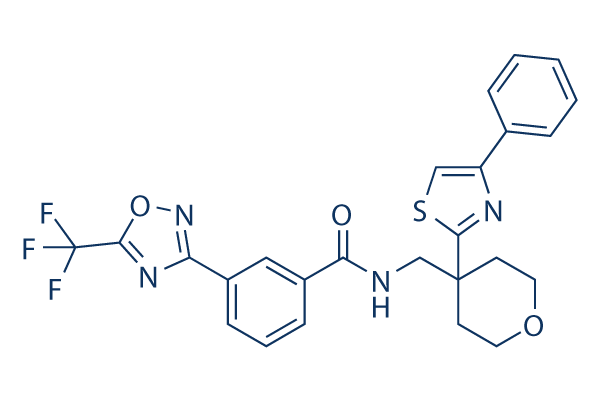
TMP269 HDAC inhibitor
Cat.No.S7324
Quality Control
Cell Culture, Treatment & Working Concentration
| Cell Lines | Assay Type | Concentration | Incubation Time | Formulation | Activity Description | PMID |
|---|---|---|---|---|---|---|
| insect cells | Function assay | 60 mins | Inhibition of human recombinant N-terminal GST-tagged HDAC7 (518 to 991 residues) expressed in insect cells using Boc-K(TFA)-AMC as substrate incubated for 60 mins by fluorescence assay, IC50 = 0.04085 μM. | 27060764 | ||
| insect cells | Function assay | 60 mins | Inhibition of recombinant human N-terminal GST-tagged HDAC7 (518 to 991 residues) expressed in baculovirus-infected insect cells after 60 mins by fluorimeter, Ki = 0.0463 μM. | 29589441 | ||
| insect cells | Function assay | 60 mins | Inhibition of recombinant human C-terminal His-tagged HDAC5 (656 to 1122 residues) expressed in baculovirus-infected insect cells using Boc-Lys(TFA)-AMC as substrate after 60 mins by fluorimeter, Ki = 0.0869 μM. | 29589441 | ||
| insect cells | Function assay | Inhibition of recombinant human C-terminal GST-tagged HDAC4 expressed in baculovirus-infected insect cells using Boc-Lys(TFA)-AMC as substrate by fluorimeter, Ki = 0.0905 μM. | 29589441 | |||
| insect cells | Function assay | 60 mins | Inhibition of human recombinant C-terminal His-tagged HDAC5 (657 to 1123 residues) expressed in insect cells using Boc-K(TFA)-AMC as substrate incubated for 60 mins by fluorescence assay, IC50 = 0.1084 μM. | 27060764 | ||
| insect cells | Function assay | 60 mins | Inhibition of human recombinant N-terminal GST-tagged C-terminal His-tagged HDAC4 (627 to 1084 residues) expressed in insect cells using Boc-K(TFA)-AMC as substrate incubated for 60 mins by fluorescence assay, IC50 = 0.1344 μM. | 27060764 | ||
| insect cells | Function assay | 60 mins | Inhibition of recombinant human C-terminal His-tagged HDAC8 (1 to 377 residues) expressed in baculovirus-infected insect cells using RHK(Ac)K(Ac)AMC as substrate after 60 mins by fluorimeter, Ki = 2.706 μM. | 29589441 | ||
| Click to View More Cell Line Experimental Data | ||||||
Solubility
|
In vitro |
DMSO
: 100 mg/mL
(194.35 mM)
Ethanol : 2 mg/mL Water : Insoluble |
Molarity Calculator
|
In vivo |
|||||
In vivo Formulation Calculator (Clear solution)
Step 1: Enter information below (Recommended: An additional animal making an allowance for loss during the experiment)
Step 2: Enter the in vivo formulation (This is only the calculator, not formulation. Please contact us first if there is no in vivo formulation at the solubility Section.)
Calculation results:
Working concentration: mg/ml;
Method for preparing DMSO master liquid: mg drug pre-dissolved in μL DMSO ( Master liquid concentration mg/mL, Please contact us first if the concentration exceeds the DMSO solubility of the batch of drug. )
Method for preparing in vivo formulation: Take μL DMSO master liquid, next addμL PEG300, mix and clarify, next addμL Tween 80, mix and clarify, next add μL ddH2O, mix and clarify.
Method for preparing in vivo formulation: Take μL DMSO master liquid, next add μL Corn oil, mix and clarify.
Note: 1. Please make sure the liquid is clear before adding the next solvent.
2. Be sure to add the solvent(s) in order. You must ensure that the solution obtained, in the previous addition, is a clear solution before proceeding to add the next solvent. Physical methods such
as vortex, ultrasound or hot water bath can be used to aid dissolving.
Chemical Information, Storage & Stability
| Molecular Weight | 514.52 | Formula | C25H21F3N4O3S |
Storage (From the date of receipt) | |
|---|---|---|---|---|---|
| CAS No. | 1314890-29-3 | Download SDF | Storage of Stock Solutions |
|
|
| Synonyms | N/A | SMILES | C1COCCC1(CNC(=O)C2=CC=CC(=C2)C3=NOC(=N3)C(F)(F)F)C4=NC(=CS4)C5=CC=CC=C5 | ||
Read more about storage stability stock solution CAS number SMILES
Mechanism of Action
| Targets/IC50/Ki |
HDAC9
(Cell-free assay) 23 nM
HDAC7
(Cell-free assay) 43 nM
HDAC5
(Cell-free assay) 97 nM
HDAC4
(Cell-free assay) 157 nM
|
|---|---|
| In vitro |
TMP269 has no impact on the mitochondrial activity and/or the viability of human CD4+ T cells at 10 μM, and may be used as tools to identify the endogenous substrates of the class IIa HDAC enzymes. In IEC-18 intestinal epithelial cells, this compound prevents cell cycle progression, DNA synthesis, and proliferation induced in response to G protein-coupled receptor/PKD1 activation. |
| Kinase Assay |
HDAC selectivity assays
|
|
Dose-response studies are done with ten concentrations in a threefold dilution series from a maximum final compound concentration of 100 μM in the reaction mixture and are conducted at Reaction Biology Corp. All assays are based on the same principle as the HDAC9 assay described above: the deacetylation of acetylated or trifluoroacetylated lysine residues on fluorogenic peptide substrates by HDAC. HDAC1, HDAC2, HDAC3, HDAC6, HDAC10 and HDAC11 used a substrate based on residues 379-382 of p53 (Arg-His-Lys-Lys(Ac)). For HDAC8, the diacetylated peptide substrate, based on residues 379–382 of p53 (Arg-His-Lys(Ac)-Lys(Ac)), is used. HDAC4, HDAC5, HDAC7 and HDAC9 assays used the class IIa HDAC–specific fluorogenic substrate (Boc-Lys(trifluoroacetyl)-AMC). All reactions are done with 50 μM HDAC substrate in assay buffer (50 mM Tris-HCl, pH 8.0, 137 mM NaCl, 2.7 mM KCl, 1 mM MgCl2, 1 mg/mL BSA) containing 1% DMSO final concentration; incubated for 2 h at 30 °C; and developed with trichostatin A and trypsin.
|
|
| In vivo |
TMP269 is a selective class IIa HDAC inhibitor. |
References |
|
Tech Support
Tel: +1-832-582-8158 Ext:3
If you have any other enquiries, please leave a message.
Signaling Pathway Map

Products are for research use only. Not for human use. We do not sell to patients.
©Copyright 2013 Selleck Chemicals. All Rights Reserved.