
-
 Argentina
-
 Australia
-
 Austria
-
 Belgium
-
 Brazil
-
 Canada
-
 China
China
-
 Czech Republic
-
 Denmark
-
 Finland
-
 France
-
 Germany
-
 Greece
-
 Hong Kong
-
 Hungary
-
 Iceland
-
 India
India
-
 Ireland
-
 Israel
-
 Italy
Italy
-
 Japan
Japan
-
 Korea
Korea
-
 Luxembourg
-
 Malaysia
-
 Netherlands
-
 New Zealand
-
 Norway
-
 Poland
-
 Portugal
-
 Qatar
Qatar
-
 Romania
-
 Saudi Arabia
-
 Singapore
-
 Spain
Spain
-
 Sweden
-
 Switzerland
-
 Taiwan
-
 Turkey
-
 United Kingdom
-
 United States
research use only
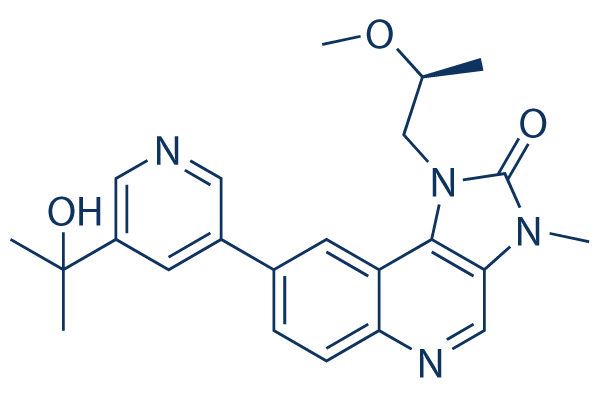
Samotolisib (LY3023414) PI3K inhibitor
Cat.No.S8322
Quality Control
| Related Targets | Akt mTOR GSK-3 ATM/ATR DNA-PK AMPK PDPK1 PTEN PI4K PP2A |
|---|---|
| Other PI3K Inhibitors | GDC-0077 (Inavolisib) SAR405 Quercetin (Sophoretin) LY294002 XL147 analogue Tersolisib (STX-478) Buparlisib (BKM120) 740 Y-P (PDGFR 740Y-P) GO-203 TFA Eganelisib (IPI-549) |
Cell Culture, Treatment & Working Concentration
| Cell Lines | Assay Type | Concentration | Incubation Time | Formulation | Activity Description | PMID |
|---|---|---|---|---|---|---|
| KB-8-5-11 | qHTS assay | P-glycoprotein substrates identified in KB-8-5-11 adenocarcinoma cell line, qHTS therapeutic library screen, Potency=0.6513μM. | 31515284 | |||
| KB-3-1 | qHTS assay | P-glycoprotein substrates identified in KB-3-1 adenocarcinoma cell line, qHTS therapeutic library screen. | 31515284 | |||
| Click to View More Cell Line Experimental Data | ||||||
Solubility
|
In vitro |
DMSO
: 81 mg/mL
(199.27 mM)
Ethanol : 6 mg/mL Water : Insoluble |
Molarity Calculator
|
In vivo |
|||||
In vivo Formulation Calculator (Clear solution)
Step 1: Enter information below (Recommended: An additional animal making an allowance for loss during the experiment)
Step 2: Enter the in vivo formulation (This is only the calculator, not formulation. Please contact us first if there is no in vivo formulation at the solubility Section.)
Calculation results:
Working concentration: mg/ml;
Method for preparing DMSO master liquid: mg drug pre-dissolved in μL DMSO ( Master liquid concentration mg/mL, Please contact us first if the concentration exceeds the DMSO solubility of the batch of drug. )
Method for preparing in vivo formulation: Take μL DMSO master liquid, next addμL PEG300, mix and clarify, next addμL Tween 80, mix and clarify, next add μL ddH2O, mix and clarify.
Method for preparing in vivo formulation: Take μL DMSO master liquid, next add μL Corn oil, mix and clarify.
Note: 1. Please make sure the liquid is clear before adding the next solvent.
2. Be sure to add the solvent(s) in order. You must ensure that the solution obtained, in the previous addition, is a clear solution before proceeding to add the next solvent. Physical methods such
as vortex, ultrasound or hot water bath can be used to aid dissolving.
Chemical Information, Storage & Stability
| Molecular Weight | 406.48 | Formula | C23H26N4O3 |
Storage (From the date of receipt) | |
|---|---|---|---|---|---|
| CAS No. | 1386874-06-1 | Download SDF | Storage of Stock Solutions |
|
|
| Synonyms | GTPL8918 | SMILES | CC(CN1C2=C3C=C(C=CC3=NC=C2N(C1=O)C)C4=CC(=CN=C4)C(C)(C)O)OC | ||
Read more about storage stability stock solution CAS number SMILES
Mechanism of Action
| Targets/IC50/Ki |
class I PI3K isoforms
mTOR kinase
DNA-PK
|
|---|---|
| In vitro |
Samotolisib (LY3023414) shows high solubility across a wide pH range. In vitro, inhibition of PI3K/AKT/mTOR signaling by this compound causes G1 cell-cycle arrest and resulted in broad antiproliferative activity in cancer cell panel screens. In cell-based assays, its inhibition of PI3K and mTOR is assessed in the PTEN-deficient U87 MG glioblastoma cell line. It inhibits the phosphorylation of AKT at position T308 downstream of PI3K at an IC50 of 106 nM. Similarly, it inhibits phosphorylation of AKT at position S473 (IC50 = 94.2 nM) by mTORC2 as well as phosphorylation of mTORC1 kinase targets p70S6K (position T389; IC50 =10.6 nM) and 4E-BP1 (positions T37/46; IC50 = 187 nM). The downstream phosphorylation of S6RP at positions pS240/244 (IC50 = 19.1 nM) by p70S6K was inhibited as well, indicating target inhibition along the entire PI3K/AKT/mTOR pathway by this compound.
|
| In vivo |
Samotolisib (LY3023414) demonstrates high bioavailability and dose-dependent dephosphorylation of PI3K/AKT/mTOR pathway downstream substrates such as AKT, S6K, S6RP, and 4E-BP1 for 4 to 6 hours in vivo, reflecting the drug's half-life of 2 hours. Intermittent target inhibition is sufficient for its antitumor activity. This compound shows time- and dose-dependent target inhibition in vivo. It is currently being evaluated in phase 1 and 2 trials for the treatment of human malignancies.
|
References |
Applications
| Methods | Biomarkers | Images | PMID |
|---|---|---|---|
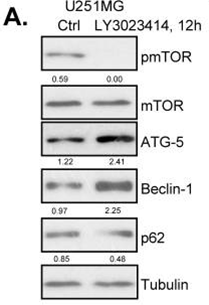
| Western blot | p-mTOR / mTOR / ATG5 / Beclin-1 / p62 pS6K1 / S6K1 / pAKT-S473 / AKT1 / pERK / ERK |
|
29228741 |
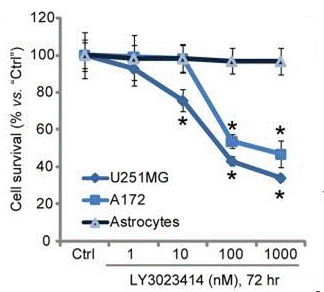
| Growth inhibition assay | Cell viability |
|
29228741 |
Clinical Trial Information
(data from https://clinicaltrials.gov, updated on 2026-06-22)
| NCT Number | Recruitment | Conditions | Sponsor/Collaborators | Start Date | Phases |
|---|---|---|---|---|---|
| NCT03675893 | RECRUITING | Endometrial Cancer |
Dana-Farber Cancer Institute |
2018-12-24 | PHASE2 |
| NCT03155620 | ACTIVE_NOT_RECRUITING | Advanced Malignant Solid Neoplasm; Ann Arbor Stage III Non-Hodgkin Lymphoma; Ann Arbor Stage IV Non-Hodgkin Lymphoma; Histiocytic Sarcoma; Juvenile Xanthogranuloma; Langerhans Cell Histiocytosis; Malignant Glioma; Recurrent Childhood Rhabdomyosarcoma; Recurrent Ependymoma; Recurrent Ewing Sarcoma; Recurrent Glioma; Recurrent Hepatoblastoma; Recurrent Langerhans Cell Histiocytosis; Recurrent Malignant Germ Cell Tumor; Recurrent Malignant Solid Neoplasm; Recurrent Medulloblastoma; Recurrent Neuroblastoma; Recurrent Non-Hodgkin Lymphoma; Recurrent Osteosarcoma; Recurrent Peripheral Primitive Neuroectodermal Tumor; Recurrent Primary Central Nervous System Neoplasm; Recurrent Rhabdoid Tumor; Recurrent Soft Tissue Sarcoma; Refractory Ewing Sarcoma; Refractory Glioma; Refractory Hepatoblastoma; Refractory Langerhans Cell Histiocytosis; Refractory Malignant Germ Cell Tumor; Refractory Malignant Solid Neoplasm; Refractory Medulloblastoma; Refractory Neuroblastoma; Refractory Non-Hodgkin Lymphoma; Refractory Osteosarcoma; Refractory Peripheral Primitive Neuroectodermal Tumor; Refractory Primary Central Nervous System Neoplasm; Refractory Rhabdoid Tumor; Refractory Rhabdomyosarcoma; Rhabdoid Tumor; Stage III Osteosarcoma AJCC v7; Stage III Soft Tissue Sarcoma AJCC v7; Stage IV Osteosarcoma AJCC v7; Stage IV Soft Tissue Sarcoma AJCC v7; Stage IVA Osteosarcoma AJCC v7; Stage IVB Osteosarcoma AJCC v7; Wilms Tumor |
National Cancer Institute (NCI) |
2017-07-31 | PHASE2 |
| NCT03213678 | COMPLETED | Advanced Malignant Solid Neoplasm; Ann Arbor Stage III Non-Hodgkin Lymphoma; Ann Arbor Stage IV Non-Hodgkin Lymphoma; Malignant Glioma; Recurrent Ependymoma; Recurrent Ewing Sarcoma; Recurrent Glioma; Recurrent Hepatoblastoma; Recurrent Langerhans Cell Histiocytosis; Recurrent Malignant Germ Cell Tumor; Recurrent Malignant Solid Neoplasm; Recurrent Medulloblastoma; Recurrent Neuroblastoma; Recurrent Non-Hodgkin Lymphoma; Recurrent Osteosarcoma; Recurrent Peripheral Primitive Neuroectodermal Tumor; Recurrent Primary Central Nervous System Neoplasm; Recurrent Rhabdomyosarcoma; Recurrent Soft Tissue Sarcoma; Refractory Langerhans Cell Histiocytosis; Refractory Malignant Germ Cell Tumor; Refractory Malignant Solid Neoplasm; Refractory Neuroblastoma; Refractory Non-Hodgkin Lymphoma; Refractory Primary Central Nervous System Neoplasm; Rhabdoid Tumor; Stage III Osteosarcoma AJCC v7; Stage III Soft Tissue Sarcoma AJCC v7; Stage IV Osteosarcoma AJCC v7; Stage IV Soft Tissue Sarcoma AJCC v7; Stage IVA Osteosarcoma AJCC v7; Stage IVB Osteosarcoma AJCC v7; Wilms Tumor |
National Cancer Institute (NCI) |
2017-11-28 | PHASE2 |
| NCT04032080 | COMPLETED | Triple Negative Breast Cancer |
Baylor Research Institute |
2019-09-05 | PHASE2 |
| NCT02549989 | COMPLETED | Endometrial Cancer; Recurrent Endometrial Cancer |
Memorial Sloan Kettering Cancer Center |
2015-09 | PHASE2 |
| NCT02057133 | ACTIVE_NOT_RECRUITING | Breast Neoplasms |
Eli Lilly and Company |
2014-03-10 | PHASE1 |
Read more about Clinical Trials
Tech Support
Tel: +1-832-582-8158 Ext:3
If you have any other enquiries, please leave a message.
Signaling Pathway Map

Products are for research use only. Not for human use. We do not sell to patients.
©Copyright 2013 Selleck Chemicals. All Rights Reserved.