
-
 Argentina
-
 Australia
-
 Austria
-
 Belgium
-
 Brazil
-
 Canada
-
 China
China
-
 Czech Republic
-
 Denmark
-
 Finland
-
 France
-
 Germany
-
 Greece
-
 Hong Kong
-
 Hungary
-
 Iceland
-
 India
India
-
 Ireland
-
 Israel
-
 Italy
Italy
-
 Japan
Japan
-
 Korea
Korea
-
 Luxembourg
-
 Malaysia
-
 Netherlands
-
 New Zealand
-
 Norway
-
 Poland
-
 Portugal
-
 Qatar
Qatar
-
 Romania
-
 Saudi Arabia
-
 Singapore
-
 Spain
Spain
-
 Sweden
-
 Switzerland
-
 Taiwan
-
 Turkey
-
 United Kingdom
-
 United States
research use only
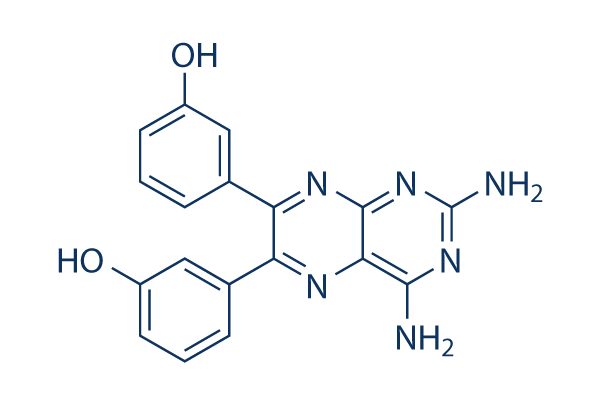
TG100-115 PI3K inhibitor
Cat.No.S1352
Quality Control
| Related Targets | Akt mTOR GSK-3 ATM/ATR DNA-PK AMPK PDPK1 PTEN PI4K PP2A |
|---|---|
| Other PI3K Inhibitors | GDC-0077 (Inavolisib) SAR405 Quercetin (Sophoretin) LY294002 XL147 analogue Tersolisib (STX-478) Buparlisib (BKM120) 740 Y-P (PDGFR 740Y-P) GO-203 TFA Eganelisib (IPI-549) |
Cell Culture, Treatment & Working Concentration
| Cell Lines | Assay Type | Concentration | Incubation Time | Formulation | Activity Description | PMID |
|---|---|---|---|---|---|---|
| HUVEC cells | Function assay | 10 μM | Inhibition of VEGF-induced VE-cadherin phosphorylation in HUVEC cells by Western blot at 10 uM | 17685602 | ||
| TC32 | qHTS assay | qHTS of pediatric cancer cell lines to identify multiple opportunities for drug repurposing: Primary screen for TC32 cells | 29435139 | |||
| DAOY | qHTS assay | qHTS of pediatric cancer cell lines to identify multiple opportunities for drug repurposing: Primary screen for DAOY cells | 29435139 | |||
| SJ-GBM2 | qHTS assay | qHTS of pediatric cancer cell lines to identify multiple opportunities for drug repurposing: Primary screen for SJ-GBM2 cells | 29435139 | |||
| A673 | qHTS assay | qHTS of pediatric cancer cell lines to identify multiple opportunities for drug repurposing: Primary screen for A673 cells | 29435139 | |||
| SK-N-MC | qHTS assay | qHTS of pediatric cancer cell lines to identify multiple opportunities for drug repurposing: Primary screen for SK-N-MC cells | 29435139 | |||
| BT-37 | qHTS assay | qHTS of pediatric cancer cell lines to identify multiple opportunities for drug repurposing: Primary screen for BT-37 cells | 29435139 | |||
| U-2 OS | qHTS assay | qHTS of pediatric cancer cell lines to identify multiple opportunities for drug repurposing: Primary screen for U-2 OS cells | 29435139 | |||
| Saos-2 | qHTS assay | qHTS of pediatric cancer cell lines to identify multiple opportunities for drug repurposing: Primary screen for Saos-2 cells | 29435139 | |||
| SK-N-SH | qHTS assay | qHTS of pediatric cancer cell lines to identify multiple opportunities for drug repurposing: Primary screen for SK-N-SH cells | 29435139 | |||
| NB1643 | qHTS assay | qHTS of pediatric cancer cell lines to identify multiple opportunities for drug repurposing: Primary screen for NB1643 cells | 29435139 | |||
| LAN-5 | qHTS assay | qHTS of pediatric cancer cell lines to identify multiple opportunities for drug repurposing: Primary screen for LAN-5 cells | 29435139 | |||
| BT-12 | qHTS assay | qHTS of pediatric cancer cell lines to identify multiple opportunities for drug repurposing: Primary screen for BT-12 cells | 29435139 | |||
| OHS-50 | qHTS assay | qHTS of pediatric cancer cell lines to identify multiple opportunities for drug repurposing: Primary screen for OHS-50 cells | 29435139 | |||
| RD | qHTS assay | qHTS of pediatric cancer cell lines to identify multiple opportunities for drug repurposing: Primary screen for RD cells | 29435139 | |||
| Click to View More Cell Line Experimental Data | ||||||
Solubility
|
In vitro |
DMSO
: 9 mg/mL
(25.98 mM)
Water : Insoluble Ethanol : Insoluble |
Molarity Calculator
|
In vivo |
|||||
In vivo Formulation Calculator (Clear solution)
Step 1: Enter information below (Recommended: An additional animal making an allowance for loss during the experiment)
Step 2: Enter the in vivo formulation (This is only the calculator, not formulation. Please contact us first if there is no in vivo formulation at the solubility Section.)
Calculation results:
Working concentration: mg/ml;
Method for preparing DMSO master liquid: mg drug pre-dissolved in μL DMSO ( Master liquid concentration mg/mL, Please contact us first if the concentration exceeds the DMSO solubility of the batch of drug. )
Method for preparing in vivo formulation: Take μL DMSO master liquid, next addμL PEG300, mix and clarify, next addμL Tween 80, mix and clarify, next add μL ddH2O, mix and clarify.
Method for preparing in vivo formulation: Take μL DMSO master liquid, next add μL Corn oil, mix and clarify.
Note: 1. Please make sure the liquid is clear before adding the next solvent.
2. Be sure to add the solvent(s) in order. You must ensure that the solution obtained, in the previous addition, is a clear solution before proceeding to add the next solvent. Physical methods such
as vortex, ultrasound or hot water bath can be used to aid dissolving.
Chemical Information, Storage & Stability
| Molecular Weight | 346.34 | Formula | C18H14N6O2 |
Storage (From the date of receipt) | |
|---|---|---|---|---|---|
| CAS No. | 677297-51-7 | Download SDF | Storage of Stock Solutions |
|
|
| Synonyms | N/A | SMILES | C1=CC(=CC(=C1)O)C2=NC3=C(N=C(N=C3N=C2C4=CC(=CC=C4)O)N)N | ||
Read more about storage stability stock solution CAS number SMILES
Mechanism of Action
| Features |
A potent and dual selective PI3Kγ/δ inhibitor.
|
|---|---|
| Targets/IC50/Ki |
PI3Kγ
(Cell-free assay) 83 nM
PI3Kδ
(Cell-free assay) 235 nM
PI3Kβ
(Cell-free assay) 1.2 μM
PI3Kα
(Cell-free assay) 1.3 μM
|
| In vitro |
TG100-115 inhibits PI3Kγ and -δ, with IC50 of 83 and 235 nM, respectively. This compound is not active for PI3Kα and -β, with IC50 of 1.2 and 1.3 mM. In human umbilical vein endothelial cells (HUVECs), this chemical (up to 10 μM) has no effects on cell proliferation and VEGF-stimulated ERK phosphorylation. However, it (10 μM) interrupts other VEGF signaling pathways, such as those that culminate in VE-cadherin phosphorylation. In HUVECs, this compound (10 μM) inhibits the VEGF-induced increase of total level of VE-cadherin. It inhibits VEGF mediated phosphorylation of mTOR and p70S6 kinase, both of which are downstream of PI3K. This chemical (125 nM to 10 μM) also inhibits FGF-stimulated phosphorylation of Akt.
|
| Kinase Assay |
PI3K assays
|
|
Forty mL of reaction buffer (20 mM Tris/4 mM MgCl2/10 mM NaCl, pH 7.4) containing 50 mM D-myo-phosphatidylinositol 4,5-bisphosphate substrate and the desired PI3K isoform are aliquoted to 96-well plates; kinase concentrations are 250-500 ng/well, such that linear kinetics are achieved over 90 min. TG100-115 is then added as 2.5 mL of a DMSO stock to final concentration range of 100 mM to 1 nM. Reactions are initiated by addition of 10 mL of ATP to a final concentration of 3 mM, and after 90 min, 50 mL of Kinase-Glo reagent added to quantify residual ATP levels; luminosity is measured using an Ultra 384 instrument. Control reactions omitting either this compound or substrate are also performed. IC50 values are derived from experimental data by nonlinear curve fitting using Prism Version 4.
|
|
| In vivo |
In Miles assay models, TG100-115 (1-5 mg/kg) reduces edema formation and inflammation in rats. In rigorous rodent and porcine models of myocardial ischemia (MI), this compound (0.5-5 mg/kg) provides potent cardioprotection, limits infarct development, and preserves myocardial function. In mice, this chemical (5 mg/kg) markedly diminishes vascular permeability (VP) in response to either Sema3A or VEGF, indicating that both factors may depend on PI3Kγ/δ to induce VP. In a mouse asthma model, aerosolized TG100-115 markedly reduces the pulmonary eosinophilia, inhibits interleukin-13 and mucin accumulation.
|
References |
|
Clinical Trial Information
(data from https://clinicaltrials.gov, updated on 2008-05-20)
| NCT Number | Recruitment | Conditions | Sponsor/Collaborators | Start Date | Phases |
|---|---|---|---|---|---|
| NCT00103350 | COMPLETED | Myocardial Infarction |
TargeGen |
2005-01 | PHASE1; PHASE2 |
| NCT00103350 | Completed | Myocardial Infarction |
TargeGen |
2005-01 | Phase 1|Phase 2 |
Read more about Clinical Trials
Tech Support
Tel: +1-832-582-8158 Ext:3
If you have any other enquiries, please leave a message.
Signaling Pathway Map

Products are for research use only. Not for human use. We do not sell to patients.
©Copyright 2013 Selleck Chemicals. All Rights Reserved.