
-
 Australia
-
 Austria
-
 Belgium
-
 Brazil
-
 Canada
-
 China
China
-
 Czech Republic
-
 Denmark
-
 Finland
-
 France
-
 Germany
-
 Greece
-
 Hong Kong
-
 Hungary
-
 Iceland
-
 India
India
-
 Ireland
-
 Israel
-
 Italy
Italy
-
 Japan
Japan
-
 Korea
Korea
-
 Luxembourg
-
 Malaysia
-
 Netherlands
-
 New Zealand
-
 Norway
-
 Poland
-
 Qatar
Qatar
-
 Romania
-
 Saudi Arabia
-
 Singapore
-
 Spain
Spain
-
 Sweden
-
 Switzerland
-
 Taiwan
-
 Turkey
-
 United Kingdom
-
 United States
research use only
AS-604850 PI3K inhibitor
Cat.No.S2681
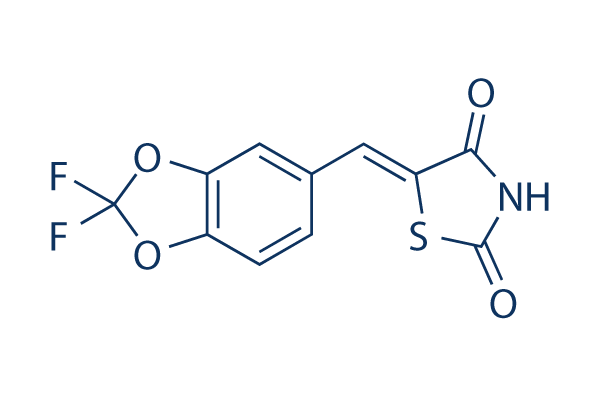
Chemical Structure
Molecular Weight: 285.22
Quality Control
| Related Targets | Akt mTOR GSK-3 ATM/ATR DNA-PK AMPK PDPK1 PTEN PP2A PDK |
|---|---|
| Other PI3K Inhibitors | GDC-0077 (Inavolisib) SAR405 Quercetin (Sophoretin) LY294002 XL147 analogue Tersolisib (STX-478) Buparlisib (BKM120) 740 Y-P (PDGFR 740Y-P) GO-203 TFA Eganelisib (IPI-549) |
Solubility
|
In vitro |
DMSO
: 57 mg/mL
(199.84 mM)
Ethanol : 5 mg/mL Water : Insoluble |
Molarity Calculator
|
In vivo |
|||||
In vivo Formulation Calculator (Clear solution)
Step 1: Enter information below (Recommended: An additional animal making an allowance for loss during the experiment)
Step 2: Enter the in vivo formulation (This is only the calculator, not formulation. Please contact us first if there is no in vivo formulation at the solubility Section.)
Calculation results:
Working concentration: mg/ml;
Method for preparing DMSO master liquid: mg drug pre-dissolved in μL DMSO ( Master liquid concentration mg/mL, Please contact us first if the concentration exceeds the DMSO solubility of the batch of drug. )
Method for preparing in vivo formulation: Take μL DMSO master liquid, next addμL PEG300, mix and clarify, next addμL Tween 80, mix and clarify, next add μL ddH2O, mix and clarify.
Method for preparing in vivo formulation: Take μL DMSO master liquid, next add μL Corn oil, mix and clarify.
Note: 1. Please make sure the liquid is clear before adding the next solvent.
2. Be sure to add the solvent(s) in order. You must ensure that the solution obtained, in the previous addition, is a clear solution before proceeding to add the next solvent. Physical methods such
as vortex, ultrasound or hot water bath can be used to aid dissolving.
Chemical Information, Storage & Stability
| Molecular Weight | 285.22 | Formula | C11H5F2NO4S |
Storage (From the date of receipt) | |
|---|---|---|---|---|---|
| CAS No. | 648449-76-7 | Download SDF | Storage of Stock Solutions |
|
|
| Synonyms | N/A | Smiles | C1=CC2=C(C=C1C=C3C(=O)NC(=O)S3)OC(O2)(F)F | ||
Mechanism of Action
| Targets/IC50/Ki |
PI3Kγ
0.25 μM
PI3Kα
4.5 μM
|
|---|---|
| In vitro |
AS-604850 is ATP-competitive PI3Kγ inhibitor with Ki values of 0.18 μM. This compound is isoform selective inhibitor of PI3Kγ with over 30-fold selectivity for PI3Kδ and β, and 18-fold selectivity over PI3Kα. (PI3Kα: IC50 = 4.5 μM, PI3Kγ and β: IC50 > 20μM) It is capable of inhibiting C5a-mediated PKB phosphorylation in RAW264 mouse macrophages with an IC50 with 10 μM. This chemical blocks MCP-1-mediated chemotaxis in Pik3cg +/+ monocytes in a concentration- dependent manner, with an IC50 of 21 mM, but dosn't affect chemotaxis in Pik3cg-/- cells, indicating that it acts through PI3Kγ. It diminishes glycochenodeoxycholate (GCDC) induced Akt-phosphorylation and apoptosis in rat hepatocytes. This compound diminishes bile salt-induced apoptosis in HepG2 Ntcp and Huh7-Ntcp cells. It causes a concentration-dependent suppression of chemotactic responses of EoL-1 cells and blood eosinophils to platelet-activating factor (PAF).
|
| Kinase Assay |
In vitro PI3Kγ Kinase Assay
|
|
Human PI3Kγ (100 ng) is incubated at RT with kinase buffer (10 mM MgCl2, 1 mM β-glycerophosphate, 1 mM DTT, 0.1 mM Na3VO4, 0.1% Na Cholate and 15 M ATP/100 nCi γ[33]ATP, final concentrations) and lipid vesicles containing 18 M PtdIns and 250 M of PtdSer (final concentrations), in the presence of this compound or DMSO. Kinase reaction is stopped by adding 250 g of Neomycin-coated Scintillation Proximity Assay (SPA) beads and preceded.
|
|
| In vivo |
AS-604850 reduces RANTES-induced peritoneal neutrophil recruitment with a ED50 of 42.4 mg/kg. In the thioglycollate-induced peritonitis model, oral administration of 10 mg/kg of this compound results in a 31% reduction of neutrophil recruitment.
|
References |
|
Tech Support
Tel: +1-832-582-8158 Ext:3
If you have any other enquiries, please leave a message.
Signaling Pathway Map

Products are for research use only. Not for human use. We do not sell to patients.
©Copyright 2013 Selleck Chemicals. All Rights Reserved.