
-
 Argentina
-
 Australia
-
 Austria
-
 Belgium
-
 Brazil
-
 Canada
-
 China
China
-
 Czech Republic
-
 Denmark
-
 Finland
-
 France
-
 Germany
-
 Greece
-
 Hong Kong
-
 Hungary
-
 Iceland
-
 India
India
-
 Ireland
-
 Israel
-
 Italy
Italy
-
 Japan
Japan
-
 Korea
Korea
-
 Luxembourg
-
 Malaysia
-
 Netherlands
-
 New Zealand
-
 Norway
-
 Poland
-
 Portugal
-
 Qatar
Qatar
-
 Romania
-
 Saudi Arabia
-
 Singapore
-
 Spain
Spain
-
 Sweden
-
 Switzerland
-
 Taiwan
-
 Turkey
-
 United Kingdom
-
 United States
research use only
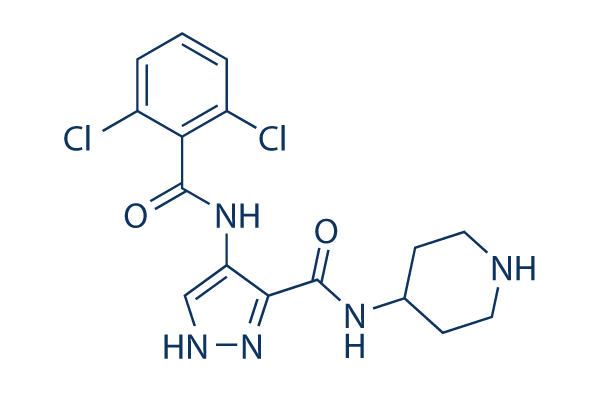
AT7519 CDK inhibitor
Cat.No.S1524
Quality Control
Cell Culture, Treatment & Working Concentration
| Cell Lines | Assay Type | Concentration | Incubation Time | Formulation | Activity Description | PMID |
|---|---|---|---|---|---|---|
| HCT116 | Antiproliferative assay | 72 hrs | Antiproliferative activity against human HCT116 cells assessed as cell viability after 72 hrs by alamar blue assay, IC50=0.082μM | 18656911 | ||
| A2780 | Antiproliferative assay | 72 hrs | Antiproliferative activity against human A2780 cells assessed as cell viability after 72 hrs by alamar blue assay, IC50=0.35μM | 18656911 | ||
| MRC5 | Antiproliferative assay | 72 hrs | Antiproliferative activity against human MRC5 cells assessed as cell viability after 72 hrs by alamar blue assay, IC50=0.98μM | 18656911 | ||
| HCT116 | Function assay | Inhibition of CDK1 in human HCT116 cells assessed as PP1-alpha(Thr320) phosphorylation | 18656911 | |||
| HCT116 | Function assay | Inhibition of CDK2 in human HCT116 cells assessed as Rb(Thr321) phosphorylation | 18656911 | |||
| HCT116 | Function assay | Inhibition of CDK2 in human HCT116 cells assessed as NPM(Thr199) phosphorylation | 18656911 | |||
| HCT116 | Cytotoxicity assay | 72 hrs | Cytotoxicity against human HCT116 cells assessed as growth inhibition after 72 hrs by Alamar blue assay, IC50=0.08μM | 26115571 | ||
| Sf21 | Function assay | Inhibition of recombinant human full length N-terminal His6-tagged CDK5/N-terminal GST-tagged p25 expressed in baculovirus infected Sf21 insect cells using histone H1 as substrate, Ki=0.018μM | 27171036 | |||
| Sf21 | Function assay | Inhibition of human full length C-terminal His6-tagged CDK2/N-terminal GST-tagged cyclin A expressed in baculovirus infected Sf21 insect cells using histone H1 as substrate, Ki=0.044μM | 27171036 | |||
| sf cells | Function assay | Inhibition of recombinant human N-terminal GST-tagged CDK4/cyclin D1 expressed in baculovirus infected sf cells, Ki=0.067μM | 27171036 | |||
| Sf21 | Function assay | Inhibition of recombinant human full length C-terminal His6-tagged CDK9/cyclin T1 expressed in baculovirus infected Sf21 insect cells using PDKtide as substrate, Ki<0.1μM | 27171036 | |||
| Sf21 | Function assay | Inhibition of human full length C-terminal His6-tagged CDK1/N-terminal GST-tagged cyclin B expressed in baculovirus infected Sf21 insect cells using histone H1 as substrate, Ki=0.19μM | 27171036 | |||
| Sf21 | Function assay | Inhibition of recombinant human full length C-terminal His6-tagged CDK2/N-terminal GST-tagged cyclin E expressed in baculovirus infected Sf21 insect cells using histone H1 as substrate, Ki=0.51μM | 27171036 | |||
| Sf21 | Function assay | Inhibition of recombinant human full length C-terminal His6-tagged CDK7/cyclin H/N-terminal GST-tagged MAT1 expressed in baculovirus infected Sf21 insect cells using cdk7 substrate peptide, Ki=2.8μM | 27171036 | |||
| TC32 | qHTS assay | qHTS of pediatric cancer cell lines to identify multiple opportunities for drug repurposing: Primary screen for TC32 cells | 29435139 | |||
| DAOY | qHTS assay | qHTS of pediatric cancer cell lines to identify multiple opportunities for drug repurposing: Primary screen for DAOY cells | 29435139 | |||
| SJ-GBM2 | qHTS assay | qHTS of pediatric cancer cell lines to identify multiple opportunities for drug repurposing: Primary screen for SJ-GBM2 cells | 29435139 | |||
| A673 | qHTS assay | qHTS of pediatric cancer cell lines to identify multiple opportunities for drug repurposing: Primary screen for A673 cells | 29435139 | |||
| SK-N-MC | qHTS assay | qHTS of pediatric cancer cell lines to identify multiple opportunities for drug repurposing: Primary screen for SK-N-MC cells | 29435139 | |||
| BT-37 | qHTS assay | qHTS of pediatric cancer cell lines to identify multiple opportunities for drug repurposing: Primary screen for BT-37 cells | 29435139 | |||
| NB-EBc1 | qHTS assay | qHTS of pediatric cancer cell lines to identify multiple opportunities for drug repurposing: Primary screen for NB-EBc1 cells | 29435139 | |||
| Saos-2 | qHTS assay | qHTS of pediatric cancer cell lines to identify multiple opportunities for drug repurposing: Primary screen for Saos-2 cells | 29435139 | |||
| SK-N-SH | qHTS assay | qHTS of pediatric cancer cell lines to identify multiple opportunities for drug repurposing: Primary screen for SK-N-SH cells | 29435139 | |||
| BT-12 | qHTS assay | qHTS of pediatric cancer cell lines to identify multiple opportunities for drug repurposing: Primary screen for BT-12 cells | 29435139 | |||
| OHS-50 | qHTS assay | qHTS of pediatric cancer cell lines to identify multiple opportunities for drug repurposing: Primary screen for OHS-50 cells | 29435139 | |||
| RD | qHTS assay | qHTS of pediatric cancer cell lines to identify multiple opportunities for drug repurposing: Primary screen for RD cells | 29435139 | |||
| MG 63 (6-TG R) | qHTS assay | qHTS of pediatric cancer cell lines to identify multiple opportunities for drug repurposing: Primary screen for MG 63 (6-TG R) cells | 29435139 | |||
| Rh41 | qHTS assay | qHTS of pediatric cancer cell lines to identify multiple opportunities for drug repurposing: Primary screen for Rh41 cells | 29435139 | |||
| A673 | qHTS assay | qHTS of pediatric cancer cell lines to identify multiple opportunities for drug repurposing: Confirmatory screen for A673 cells) | 29435139 | |||
| SK-N-MC | qHTS assay | qHTS of pediatric cancer cell lines to identify multiple opportunities for drug repurposing: Confirmatory screen for SK-N-MC cells | 29435139 | |||
| BT-12 | qHTS assay | qHTS of pediatric cancer cell lines to identify multiple opportunities for drug repurposing: Confirmatory screen for BT-12 cells | 29435139 | |||
| DAOY | qHTS assay | qHTS of pediatric cancer cell lines to identify multiple opportunities for drug repurposing: Confirmatory screen for DAOY cells | 29435139 | |||
| SJ-GBM2 | qHTS assay | qHTS of pediatric cancer cell lines to identify multiple opportunities for drug repurposing: Confirmatory screen for SJ-GBM2 cells | 29435139 | |||
| BT-37 | qHTS assay | qHTS of pediatric cancer cell lines to identify multiple opportunities for drug repurposing: Confirmatory screen for BT-37 cells | 29435139 | |||
| TC32 | qHTS assay | qHTS of pediatric cancer cell lines to identify multiple opportunities for drug repurposing: Confirmatory screen for TC32 cells | 29435139 | |||
| U-2 OS | qHTS assay | qHTS of pediatric cancer cell lines to identify multiple opportunities for drug repurposing: Confirmatory screen for U-2 OS cells | 29435139 | |||
| Rh41 | qHTS assay | qHTS of pediatric cancer cell lines to identify multiple opportunities for drug repurposing: Confirmatory screen for Rh41 cells | 29435139 | |||
| RD | qHTS assay | qHTS of pediatric cancer cell lines to identify multiple opportunities for drug repurposing: Confirmatory screen for RD cells | 29435139 | |||
| Rh30 | qHTS assay | qHTS of pediatric cancer cell lines to identify multiple opportunities for drug repurposing: Confirmatory screen for Rh30 cells | 29435139 | |||
| Saos-2 | qHTS assay | qHTS of pediatric cancer cell lines to identify multiple opportunities for drug repurposing: Confirmatory screen for Saos-2 cells | 29435139 | |||
| OHS-50 | qHTS assay | qHTS of pediatric cancer cell lines to identify multiple opportunities for drug repurposing: Confirmatory screen for OHS-50 cells | 29435139 | |||
| SK-N-SH | qHTS assay | qHTS of pediatric cancer cell lines to identify multiple opportunities for drug repurposing: Confirmatory screen for SK-N-SH cells | 29435139 | |||
| HEI-OC1 | Function assay | Protection against cisplatin-induced cell death in neonatal mouse HEI-OC1 cells assessed as reduction in caspase-3/7 activity, EC50=0.38μM | 30091915 | |||
| MIAPaCa2 | Antiproliferative assay | 72 hrs | Antiproliferative activity against human MIAPaCa2 cells after 72 hrs by prestoblue assay, IC50=0.411μM | 30343954 | ||
| AsPC1 | Antiproliferative assay | 72 hrs | Antiproliferative activity against human AsPC1 cells after 72 hrs by prestoblue assay, IC50=0.533μM | 30343954 | ||
| SUIT2 | Antiproliferative assay | 72 hrs | Antiproliferative activity against human SUIT2 cells after 72 hrs by prestoblue assay, IC50=0.557μM | 30343954 | ||
| BxPC3 | Antiproliferative assay | 72 hrs | Antiproliferative activity against human BxPC3 cells after 72 hrs by prestoblue assay, IC50=0.64μM | 30343954 | ||
| S2-013 | Antiproliferative assay | 72 hrs | Antiproliferative activity against human S2-013 cells after 72 hrs by prestoblue assay, IC50=2.77μM | 30343954 | ||
| Sf21 | Function assay | Inhibition of recombinant human full-length C-terminal His6-tagged CDK9/human full-length untagged cyclin T1 expressed in baculovirus infected Sf21 insect cells using PDKtide as substrate, IC50<0.01μM | 30543440 | |||
| Sf21 | Function assay | 2 hrs | Inhibition of recombinant full-length human C-terminal His6-tagged CDK1/human full-length N-terminal GST-tagged Cyclin B expressed in baculovirus infected Sf21 insect cells using histone H1 as substrate measured after 2 hrs in presence of gamma[32P] ATP b, IC50=0.21μM | 30543440 | ||
| Sf21 | Function assay | Inhibition of recombinant human full-length C-terminal His6-tagged CDK3/full-length human N-terminal GST-tagged Cyclin E expressed in baculovirus infected Sf21 insect cells using histone H1 as substrate, IC50=0.36μM | 30543440 | |||
| Sf21 | Function assay | Inhibition of recombinant human C-terminal His6-tagged full length CDK7/untagged recombinant full length human Cyclin H/N-terminal GST-tagged recombinant full length human MAT1 expressed in baculovirus infected Sf21 insect cells using cdk7 peptide as subs, IC50=2.4μM | 30543440 | |||
| HCT116 | Antiproliferative assay | 72 hrs | Antiproliferative activity against human HCT116 cells assessed as reduction in cell viability after 72 hrs by cell titer glo-based luminescence assay, IC50=0.132μM | 31175010 | ||
| Click to View More Cell Line Experimental Data | ||||||
Solubility
|
In vitro |
DMSO
: 10 mg/mL
(26.16 mM)
Water : Insoluble Ethanol : Insoluble |
Molarity Calculator
|
In vivo |
|||||
In vivo Formulation Calculator (Clear solution)
Step 1: Enter information below (Recommended: An additional animal making an allowance for loss during the experiment)
Step 2: Enter the in vivo formulation (This is only the calculator, not formulation. Please contact us first if there is no in vivo formulation at the solubility Section.)
Calculation results:
Working concentration: mg/ml;
Method for preparing DMSO master liquid: mg drug pre-dissolved in μL DMSO ( Master liquid concentration mg/mL, Please contact us first if the concentration exceeds the DMSO solubility of the batch of drug. )
Method for preparing in vivo formulation: Take μL DMSO master liquid, next addμL PEG300, mix and clarify, next addμL Tween 80, mix and clarify, next add μL ddH2O, mix and clarify.
Method for preparing in vivo formulation: Take μL DMSO master liquid, next add μL Corn oil, mix and clarify.
Note: 1. Please make sure the liquid is clear before adding the next solvent.
2. Be sure to add the solvent(s) in order. You must ensure that the solution obtained, in the previous addition, is a clear solution before proceeding to add the next solvent. Physical methods such
as vortex, ultrasound or hot water bath can be used to aid dissolving.
Chemical Information, Storage & Stability
| Molecular Weight | 382.24 | Formula | C16H17Cl2N5O2 |
Storage (From the date of receipt) | |
|---|---|---|---|---|---|
| CAS No. | 844442-38-2 | Download SDF | Storage of Stock Solutions |
|
|
| Synonyms | AT7519M | SMILES | C1CNCCC1NC(=O)C2=C(C=NN2)NC(=O)C3=C(C=CC=C3Cl)Cl | ||
Read more about storage stability stock solution CAS number SMILES
Mechanism of Action
| Targets/IC50/Ki |
CDK9/CyclinT
(Cell-free assay) <10 nM
CDK5/p35
(Cell-free assay) 13 nM
CDK2/CyclinA
(Cell-free assay) 47 nM
GSK-3β
(Cell-free assay) 89 nM
CDK4/CyclinD1
(Cell-free assay) 100 nM
CDK6/CyclinD3
(Cell-free assay) 170 nM
CDK1/CyclinB
(Cell-free assay) 210 nM
CDK3/CyclinE
(Cell-free assay) 360 nM
|
|---|---|
| In vitro |
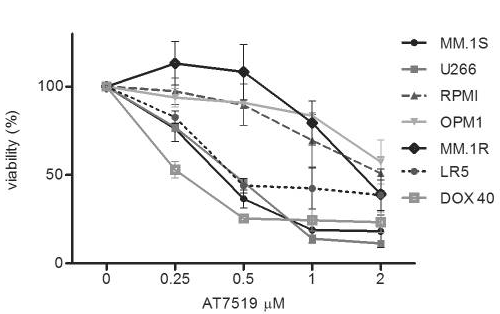
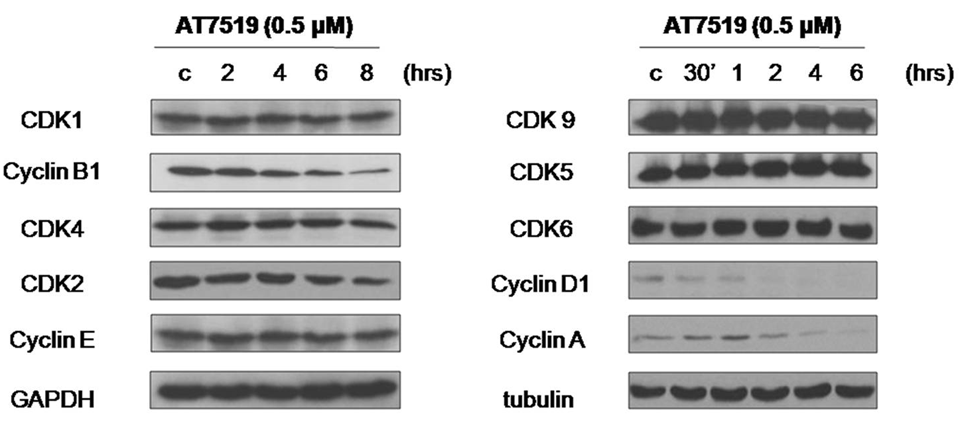
AT7519 is an ATP competitive CDK inhibitor with a Ki value of 38 nM for CDK1. This compound is inactive against all non-CDK kinases with the exception of GSK3β (IC50 = 89 nM). It shows potent antiproliferative activity in a variety of human tumor cell lines with IC50 values ranging from 40 nM for MCF-7 to 940 nM for SW620 consistent with the inhibition of CDK1 and CDK2. This chemical induces dose-dependent cytotoxicity in multiple myeloma (MM) cell lines with IC50 values ranging from 0.5 to 2 μM at 48 hours, with the most sensitive cell lines being MM.1S (0.5 μM) and U266 (0.5 μM) and the most resistant MM.1R (>2 μM). It does not induce cytotoxicity in peripheral blood mononuclear cells (PBMNC). This inhibitor partially overcomes the proliferative advantage conferred by IL6 and IGF-1 as well as the protective effect of bone marrow stromal cells (BMSCs). It induces rapid dephosphorylation of RNA pol II CTD at serine 2 and serine 5 sites, and leads to the inhibition of transcription, partially contributing to its induced cytotoxicity of MM cells. This agent induces activation of GSK-3β by down-regulating GSK-3β phosphorylation, which also contributes to its induced apoptosis independent of the inhibition of transcription.
|
| Kinase Assay |
In vitro Kinase Assays
|
|
[API调用失败: invalid chat.event: ping, {'event': 'ping', 'data': '{"timestamp_ms":"1763712465092"}'}]
|
|
| In vivo |
A twice daily dosing of AT7519 (9.1 mg/kg) causes tumor regression of both early-stage and advanced-stage s.c. tumors in the HCT116 and HT29 colon cancer xenograft models. This compound treatment (15 mg/kg) inhibits tumor growth and prolongs the median overall survival of mice in the human MM xenograft mouse model in association with increased caspase 3 activation.
|
References |
|
Applications
| Methods | Biomarkers | Images | PMID |
|---|---|---|---|
| Growth inhibition assay | Cell viability |
|
20101221 |
| Western blot | CDK1 / CDK2 / CDK4 / Cyclin B1 / Cyclin E / CDK9 / CDK5 / CDK6 / Cyclin D1 / Cyclin A |
|
20101221 |
Clinical Trial Information
(data from https://clinicaltrials.gov, updated on 2025-02-10)
| NCT Number | Recruitment | Conditions | Sponsor/Collaborators | Start Date | Phases |
|---|---|---|---|---|---|
| NCT02503709 | COMPLETED | Advanced Malignant Solid Neoplasm; Metastatic Malignant Solid Neoplasm; Unresectable Solid Neoplasm |
National Cancer Institute (NCI) |
2016-09-30 | PHASE1 |
| NCT00390117 | COMPLETED | Lymphoma; Unspecified Adult Solid Tumor, Protocol Specific |
NCIC Clinical Trials Group |
2007-01-05 | PHASE1 |
| NCT01183949 | Completed | Multiple Myeloma |
Astex Pharmaceuticals Inc.|Multiple Myeloma Research Consortium |
2010-11 | Phase 1|Phase 2 |
Read more about Clinical Trials
Tech Support
Tel: +1-832-582-8158 Ext:3
If you have any other enquiries, please leave a message.
Signaling Pathway Map

Products are for research use only. Not for human use. We do not sell to patients.
©Copyright 2013 Selleck Chemicals. All Rights Reserved.