
-
 Argentina
-
 Australia
-
 Austria
-
 Belgium
-
 Brazil
-
 Canada
-
 China
China
-
 Czech Republic
-
 Denmark
-
 Finland
-
 France
-
 Germany
-
 Greece
-
 Hong Kong
-
 Hungary
-
 Iceland
-
 India
India
-
 Ireland
-
 Israel
-
 Italy
Italy
-
 Japan
Japan
-
 Korea
Korea
-
 Luxembourg
-
 Malaysia
-
 Netherlands
-
 New Zealand
-
 Norway
-
 Poland
-
 Portugal
-
 Qatar
Qatar
-
 Romania
-
 Saudi Arabia
-
 Singapore
-
 Spain
Spain
-
 Sweden
-
 Switzerland
-
 Taiwan
-
 Turkey
-
 United Kingdom
-
 United States
research use only
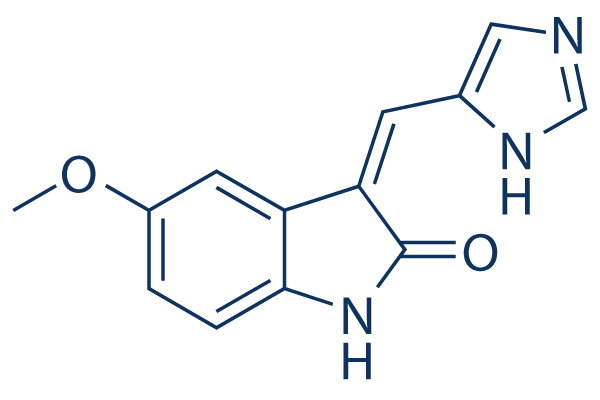
SU9516 CDK inhibitor
Cat.No.S7636
Quality Control
Solubility
|
In vitro |
DMSO
: 48 mg/mL
(198.96 mM)
Ethanol : 12 mg/mL Water : Insoluble |
Molarity Calculator
|
In vivo |
|||||
In vivo Formulation Calculator (Clear solution)
Step 1: Enter information below (Recommended: An additional animal making an allowance for loss during the experiment)
Step 2: Enter the in vivo formulation (This is only the calculator, not formulation. Please contact us first if there is no in vivo formulation at the solubility Section.)
Calculation results:
Working concentration: mg/ml;
Method for preparing DMSO master liquid: mg drug pre-dissolved in μL DMSO ( Master liquid concentration mg/mL, Please contact us first if the concentration exceeds the DMSO solubility of the batch of drug. )
Method for preparing in vivo formulation: Take μL DMSO master liquid, next addμL PEG300, mix and clarify, next addμL Tween 80, mix and clarify, next add μL ddH2O, mix and clarify.
Method for preparing in vivo formulation: Take μL DMSO master liquid, next add μL Corn oil, mix and clarify.
Note: 1. Please make sure the liquid is clear before adding the next solvent.
2. Be sure to add the solvent(s) in order. You must ensure that the solution obtained, in the previous addition, is a clear solution before proceeding to add the next solvent. Physical methods such
as vortex, ultrasound or hot water bath can be used to aid dissolving.
Chemical Information, Storage & Stability
| Molecular Weight | 241.25 | Formula | C13H11N3O2 |
Storage (From the date of receipt) | |
|---|---|---|---|---|---|
| CAS No. | 377090-84-1 | Download SDF | Storage of Stock Solutions |
|
|
| Synonyms | N/A | SMILES | COC1=CC2=C(C=C1)NC(=O)C2=CC3=CN=CN3 | ||
Read more about storage stability stock solution CAS number SMILES
Mechanism of Action
| Targets/IC50/Ki |
CDK2
22 nM
CDK1
40 nM
CDK4
200 nM
|
|---|---|
| In vitro |
SU9516 decreases cdk2-specific phosphorylation of the retinoblastoma protein pRB, increases caspase-3 activation, and alters cell cycle in RKO and SW480 cells. This compound also inhibits the cell proliferation, and induces cell apoptosis in both cell lines. It kills leukemic cells through inhibition of RNA Pol II CTD phosphorylation, oxidative damage and transcriptional down-regulation of Mcl-1. In human T-cell leukemia Jurkat cells, this chemical significantly enhances sensitivity to methotrexate. In addition, it also suppresses Aurora-A centrosomal localization and consequent centrosome amplification.
|
| Kinase Assay |
CDK kinase assay
|
|
Kinase assays are performed in 96-well polypropylene plates. Each reaction contained 2 μg of histone H1 at a final concentration of 10 μM [γ-33P]ATP (0.2 μCi/well; approximately twice the experimentally determined Km), 10 mM MgCl2, 1 mM DTT, 0.01% Triton X-100, and 10% glycerol in a 40 μL volume. The reaction is initiated with the addition of 20 μL enzyme (6 ng cdk2/well resulting in a final concentration of 1.6 nM), which is previously diluted 1:50–1:200 in the same buffer, and allowed to proceed for 1 h at room temperature. Reaction is stopped by the addition of 0.01 mL 10% phosphoric acid, and 25 μL of reaction mixture is transferred to P30 phosphocellulose filter mat paper. The filter mat is washed three times with 1.0% phosphoric acid, air dried, and then counted for radioactivity in a liquid scintillation counter. The cdk4 kinase assay for cyclin D1-cdk4 is carried out in a polypropylene 96-well microtiter plate format measuring the incorporation of radioactive phosphate into GST-Rb. Purified cyclin D1-cdk4 is incubated with 1 μg GST-Rb in 20 mM HEPES (pH 7.5) in the presence of 10 mM MgCl2, 1 mM DTT, 0.01% Triton X-100, and 10% glycerol. The final cdk4 concentration is 10 ng/well, or 1.6 nM. Kinase reaction is initiated by the addition of ATP at a final concentration of 10 μM ATP (twice the experimentally determined Km) and [γ-33P]ATP (1.0 μCi per well) in a 60-μL volume and allowed to proceed at room temperature for 1 h. Reaction is stopped by the addition of 0.01 ml 10% phosphoric acid, and 25 μL of reaction mixture is transferred to P30 phosphocellulose filter mat paper. The filter mat is treated as for Cdk1/Cdk2 assays.
|
References |
|
Tech Support
Tel: +1-832-582-8158 Ext:3
If you have any other enquiries, please leave a message.
Signaling Pathway Map

Products are for research use only. Not for human use. We do not sell to patients.
©Copyright 2013 Selleck Chemicals. All Rights Reserved.