
-
 Australia
-
 Austria
-
 Belgium
-
 Brazil
-
 Canada
-
 China
China
-
 Czech Republic
-
 Denmark
-
 Finland
-
 France
-
 Germany
-
 Greece
-
 Hong Kong
-
 Hungary
-
 Iceland
-
 India
India
-
 Ireland
-
 Israel
-
 Italy
Italy
-
 Japan
Japan
-
 Korea
Korea
-
 Luxembourg
-
 Malaysia
-
 Netherlands
-
 New Zealand
-
 Norway
-
 Poland
-
 Qatar
Qatar
-
 Romania
-
 Saudi Arabia
-
 Singapore
-
 Spain
Spain
-
 Sweden
-
 Switzerland
-
 Taiwan
-
 Turkey
-
 United Kingdom
-
 United States
research use only
SNS-032 (BMS-387032) CDK inhibitor
Cat.No.S1145
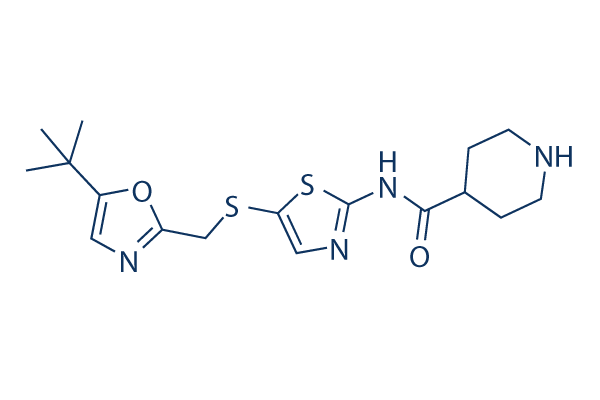
Chemical Structure
Molecular Weight: 380.53
Quality Control
Cell Culture, Treatment & Working Concentration
| Cell Lines | Assay Type | Concentration | Incubation Time | Formulation | Activity Description | PMID |
|---|---|---|---|---|---|---|
| human A2780 cell line | Proliferation assay | 72 h | Antiproliferative effect against human A2780 cell line was determined in a whole cell 72 hr cytotoxicity assay, IC50=95 nM | 15027863 | ||
| Sf21 | Function assay | Inhibition of recombinant human full length C-terminal His6-tagged CDK9/cyclin T1 expressed in baculovirus infected Sf21 insect cells using PDKtide as substrate, IC50=0.004μM | 27171036 | |||
| Sf21 | Function assay | Inhibition of human full length C-terminal His6-tagged CDK2/N-terminal GST-tagged cyclin A expressed in baculovirus infected Sf21 insect cells using histone H1 as substrate, IC50=0.038μM | 27171036 | |||
| Sf21 | Function assay | Inhibition of recombinant human full length C-terminal His6-tagged CDK2/N-terminal GST-tagged cyclin E expressed in baculovirus infected Sf21 insect cells using histone H1 as substrate, IC50=0.048μM | 27171036 | |||
| Sf21 | Function assay | Inhibition of recombinant human full length C-terminal His6-tagged CDK7/cyclin H/N-terminal GST-tagged MAT1 expressed in baculovirus infected Sf21 insect cells using cdk7 substrate peptide, IC50=0.062μM | 27171036 | |||
| Sf21 | Function assay | Inhibition of recombinant human full length N-terminal His6-tagged CDK5/N-terminal GST-tagged p25 expressed in baculovirus infected Sf21 insect cells using histone H1 as substrate, IC50=0.34μM | 27171036 | |||
| HCT116 | Function assay | 16 hrs | Inhibition of CDK9 in human HCT116 cells assessed as phosphor-ser2 level of RNA polymerase 2 after 16 hrs by high content cellular assay, IC50=0.458μM | 18842409 | ||
| Sf21 | Function assay | Inhibition of human full length C-terminal His6-tagged CDK1/N-terminal GST-tagged cyclin B expressed in baculovirus infected Sf21 insect cells using histone H1 as substrate, IC50=0.48μM | 27171036 | |||
| HCT116 | Function assay | 16 hrs | Inhibition of CDK9-mediated RNA pol 2 phosphorylation at ser2 in human HCT116 cells after 16 hrs by HCS assay, IC50=0.55μM | 18926699 | ||
| HCT116 | Antiproliferative assay | 24 hrs | Antiproliferative activity against human HCT116 cells after 24 hrs by MTT assay, IC50=0.7μM | 30197029 | ||
| Sf cells | Function assay | Inhibition of recombinant human N-terminal GST-tagged CDK4/cyclin D1 expressed in baculovirus infected sf cells, IC50=0.925μM | 27171036 | |||
| MCF7 | Antiproliferative assay | 24 hrs | Antiproliferative activity against human MCF7 cells after 24 hrs by MTT assay, IC50=1μM | 30197029 | ||
| TC32 | qHTS assay | qHTS of pediatric cancer cell lines to identify multiple opportunities for drug repurposing: Primary screen for TC32 cells | 29435139 | |||
| DAOY | qHTS assay | qHTS of pediatric cancer cell lines to identify multiple opportunities for drug repurposing: Primary screen for DAOY cells | 29435139 | |||
| SJ-GBM2 | qHTS assay | qHTS of pediatric cancer cell lines to identify multiple opportunities for drug repurposing: Primary screen for SJ-GBM2 cells | 29435139 | |||
| A673 | qHTS assay | qHTS of pediatric cancer cell lines to identify multiple opportunities for drug repurposing: Primary screen for A673 cells | 29435139 | |||
| SK-N-MC | qHTS assay | qHTS of pediatric cancer cell lines to identify multiple opportunities for drug repurposing: Primary screen for SK-N-MC cells | 29435139 | |||
| BT-37 | qHTS assay | qHTS of pediatric cancer cell lines to identify multiple opportunities for drug repurposing: Primary screen for BT-37 cells | 29435139 | |||
| NB-EBc1 | qHTS assay | qHTS of pediatric cancer cell lines to identify multiple opportunities for drug repurposing: Primary screen for NB-EBc1 cells | 29435139 | |||
| Saos-2 | qHTS assay | qHTS of pediatric cancer cell lines to identify multiple opportunities for drug repurposing: Primary screen for Saos-2 cells | 29435139 | |||
| SK-N-SH | qHTS assay | qHTS of pediatric cancer cell lines to identify multiple opportunities for drug repurposing: Primary screen for SK-N-SH cells | 29435139 | |||
| BT-12 | qHTS assay | qHTS of pediatric cancer cell lines to identify multiple opportunities for drug repurposing: Primary screen for BT-12 cells | 29435139 | |||
| OHS-50 | qHTS assay | qHTS of pediatric cancer cell lines to identify multiple opportunities for drug repurposing: Primary screen for OHS-50 cells | 29435139 | |||
| RD | qHTS assay | qHTS of pediatric cancer cell lines to identify multiple opportunities for drug repurposing: Primary screen for RD cells | 29435139 | |||
| Rh41 | qHTS assay | qHTS of pediatric cancer cell lines to identify multiple opportunities for drug repurposing: Primary screen for Rh41 cells | 29435139 | |||
| NB1643 | qHTS assay | qHTS of pediatric cancer cell lines to identify multiple opportunities for drug repurposing: Confirmatory screen for NB1643 cells | 29435139 | |||
| A673 | qHTS assay | qHTS of pediatric cancer cell lines to identify multiple opportunities for drug repurposing: Confirmatory screen for A673 cells) | 29435139 | |||
| SK-N-MC | qHTS assay | qHTS of pediatric cancer cell lines to identify multiple opportunities for drug repurposing: Confirmatory screen for SK-N-MC cells | 29435139 | |||
| BT-12 | qHTS assay | qHTS of pediatric cancer cell lines to identify multiple opportunities for drug repurposing: Confirmatory screen for BT-12 cells | 29435139 | |||
| LAN-5 | qHTS assay | qHTS of pediatric cancer cell lines to identify multiple opportunities for drug repurposing: Confirmatory screen for LAN-5 cells | 29435139 | |||
| DAOY | qHTS assay | qHTS of pediatric cancer cell lines to identify multiple opportunities for drug repurposing: Confirmatory screen for DAOY cells | 29435139 | |||
| SJ-GBM2 | qHTS assay | qHTS of pediatric cancer cell lines to identify multiple opportunities for drug repurposing: Confirmatory screen for SJ-GBM2 cells | 29435139 | |||
| BT-37 | qHTS assay | qHTS of pediatric cancer cell lines to identify multiple opportunities for drug repurposing: Confirmatory screen for BT-37 cells | 29435139 | |||
| TC32 | qHTS assay | qHTS of pediatric cancer cell lines to identify multiple opportunities for drug repurposing: Confirmatory screen for TC32 cells | 29435139 | |||
| U-2 OS | qHTS assay | qHTS of pediatric cancer cell lines to identify multiple opportunities for drug repurposing: Confirmatory screen for U-2 OS cells | 29435139 | |||
| Rh41 | qHTS assay | qHTS of pediatric cancer cell lines to identify multiple opportunities for drug repurposing: Confirmatory screen for Rh41 cells | 29435139 | |||
| RD | qHTS assay | qHTS of pediatric cancer cell lines to identify multiple opportunities for drug repurposing: Confirmatory screen for RD cells | 29435139 | |||
| Saos-2 | qHTS assay | qHTS of pediatric cancer cell lines to identify multiple opportunities for drug repurposing: Confirmatory screen for Saos-2 cells | 29435139 | |||
| OHS-50 | qHTS assay | qHTS of pediatric cancer cell lines to identify multiple opportunities for drug repurposing: Confirmatory screen for OHS-50 cells | 29435139 | |||
| SK-N-SH | qHTS assay | qHTS of pediatric cancer cell lines to identify multiple opportunities for drug repurposing: Confirmatory screen for SK-N-SH cells | 29435139 | |||
| Click to View More Cell Line Experimental Data | ||||||
Solubility
|
In vitro |
DMSO
: 76 mg/mL
(199.72 mM)
Ethanol : 30 mg/mL Water : Insoluble |
Molarity Calculator
|
In vivo |
|||||
In vivo Formulation Calculator (Clear solution)
Step 1: Enter information below (Recommended: An additional animal making an allowance for loss during the experiment)
Step 2: Enter the in vivo formulation (This is only the calculator, not formulation. Please contact us first if there is no in vivo formulation at the solubility Section.)
Calculation results:
Working concentration: mg/ml;
Method for preparing DMSO master liquid: mg drug pre-dissolved in μL DMSO ( Master liquid concentration mg/mL, Please contact us first if the concentration exceeds the DMSO solubility of the batch of drug. )
Method for preparing in vivo formulation: Take μL DMSO master liquid, next addμL PEG300, mix and clarify, next addμL Tween 80, mix and clarify, next add μL ddH2O, mix and clarify.
Method for preparing in vivo formulation: Take μL DMSO master liquid, next add μL Corn oil, mix and clarify.
Note: 1. Please make sure the liquid is clear before adding the next solvent.
2. Be sure to add the solvent(s) in order. You must ensure that the solution obtained, in the previous addition, is a clear solution before proceeding to add the next solvent. Physical methods such
as vortex, ultrasound or hot water bath can be used to aid dissolving.
Chemical Information, Storage & Stability
| Molecular Weight | 380.53 | Formula | C17H24N4O2S2 |
Storage (From the date of receipt) | |
|---|---|---|---|---|---|
| CAS No. | 345627-80-7 | Download SDF | Storage of Stock Solutions |
|
|
| Synonyms | N/A | Smiles | CC(C)(C)C1=CN=C(O1)CSC2=CN=C(S2)NC(=O)C3CCNCC3 | ||
Mechanism of Action
| Targets/IC50/Ki |
CDK9/CyclinT
(Cell-free assay) 4 nM
CDK2/CyclinA
(Cell-free assay) 38 nM
CDK2/CyclinE
(Cell-free assay) 48 nM
CDK7/CyclinH
(Cell-free assay) 62 nM
GSK-3α
(Cell-free assay) 230 nM
CDK5/p35
(Cell-free assay) 340 nM
|
|---|---|
| In vitro |
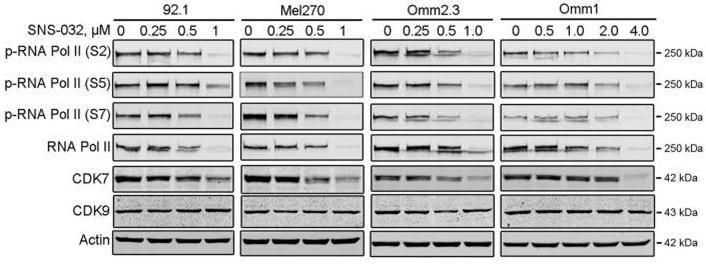
SNS-032 (BMS-387032) has low sensitivity to CDK1 and CDK4 with IC50 of 480 nM and 925 nM, respectively. This compound effectively kills chronic lymphocytic leukemia cells in vitro regardless of prognostic indicators and treatment history. Compared with flavopiridol and roscovitine, this agent is more potent, both in inhibition of RNA synthesis and at induction of apoptosis. Its activity is readily reversible; removal of this compound reactivates RNA polymerase II, which led to resynthesis of Mcl-1 and cell survival. This inhibitor inhibits three dimensional capillary network formations of endothelial cells. It completely prevents U87MG cell–mediated capillary formation of HUVECs. In addition, this chemical significantly prevents the production of VEGF in both cell lines, it prevents in vitro angiogenesis, and this action is attributable to blocking of VEGF. Preclinical studies have shown that this compound induces cell cycle arrest and apoptosis across multiple cell lines. This agent blocks the cell cycle via inhibition of CDKs 2 and 7, and transcription via inhibition of CDKs 7 and 9. Its activity is unaffected by human serum. This compound induces a dose-dependent increase in annexin V staining and caspase-3 activation. At the molecular level, it induces a marked dephosphorylation of serine 2 and 5 of RNA polymerase (RNA Pol) II and inhibits the expression of CDK2 and CDK9 and dephosphorylated CDK7. |
| In vivo |
SNS-032 (BMS-387032) prevents tumor cell-induced VEGF secretion in a tumor coculture model. This compound, a new CDK inhibitor, is more selective and less cytotoxic and has been shown to prolong stable disease in solid tumors. |
References |
|
Applications
| Methods | Biomarkers | Images | PMID |
|---|---|---|---|
| Western blot | p-RNA PolII / RNA Pol II / CDK7 / CDK9 YAP / p-YAP / CTGF / CYR61 p-ROCK / ROCK / p-LIMK1/2 / LIMK1/2 / p-Cofilin / Cofilin Mcl-1 / Cyclin D1 / Bcl-2 / PARP |
|
31526394 |
| Growth inhibition assay | Cell viability |
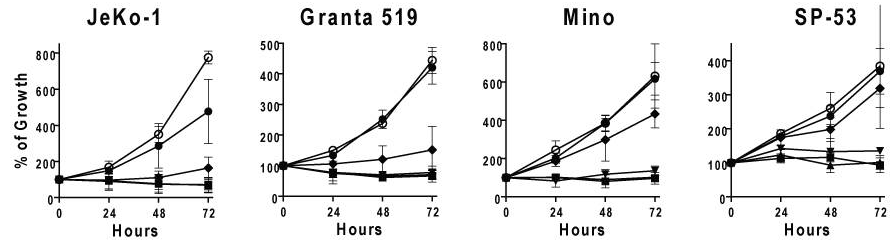
|
20663900 |
Clinical Trial Information
(data from https://clinicaltrials.gov, updated on 2024-05-22)
| NCT Number | Recruitment | Conditions | Sponsor/Collaborators | Start Date | Phases |
|---|---|---|---|---|---|
| NCT00446342 | Completed | B-lymphoid Malignancies|Chronic Lymphocytic Leukemia|Mantle Cell Lymphoma|Multiple Myeloma |
Sunesis Pharmaceuticals |
February 2007 | Phase 1 |
Tech Support
Tel: +1-832-582-8158 Ext:3
If you have any other enquiries, please leave a message.
Signaling Pathway Map

Products are for research use only. Not for human use. We do not sell to patients.
©Copyright 2013 Selleck Chemicals. All Rights Reserved.