
-
 Argentina
-
 Australia
-
 Austria
-
 Belgium
-
 Brazil
-
 Canada
-
 China
China
-
 Czech Republic
-
 Denmark
-
 Finland
-
 France
-
 Germany
-
 Greece
-
 Hong Kong
-
 Hungary
-
 Iceland
-
 India
India
-
 Ireland
-
 Israel
-
 Italy
Italy
-
 Japan
Japan
-
 Korea
Korea
-
 Luxembourg
-
 Malaysia
-
 Netherlands
-
 New Zealand
-
 Norway
-
 Poland
-
 Portugal
-
 Qatar
Qatar
-
 Romania
-
 Saudi Arabia
-
 Singapore
-
 Spain
Spain
-
 Sweden
-
 Switzerland
-
 Taiwan
-
 Turkey
-
 United Kingdom
-
 United States
research use only
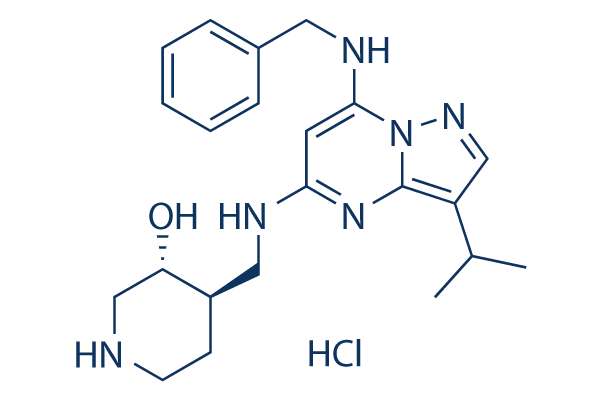
Samuraciclib (ICEC0942) hydrochloride CDK inhibitor
Cat.No.S8722
Quality Control
Solubility
|
In vitro |
DMSO
: 86 mg/mL
(199.54 mM)
Water : 86 mg/mL Ethanol : 15 mg/mL |
Molarity Calculator
|
In vivo |
|||||
In vivo Formulation Calculator (Clear solution)
Step 1: Enter information below (Recommended: An additional animal making an allowance for loss during the experiment)
Step 2: Enter the in vivo formulation (This is only the calculator, not formulation. Please contact us first if there is no in vivo formulation at the solubility Section.)
Calculation results:
Working concentration: mg/ml;
Method for preparing DMSO master liquid: mg drug pre-dissolved in μL DMSO ( Master liquid concentration mg/mL, Please contact us first if the concentration exceeds the DMSO solubility of the batch of drug. )
Method for preparing in vivo formulation: Take μL DMSO master liquid, next addμL PEG300, mix and clarify, next addμL Tween 80, mix and clarify, next add μL ddH2O, mix and clarify.
Method for preparing in vivo formulation: Take μL DMSO master liquid, next add μL Corn oil, mix and clarify.
Note: 1. Please make sure the liquid is clear before adding the next solvent.
2. Be sure to add the solvent(s) in order. You must ensure that the solution obtained, in the previous addition, is a clear solution before proceeding to add the next solvent. Physical methods such
as vortex, ultrasound or hot water bath can be used to aid dissolving.
Chemical Information, Storage & Stability
| Molecular Weight | 430.97 | Formula | C22H31ClN6O |
Storage (From the date of receipt) | 3 years -20°C powder |
|---|---|---|---|---|---|
| CAS No. | 1805789-54-1 | -- | Storage of Stock Solutions |
|
|
| Synonyms | CT7001 hydrochloride | SMILES | CC(C)C1=C2N=C(C=C(N2N=C1)NCC3=CC=CC=C3)NCC4CCNCC4O.Cl | ||
Read more about storage stability stock solution CAS number SMILES
Mechanism of Action
| Targets/IC50/Ki |
CDK7
(Cell-free assay) 40 nM
CDK2
(Cell-free assay) 620 nM
CDK9
(Cell-free assay) 1.2 μM
CDK1
(Cell-free assay) 1.8 μM
|
|---|---|
| In vitro |
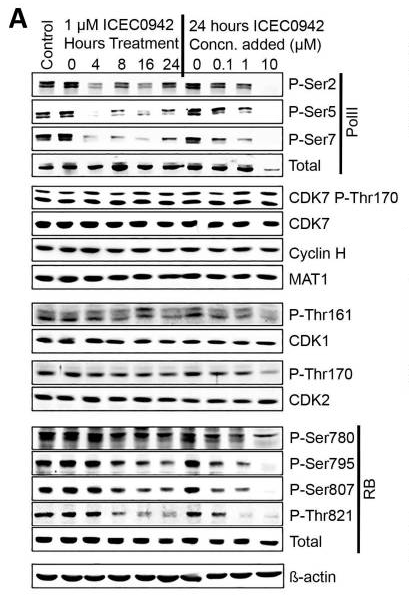
A wide range of cancer types are sensitive to CDK7 inhibition by ICEC0942 with GI50 values ranging between 0.2-0.3 µM. ICEC0942 inhibits PolII, CDK1, CDK2 and RB (retinoblastoma) phosphorylation in the MCF7 breast cancer cell line in a time and dose-sependent manner. ICEC0942 inhibits phosphorylation of CDK7 substrates and promotes cell cycle arrest and apoptosis. |
| In vivo |
In xenografts of both breast and colorectal cancers, ICEC0942 has substantial anti-tumor effects. For pharmacokinetics, CD1 male mice are treated intravenously (IV), subcutaneously (SC) or by oral gavage (PO) with 10 mg/kg ICEC0942. In plasma, ICEC0942 levels decline in a bi-phasic manner, indicating rapid distribution into tissues. Following IV administration of ICEC0942 at 10 mg/kg in male CD1 mice Cl(plasma) is calculated at 78 ml.min/kg. Blood/plasma ratio (Bl/Pl) is 1.81. ICEC0942 has a half-life of 1.9 hrs, a moderate half-life in this species. Only a small proportion (13.5%) of ICEC0942 is metabolized after 2 and 4 hour following a single PO administration (100 mg/kg). Comparing exposure (AUCt) after single PO and IV administration at 10 mg/kg, oral bioavailability (F%) is calculated at 30%. Median Tmax for PO administration is 2 hours and is unaffected by increasing dose. Over this dose range, Cmax is linearly associated with dose, as is the total exposure over time (AUCt). In tumor-bearing mice, there is appreciable accumulation of ICEC0942 in tumors 6-hours post administration. ICEC0942 levels in tumors lag behind plasma levels. |
References |
Applications
| Methods | Biomarkers | Images | PMID |
|---|---|---|---|
| Western blot | p-Ser2 PolII / p-Ser5 PolII / p-Ser7 PolII / p-CDK7 / CDK7 / p-RB |
|
29545334 |
Clinical Trial Information
(data from https://clinicaltrials.gov, updated on 2026-09-03)
| NCT Number | Recruitment | Conditions | Sponsor/Collaborators | Start Date | Phases |
|---|---|---|---|---|---|
| NCT04802759 | RECRUITING | Inoperable, Locally Advanced or Metastatic, ER-positive Breast Cancer |
Hoffmann-La Roche |
2021-06-22 | PHASE1; PHASE2 |
| NCT07665684 | NOT_YET_RECRUITING | Pancreas Ductal Adenocarcinoma; Pancreas Cancer, Metastatic; Pancreatic Adenocarcinoma Metastatic; Adenosquamous Carcinoma of the Pancreas; Mucinous Adenocarcinoma |
University Health Network, Toronto |
2026-07 | PHASE1; PHASE2 |
| NCT07645651 | RECRUITING | Resectable Pancreatic Ductal Adenocarcinoma; Borderline Resectable Pancreatic Ductal Adenocarcinoma; Locally Advanced Pancreatic Ductal Adenocarcinoma |
University of Washington |
2026-09-15 | PHASE1 |
| NCT06125522 | ACTIVE_NOT_RECRUITING | Breast Cancer |
Pfizer |
2024-01-10 | PHASE1; PHASE2 |
| NCT05963997 | COMPLETED | Metastatic Breast Cancer; Locally Advanced Breast Cancer; Breast Cancer |
Carrick Therapeutics Limited |
2023-10-09 | PHASE1; PHASE2 |
| NCT05963984 | COMPLETED | Metastatic Breast Cancer; Locally Advanced Breast Cancer; Breast Cancer |
Carrick Therapeutics Limited |
2023-11-16 | PHASE2 |
Read more about Clinical Trials
Tech Support
Tel: +1-832-582-8158 Ext:3
If you have any other enquiries, please leave a message.
Signaling Pathway Map

Products are for research use only. Not for human use. We do not sell to patients.
©Copyright 2013 Selleck Chemicals. All Rights Reserved.