
-
 Argentina
-
 Australia
-
 Austria
-
 Belgium
-
 Brazil
-
 Canada
-
 China
China
-
 Czech Republic
-
 Denmark
-
 Finland
-
 France
-
 Germany
-
 Greece
-
 Hong Kong
-
 Hungary
-
 Iceland
-
 India
India
-
 Ireland
-
 Israel
-
 Italy
Italy
-
 Japan
Japan
-
 Korea
Korea
-
 Luxembourg
-
 Malaysia
-
 Netherlands
-
 New Zealand
-
 Norway
-
 Poland
-
 Qatar
Qatar
-
 Romania
-
 Saudi Arabia
-
 Singapore
-
 Spain
Spain
-
 Sweden
-
 Switzerland
-
 Taiwan
-
 Turkey
-
 United Kingdom
-
 United States
research use only
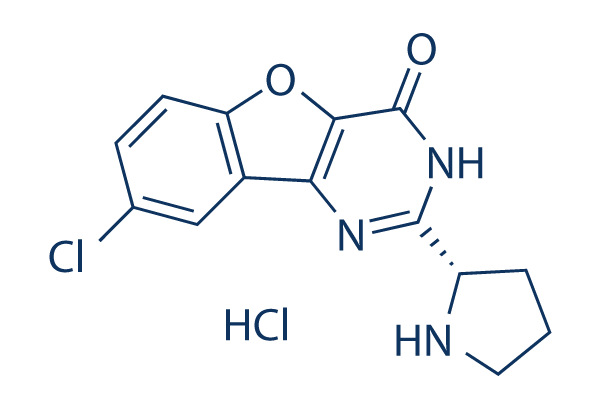
XL413 Hydrochloride (BMS-863233) CDK inhibitor
Cat.No.S7547
Quality Control
Cell Culture, Treatment & Working Concentration
| Cell Lines | Assay Type | Concentration | Incubation Time | Formulation | Activity Description | PMID |
|---|---|---|---|---|---|---|
| human MDA-MB-231T cells | Function assay | 4 h | Inhibition of CDC7 in human MDA-MB-231T cells assessed as inhibition of MCM2 phosphorylation at Ser53 after 4 hrs, IC50=0.118 μM | 22560567 | ||
| human Caco2 cells | Function assay | 4 h | Inhibition of CDC7 in human Caco2 cells assessed as inhibition of MCM2 phosphorylation at Ser53 after 4 hrs, IC50=0.14 μM | 22560567 | ||
| human Caco2 cells | Proliferation assay | Antiproliferative activity against human Caco2 cells assessed as inhibition of anchorage-independent growth in soft agar, IC50=0.715 μM | 22560567 | |||
| Caco2 cells | Function assay | Induction of apoptosis in human Caco2 cells assessed as increase in caspase 3/7 activity, EC50=2.288 μM | 22560567 | |||
| MDA-MB-468 | Function assay | Inhibition of PHGDH in human MDA-MB-468 cells assessed as decrease in serine flux, EC50 = 2.3 μM. | 29555419 | |||
| MDA-MB-468 | Cytotoxicity assay | Cytotoxicity against human MDA-MB-468 cells, EC50 = 8 μM. | 29555419 | |||
| Click to View More Cell Line Experimental Data | ||||||
Solubility
|
In vitro |
Water : 46 mg/mL
DMSO
: Insoluble
Ethanol : Insoluble |
Molarity Calculator
|
In vivo |
|||||
In vivo Formulation Calculator (Clear solution)
Step 1: Enter information below (Recommended: An additional animal making an allowance for loss during the experiment)
Step 2: Enter the in vivo formulation (This is only the calculator, not formulation. Please contact us first if there is no in vivo formulation at the solubility Section.)
Calculation results:
Working concentration: mg/ml;
Method for preparing DMSO master liquid: mg drug pre-dissolved in μL DMSO ( Master liquid concentration mg/mL, Please contact us first if the concentration exceeds the DMSO solubility of the batch of drug. )
Method for preparing in vivo formulation: Take μL DMSO master liquid, next addμL PEG300, mix and clarify, next addμL Tween 80, mix and clarify, next add μL ddH2O, mix and clarify.
Method for preparing in vivo formulation: Take μL DMSO master liquid, next add μL Corn oil, mix and clarify.
Note: 1. Please make sure the liquid is clear before adding the next solvent.
2. Be sure to add the solvent(s) in order. You must ensure that the solution obtained, in the previous addition, is a clear solution before proceeding to add the next solvent. Physical methods such
as vortex, ultrasound or hot water bath can be used to aid dissolving.
Chemical Information, Storage & Stability
| Molecular Weight | 326.18 | Formula | C14H13Cl2N3O2 |
Storage (From the date of receipt) | |
|---|---|---|---|---|---|
| CAS No. | 1169562-71-3 | Download SDF | Storage of Stock Solutions |
|
|
| Synonyms | BMS-863233 | SMILES | C1CC(NC1)C2=NC3=C(C(=O)N2)OC4=C3C=C(C=C4)Cl.Cl | ||
Read more about storage stability stock solution CAS number SMILES
Mechanism of Action
| Targets/IC50/Ki |
Cdc7
(Cell-free assay) 3.4 nM
Pim1
(Cell-free assay) 42 nM
CK2
(Cell-free assay) 212 nM
|
|---|---|
| In vitro |
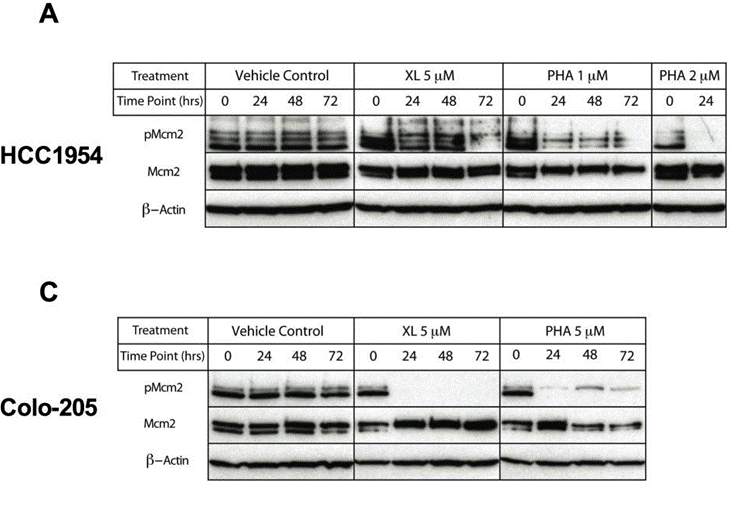
In MDA-MB-231T and Colo-205 cell lines, XL413 results in inhibition of CDC7 specific phosphorylation of MCM2. This compound also inhibits the cell proliferation, decreases cell viability and elicits the caspase 3/7 activity in Colo-205 cells. Moreover, it results in modified S phase progression that subsequently leads to apoptotic cell death.
|
| Kinase Assay |
CDC7 kinase assay
|
|
Kinase activity and compound inhibition are determined using the luciferase-luciferin-coupled chemiluminescence assay and measured as the percentage of ATP utilized following the kinase reaction in a 384-well format. The final CDC7 kinase assay condition is 6 nM CDC7/ASK, 1 μM ATP, 50 mM Hepes pH 7.4, 10 mM MgCl2, 0.02% BSA, 0.02% brij 35, 0.02% tween 20 and 1 mM DTT. It is worthy to note that the CDC7/ASK protein exhibits substrate-independent ATP utilization. All kinase reactions are incubated at room temperature for 1-2 h.
|
|
| In vivo |
In a Colo-205 xenograft model, XL413, at the 3 mg/kg dose, causes 70% inhibition of phosphorylated MCM2, and this compound causes significant tumor growth regression at the 100 mg/kg dose.
|
References |
Applications
| Methods | Biomarkers | Images | PMID |
|---|---|---|---|
| Western blot | p-Mcm2 / Mcm2 |
|
25412417 |
Clinical Trial Information
(data from https://clinicaltrials.gov, updated on 2024-05-22)
| NCT Number | Recruitment | Conditions | Sponsor/Collaborators | Start Date | Phases |
|---|---|---|---|---|---|
| NCT00886782 | Terminated | Advanced Solid Cancers|Metastatic Cancer |
Bristol-Myers Squibb|Exelixis |
2009-05-31 | Phase 1|Phase 2 |
| NCT00838890 | Terminated | Refractory Hematologic Cancer |
Bristol-Myers Squibb|Exelixis |
2009-03 | Phase 1|Phase 2 |
Read more about Clinical Trials
Tech Support
Tel: +1-832-582-8158 Ext:3
If you have any other enquiries, please leave a message.
Signaling Pathway Map

Products are for research use only. Not for human use. We do not sell to patients.
©Copyright 2013 Selleck Chemicals. All Rights Reserved.