
-
 Australia
-
 Austria
-
 Belgium
-
 Brazil
-
 Canada
-
 China
China
-
 Czech Republic
-
 Denmark
-
 Finland
-
 France
-
 Germany
-
 Greece
-
 Hong Kong
-
 Hungary
-
 Iceland
-
 India
India
-
 Ireland
-
 Israel
-
 Italy
Italy
-
 Japan
Japan
-
 Korea
Korea
-
 Luxembourg
-
 Malaysia
-
 Netherlands
-
 New Zealand
-
 Norway
-
 Poland
-
 Qatar
Qatar
-
 Romania
-
 Saudi Arabia
-
 Singapore
-
 Spain
Spain
-
 Sweden
-
 Switzerland
-
 Taiwan
-
 Turkey
-
 United Kingdom
-
 United States
research use only
JSH-150 CDK inhibitor
Cat.No.S8783
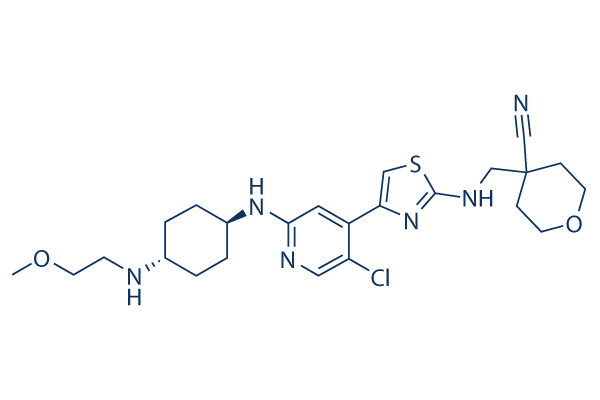
Chemical Structure
Molecular Weight: 505.08
Quality Control
Solubility
|
In vitro |
DMSO
: 100 mg/mL
(197.98 mM)
Water : 100 mg/mL Ethanol : 100 mg/mL |
Molarity Calculator
|
In vivo |
|||||
In vivo Formulation Calculator (Clear solution)
Step 1: Enter information below (Recommended: An additional animal making an allowance for loss during the experiment)
Step 2: Enter the in vivo formulation (This is only the calculator, not formulation. Please contact us first if there is no in vivo formulation at the solubility Section.)
Calculation results:
Working concentration: mg/ml;
Method for preparing DMSO master liquid: mg drug pre-dissolved in μL DMSO ( Master liquid concentration mg/mL, Please contact us first if the concentration exceeds the DMSO solubility of the batch of drug. )
Method for preparing in vivo formulation: Take μL DMSO master liquid, next addμL PEG300, mix and clarify, next addμL Tween 80, mix and clarify, next add μL ddH2O, mix and clarify.
Method for preparing in vivo formulation: Take μL DMSO master liquid, next add μL Corn oil, mix and clarify.
Note: 1. Please make sure the liquid is clear before adding the next solvent.
2. Be sure to add the solvent(s) in order. You must ensure that the solution obtained, in the previous addition, is a clear solution before proceeding to add the next solvent. Physical methods such
as vortex, ultrasound or hot water bath can be used to aid dissolving.
Chemical Information, Storage & Stability
| Molecular Weight | 505.08 | Formula | C24H33ClN6O2S |
Storage (From the date of receipt) | 3 years -20°C powder |
|---|---|---|---|---|---|
| CAS No. | 2247481-21-4 | -- | Storage of Stock Solutions |
|
|
| Synonyms | N/A | Smiles | COCCNC1CCC(CC1)NC2=NC=C(C(=C2)C3=CSC(=N3)NCC4(CCOCC4)C#N)Cl | ||
Mechanism of Action
| Targets/IC50/Ki |
CDK9
(Cell-free assay) 1 nM
|
|---|---|
| In vitro |
JSH-150 exhibits an IC50 of 1 nM against CDK9 kinase in the biochemical assay and achieves around 300-10000-fold selectivity over other CDK kinase family members. In addition, it also displays high selectivity over other 468 kinases/mutants. This compound displays potent antiproliferative effects against melanoma, neuroblastoma, hepatoma, colon cancer, lung cancer as well as leukemia cell lines. It can dose-dependently inhibit the phosphorylation of RNA Pol II, suppress the expression of MCL-1 and C-Myc, arrest the cell cycle and induce the apoptosis in the leukemia cells. |
| Kinase Assay |
The ADP-Glo kinase assay
|
|
The kinase reaction system contains 4.5 μL of CDK9/CyclinK kinase (3 ng/μL), 0.5 μL of serially diluted compounds 11-43 (including JSH-150), and 5 μL of CDK9 substrate PDKtide (0.2 μg/μL) with 10 μM ATP. The reaction in each tube is started immediately by adding ATP and keeps going for an hour under 37 °C. After the tube is cooled for 5 min at room temperature, 5 μL solvent reactions are carried out in a 384-well plate. Then 5 μL of ADP-Glo reagent is added into each well to stop the reaction and consume the remaining ADP within 40 min. At the end, 10 μL of kinase detection reagent is added into the well and incubated for 30 min to produce a luminescence signal. Luminescence signal is measured with an automated plate reader and the dose−response curve is fitted using Prism 7.0.
|
|
| In vivo |
In the MV4-11 cell-inoculated xenograft mouse model, 10 mg/kg dosage of JSH-150 can almost completely suppress the tumor progression. The high selectivity and good in vivo PK/PD profile suggests that this compound will be a good pharmacological tool to study CDK9-mediated physiology and pathology as well as a potential drug candidate for leukemia and other cancers. |
References |
Tech Support
Tel: +1-832-582-8158 Ext:3
If you have any other enquiries, please leave a message.
Signaling Pathway Map

Products are for research use only. Not for human use. We do not sell to patients.
©Copyright 2013 Selleck Chemicals. All Rights Reserved.