
-
 Argentina
-
 Australia
-
 Austria
-
 Belgium
-
 Brazil
-
 Canada
-
 China
China
-
 Czech Republic
-
 Denmark
-
 Finland
-
 France
-
 Germany
-
 Greece
-
 Hong Kong
-
 Hungary
-
 Iceland
-
 India
India
-
 Ireland
-
 Israel
-
 Italy
Italy
-
 Japan
Japan
-
 Korea
Korea
-
 Luxembourg
-
 Malaysia
-
 Netherlands
-
 New Zealand
-
 Norway
-
 Poland
-
 Portugal
-
 Qatar
Qatar
-
 Romania
-
 Saudi Arabia
-
 Singapore
-
 Spain
Spain
-
 Sweden
-
 Switzerland
-
 Taiwan
-
 Turkey
-
 United Kingdom
-
 United States
research use only
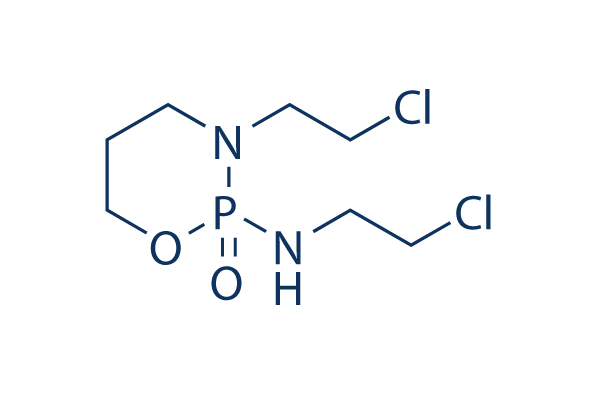
Ifosfamide Alkylating Agent
Cat.No.S1302
Quality Control
| Related Targets | HDAC PARP ATM/ATR DNA-PK WRN DNA/RNA Synthesis Topoisomerase PPAR Sirtuin Casein Kinase |
|---|---|
| Other Alkylating Agent Inhibitors | Berberine (Umbellatine) MNNG (1-Methyl-3-nitro-1-nitrosoguanidine) |
Cell Culture, Treatment & Working Concentration
| Cell Lines | Assay Type | Concentration | Incubation Time | Formulation | Activity Description | PMID |
|---|---|---|---|---|---|---|
| SJ-GBM2 | qHTS assay | qHTS of pediatric cancer cell lines to identify multiple opportunities for drug repurposing: Primary screen for SJ-GBM2 cells | 29435139 | |||
| A673 | qHTS assay | qHTS of pediatric cancer cell lines to identify multiple opportunities for drug repurposing: Primary screen for A673 cells | 29435139 | |||
| Click to View More Cell Line Experimental Data | ||||||
Solubility
|
In vitro |
DMSO
: 52 mg/mL
(199.16 mM)
Water : 52 mg/mL Ethanol : 52 mg/mL |
Molarity Calculator
|
In vivo |
|||||
In vivo Formulation Calculator (Clear solution)
Step 1: Enter information below (Recommended: An additional animal making an allowance for loss during the experiment)
Step 2: Enter the in vivo formulation (This is only the calculator, not formulation. Please contact us first if there is no in vivo formulation at the solubility Section.)
Calculation results:
Working concentration: mg/ml;
Method for preparing DMSO master liquid: mg drug pre-dissolved in μL DMSO ( Master liquid concentration mg/mL, Please contact us first if the concentration exceeds the DMSO solubility of the batch of drug. )
Method for preparing in vivo formulation: Take μL DMSO master liquid, next addμL PEG300, mix and clarify, next addμL Tween 80, mix and clarify, next add μL ddH2O, mix and clarify.
Method for preparing in vivo formulation: Take μL DMSO master liquid, next add μL Corn oil, mix and clarify.
Note: 1. Please make sure the liquid is clear before adding the next solvent.
2. Be sure to add the solvent(s) in order. You must ensure that the solution obtained, in the previous addition, is a clear solution before proceeding to add the next solvent. Physical methods such
as vortex, ultrasound or hot water bath can be used to aid dissolving.
Chemical Information, Storage & Stability
| Molecular Weight | 261.09 | Formula | C7H15Cl2N2O2P |
Storage (From the date of receipt) | |
|---|---|---|---|---|---|
| CAS No. | 3778-73-2 | Download SDF | Storage of Stock Solutions |
|
|
| Synonyms | NSC109724, Isophosphamide | SMILES | C1CN(P(=O)(OC1)NCCCl)CCCl | ||
Read more about storage stability stock solution CAS number SMILES
Mechanism of Action
| In vitro |
Ifosfamide (50 mM) increases CYP3A4, CYP2C8, and CYP2C9 protein levels in hepatocytes, which thereby enhances their own rates of 4-hydroxylation in the cultured hepatocytes. This compound only induces CYP3A4 in one human hepatocyte culture that contained the polymorphically expressed CYP3A5 in addition to the more widely expressed CYP3A4. It is a prodrug metabolised in the liver by cytochrome P450 mixed-function oxidase enzymes to isofosforamide mustard, the active alkylating compound. This drug has produced favourable response rates in small cell lung cancer, paediatric solid tumours, non-Hodgkin's and Hodgkin's lymphoma, and ovarian cancer. It is highly cytotoxic to MCF-7 cells following stable transfection of CYP2B1 but exhibits no toxicity to parental tumor cells or to a beta-galactosidase-expressing MCF-7 transfectant, this cytotoxicity could be appreciably blocked by the CYP2B1 inhibitor metyrapone. When combined with Zoledronic acid, it is more effective than each agent alone in preventing tumor recurrence, improving tissue repair, and increasing bone formation as revealed by the analysis of trabecular architecture. |
|---|---|
| In vivo |
Ifosfamide (100 mg/kg, 200 mg/kg and 400 mg/kg) injected intraperitoneally induces a dose dependent increase in bladder wet weight and Evans blue extravasation in mice. This compound reveals extensive cystitis characterized by acute inflammation with vascular congestion, edema, hemorrhage and fibrin deposition, neutrophil cell infiltration and epithelial denudation in mice. It shows intense reactivity to inducible nitric oxide synthase in the cytoplasm as well as intense and diffuse necrosis on hematoxylin and eosin staining. |
References |
|
Clinical Trial Information
(data from https://clinicaltrials.gov, updated on 2026-08-03)
| NCT Number | Recruitment | Conditions | Sponsor/Collaborators | Start Date | Phases |
|---|---|---|---|---|---|
| NCT06239272 | RECRUITING | Adipocytic Neoplasm; Liposarcoma; Atypical Fibroxanthoma; Angiomatoid Fibrous Histiocytoma; Fibrosarcoma NOS; Myxofibrosarcoma; Angiosarcoma; Osteosarcoma, Extraskeletal; Dedifferentiated Liposarcoma; Myxoid Liposarcoma; Pleomorphic Liposarcoma; Myxoid Pleomorphic Liposarcoma; Low Grade Fibromyxoid Sarcoma; Sclerosing Epithelioid Fibrosarcoma; Malignant Tenosynovial Giant Cell Tumor of Soft Tissue; Epithelioid Hemangioendothelioma; Glomus Tumor; Inflammatory Leiomyosarcoma; Leiomyosarcoma; Ossifying Fibromyxoid Tumor, Malignant; Myoepithelioma; Synovial Sarcoma; Epithelioid Sarcoma; Perineurioma, Malignant; Clear Cell Sarcoma; Extraskeletal Myxoid Chondrosarcoma; Granular Cell Tumor, Malignant; Melanotic Malignant Nerve Sheath Tumor; Malignant Peripheral Nerve Sheath Tumor; Perivascular Epithelioid Tumor, Malignant; Intimal Sarcoma; Myoepithelial Carcinoma; Undifferentiated Sarcoma; Pleomorphic Sarcoma, Undifferentiated; Round Cell Sarcoma, Undifferentiated; NTRK-Rearranged Spindle Cell Neoplasm; Phosphaturic Mesenchymal Tumor, Malignant; Round Cell Sarcoma; Well Differentiated Liposarcoma; Giant Cell Tumor of Soft Parts NOS; Low Grade Myofibroblastic Sarcoma; Dermatofibrosarcoma Protuberans, Fibrosarcomatous |
St. Jude Children's Research Hospital |
2024-03-27 | PHASE1; PHASE2 |
| NCT02106988 | ACTIVE_NOT_RECRUITING | Lymphoma |
M.D. Anderson Cancer Center |
2015-01-16 | PHASE2 |
| NCT07724457 | NOT_YET_RECRUITING | Recurrent Burkitt Lymphoma; Recurrent High Grade B-Cell Lymphoma With MYC and BCL2 Rearrangements; Refractory Burkitt Lymphoma; Refractory High Grade B-Cell Lymphoma With MYC and BCL2 Rearrangements |
National Cancer Institute (NCI) |
2026-10-30 | PHASE2; PHASE3 |
| NCT07321912 | RECRUITING | Osteosarcoma; Ewing Sarcoma |
Milton S. Hershey Medical Center |
2026-06-05 | PHASE2 |
| NCT02375204 | ACTIVE_NOT_RECRUITING | Germ Cell Tumor; Teratoma; Choriocarcinoma; Germinoma; Mixed Germ Cell Tumor; Yolk Sac Tumor; Childhood Teratoma; Malignant Germ Cell Neoplasm; Extragonadal Seminoma; Non-seminomatous Germ Cell Tumor; Seminoma |
Alliance for Clinical Trials in Oncology |
2015-08-06 | PHASE3 |
| NCT05991388 | RECRUITING | B-cell Non Hodgkin Lymphoma |
University of Birmingham |
2024-05-02 | PHASE2; PHASE3 |
Read more about Clinical Trials
Tech Support
Tel: +1-832-582-8158 Ext:3
If you have any other enquiries, please leave a message.

Products are for research use only. Not for human use. We do not sell to patients.
©Copyright 2013 Selleck Chemicals. All Rights Reserved.