
-
 Argentina
-
 Australia
-
 Austria
-
 Belgium
-
 Brazil
-
 Canada
-
 China
China
-
 Czech Republic
-
 Denmark
-
 Finland
-
 France
-
 Germany
-
 Greece
-
 Hong Kong
-
 Hungary
-
 Iceland
-
 India
India
-
 Ireland
-
 Israel
-
 Italy
Italy
-
 Japan
Japan
-
 Korea
Korea
-
 Luxembourg
-
 Malaysia
-
 Netherlands
-
 New Zealand
-
 Norway
-
 Poland
-
 Portugal
-
 Qatar
Qatar
-
 Romania
-
 Saudi Arabia
-
 Singapore
-
 Spain
Spain
-
 Sweden
-
 Switzerland
-
 Taiwan
-
 Turkey
-
 United Kingdom
-
 United States
research use only
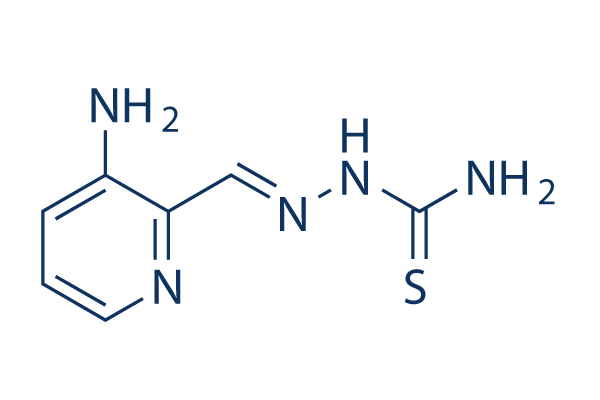
Triapine (3-AP) DNA/RNA Synthesis inhibitor
Cat.No.S7470
Quality Control
| Related Targets | HDAC PARP ATM/ATR DNA-PK WRN Topoisomerase PPAR Sirtuin Casein Kinase eIF |
|---|---|
| Other DNA/RNA Synthesis Inhibitors | CX-5461 (Pidnarulex) SCR7 Favipiravir (T-705) RK-33 EED226 BMH-21 Carmofur YK-4-279 Halofuginone Tegafur (FT-207) |
Cell Culture, Treatment & Working Concentration
| Cell Lines | Assay Type | Concentration | Incubation Time | Formulation | Activity Description | PMID |
|---|---|---|---|---|---|---|
| SK-N-MC | Antiproliferative assay | Antiproliferative activity against human SK-N-MC cells by MTT assay, IC50=0.31μM | 17142046 | |||
| SK-N-MC | Antiproliferative assay | 72 hrs | Antiproliferative activity against human SK-N-MC cells after 72 hrs by MTT assay, IC50=0.26μM | 17602603 | ||
| SK-N-MC | Antiproliferative assay | Antiproliferative activity against human SK-N-MC cells by MTT assay, IC50=0.54μM | 17963372 | |||
| BT-37 | qHTS assay | qHTS of pediatric cancer cell lines to identify multiple opportunities for drug repurposing: Primary screen for BT-37 cells | 18159922 | |||
| KB-3-1 | Cytotoxicity assay | 72 hrs | Cytotoxicity against human P-gp-negative KB-3-1 cells after 72 hrs by MTT assay, IC50=1.4μM | 19397322 | ||
| KB-3-1 | Cytotoxicity assay | 72 hrs | Cytotoxicity against human P-gp-negative KB-3-1 cells after 72 hrs by MTT assay, IC50=1.41254μM | 19397322 | ||
| KBV1 | Cytotoxicity assay | 72 hrs | Cytotoxicity against human P-glycoprotein-expressing KBV1 cells after 72 hrs by MTT assay, IC50=5.88844μM | 19397322 | ||
| KBV1 | Cytotoxicity assay | 72 hrs | Cytotoxicity against human P-glycoprotein-expressing KBV1 cells after 72 hrs by MTT assay, IC50=5.9μM | 19397322 | ||
| SK-N-MC | Antiproliferative assay | 72 hrs | Antiproliferative activity against human SK-N-MC cells after 72 hrs by MTT assay, IC50=0.26μM | 19601577 | ||
| HCT116 | Dark cytotoxicity assay | 96 hrs | Dark cytotoxicity against human HCT116 cells expressing wild type p53 after 96 hrs by MTT assay, IC50=1.226μM | 24900837 | ||
| HCT116 | Photocytotoxicity assay | 24 hrs | Photocytotoxicity against human HCT116 cells expressing wild type p53 incubated for 24 hrs followed by light irradiation measured after 24 hrs by MTS assay in presence of ALA and FeCl3 | 24900837 | ||
| HCT116 | Function assay | 4 uM | 24 hrs | Induction of ROS generation in human HCT116 cells expressing wild type p53 at 4 uM after 24 hrs by spectrophotometry | 24900837 | |
| NB-EBc1 | qHTS assay | qHTS of pediatric cancer cell lines to identify multiple opportunities for drug repurposing: Primary screen for NB-EBc1 cells | 27336684 | |||
| OHS-50 | qHTS assay | qHTS of pediatric cancer cell lines to identify multiple opportunities for drug repurposing: Primary screen for OHS-50 cells | 27336684 | |||
| KB-3-1 | Cytotoxicity assay | 72 hrs | Cytotoxicity against human KB-3-1 cells incubated for 72 hrs by MTT assay, IC50=3.1μM | 27336684 | ||
| KBC1 | Cytotoxicity assay | 72 hrs | Cytotoxicity against human KBC1 cells incubated for 72 hrs by MTT assay, IC50=8.9μM | 27336684 | ||
| SW480 | Function assay | 2.5 uM | 48 hrs | Induction of morphological changes in human SW480 cells assessed as induction of massive cell flattening at 2.5 uM incubated for 48 hrs by phase contrast microscopy | 27336684 | |
| HL60 | Function assay | 1 and 5 uM | 30 mins | Induction of intracellular ROS generation in human HL60 cells at 1 and 5 uM in presence of CuCl2 incubated for 30 mins by DCF-DA staining based fluorescence assay | 27336684 | |
| L1210 | Growth inhibition assay | Growth inhibition of mouse L1210 cells by MTS assay, IC50=1.3μM | 30904782 | |||
| SJ-GBM2 | qHTS assay | qHTS of pediatric cancer cell lines to identify multiple opportunities for drug repurposing: Primary screen for SJ-GBM2 cells | 31614257 | |||
| WPMY-1 | Antiproliferative assay | 72 hrs | Antiproliferative activity against human WPMY-1 cells assessed as reduction in cell proliferation incubated for 72 hrs by MTT assay, IC50=4.96μM | 31614257 | ||
| GES-1 | Antiproliferative assay | 72 hrs | Antiproliferative activity against human GES-1 cells assessed as reduction in cell proliferation incubated for 72 hrs by MTT assay, IC50=5.6μM | 31614257 | ||
| HEK293 | Cytotoxicity assay | Cytotoxicity against HEK293 cells (CO-ADD:MA_007); CC50 by cell viability assay in DMEM (10% FBS) media using TC plates, by Resazurin F(560/590), CC50=2.827μM | ChEMBL | |||
| GES-1 | Cytotoxicity assay | 72 hrs | Cytotoxicity against human GES-1 cells after 72 hrs by MTT assay, IC50=5.4μM | ChEMBL | ||
| MGC803 | Antiproliferative assay | 72 hrs | Antiproliferative activity against human MGC803 cells after 72 hrs by MTT assay, IC50=9.68μM | ChEMBL | ||
| MCF7 | Antiproliferative assay | 72 hrs | Antiproliferative activity against human MCF7 cells after 72 hrs by MTT assay, IC50=18.85μM | ChEMBL | ||
| SMMC7721 | Antiproliferative assay | 72 hrs | Antiproliferative activity against human SMMC7721 cells after 72 hrs by MTT assay, IC50=42.81μM | ChEMBL | ||
| Click to View More Cell Line Experimental Data | ||||||
Solubility
|
In vitro |
DMSO
: 39 mg/mL
(199.75 mM)
Water : Insoluble Ethanol : Insoluble |
Molarity Calculator
|
In vivo |
|||||
In vivo Formulation Calculator (Clear solution)
Step 1: Enter information below (Recommended: An additional animal making an allowance for loss during the experiment)
Step 2: Enter the in vivo formulation (This is only the calculator, not formulation. Please contact us first if there is no in vivo formulation at the solubility Section.)
Calculation results:
Working concentration: mg/ml;
Method for preparing DMSO master liquid: mg drug pre-dissolved in μL DMSO ( Master liquid concentration mg/mL, Please contact us first if the concentration exceeds the DMSO solubility of the batch of drug. )
Method for preparing in vivo formulation: Take μL DMSO master liquid, next addμL PEG300, mix and clarify, next addμL Tween 80, mix and clarify, next add μL ddH2O, mix and clarify.
Method for preparing in vivo formulation: Take μL DMSO master liquid, next add μL Corn oil, mix and clarify.
Note: 1. Please make sure the liquid is clear before adding the next solvent.
2. Be sure to add the solvent(s) in order. You must ensure that the solution obtained, in the previous addition, is a clear solution before proceeding to add the next solvent. Physical methods such
as vortex, ultrasound or hot water bath can be used to aid dissolving.
Chemical Information, Storage & Stability
| Molecular Weight | 195.24 | Formula | C7H9N5S |
Storage (From the date of receipt) | |
|---|---|---|---|---|---|
| CAS No. | 200933-27-3 | Download SDF | Storage of Stock Solutions |
|
|
Read more about storage stability stock solution CAS number SMILES
Mechanism of Action
| Targets/IC50/Ki |
Ribonucleotide reductase
|
|---|---|
| In vitro |
Triapine (3-AP) potently inhibits the activity of ribonucleotide reductase in both wild-type KB and HU-resistant KB nasopharyngeal carcinoma cells, and shows broad spectrum antitumor activity by inhibiting DNA synthesis in a series of cancer cell lines. In vitro, it blocks ischemic neurotoxicity and hypoxic toxicity with EC50 of 0.35 μM and 0.75 μM, respectively. This compound also shows its neuroprotective activity by suppressing cell death induced by neurotoxic agents, including staurosporine, veratridine and glutamate.
|
| Kinase Assay |
Ribonucleotide reductase assay
|
|
CDP reductase is assayed using Dowex 1-borate ion-exchange chromatography. The assay mixture contains 0.02 μCi of [14C]CDP (52.9 mCi/mmol), 3 mM dithiothreitol, 6 mM MgCl2, 30 mM HEPES, 5 mM ATP, 0.15 mM unlabeled CDP, and 10 μL of cellular extract in a final volume of 0.02 mL. The incubation time for the reaction is 60 min, during which time the reaction is linear.
|
|
| In vivo |
In mice bearing the L1210 leukemia, Triapine (3-AP) (1.25 to 20 mg/kg) is curative for some mice without lethal toxicity. This compound also inhibits the growth of solid tumors in mice M109 lung carcinoma and human A2780 ovarian carcinoma xenografts. In addition, its combination with various classes of agents that damage DNA results in synergistic inhibition of the L1210 leukemia. In a rat model of transient ischemia, it reduces infarct volume by 59% when administered i.c.v. (50 μ per rat) and by 35% when administered i.v. (1 mg/kg).
|
References |
|
Applications
| Methods | Biomarkers | Images | PMID |
|---|---|---|---|
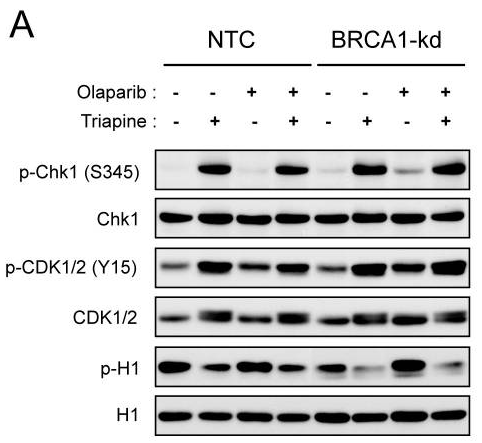
| Western blot | p-Chk1 / Chk1 / p-CDK1/2 / CDK1/2 / p-H1 |
|
24413181 |
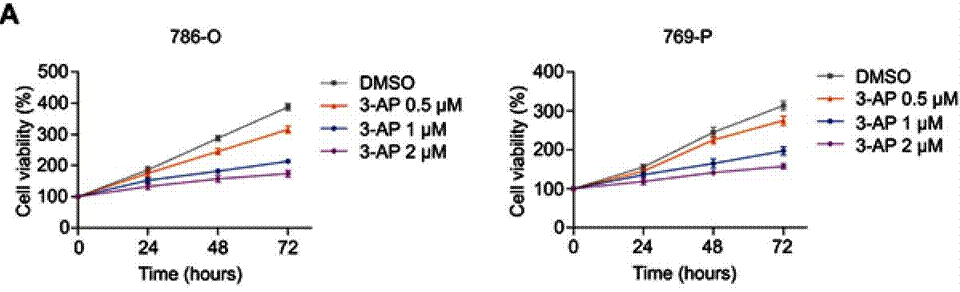
| Growth inhibition assay | Cell viability |
|
31118677 |
Clinical Trial Information
(data from https://clinicaltrials.gov, updated on 2026-05-01)
| NCT Number | Recruitment | Conditions | Sponsor/Collaborators | Start Date | Phases |
|---|---|---|---|---|---|
| NCT06410248 | RECRUITING | Recurrent Glioblastoma, IDH-Wildtype; Recurrent WHO Grade 2 Glioma; Recurrent WHO Grade 3 Glioma; Recurrent WHO Grade 4 Glioma |
Northwestern University |
2024-07-23 | PHASE1 |
| NCT06860594 | RECRUITING | Astrocytoma, IDH-Mutant, Grade 2; Recurrent Adult Diffuse Hemispheric Glioma, H3 G34-Mutant; Recurrent Adult Diffuse Midline Glioma, H3 K27-Mutant; Recurrent Astrocytoma, IDH-Mutant; Recurrent Astrocytoma, IDH-Mutant, Grade 3; Recurrent Astrocytoma, IDH-Mutant, Grade 4; Recurrent Glioblastoma, IDH-Wildtype |
National Cancer Institute (NCI) |
2025-07-30 | PHASE1 |
| NCT05724108 | ACTIVE_NOT_RECRUITING | Metastatic Neuroendocrine Tumor |
National Cancer Institute (NCI) |
2023-08-30 | PHASE2 |
| NCT04494113 | ACTIVE_NOT_RECRUITING | Endometrial Serous Adenocarcinoma |
National Cancer Institute (NCI) |
2022-02-08 | EARLY_PHASE1 |
| NCT04234568 | ACTIVE_NOT_RECRUITING | Metastatic Digestive System Neuroendocrine Neoplasm; Metastatic Neuroendocrine Tumor |
National Cancer Institute (NCI) |
2020-07-20 | PHASE1 |
| NCT02595879 | ACTIVE_NOT_RECRUITING | Advanced Cervical Adenocarcinoma; Advanced Cervical Adenosquamous Carcinoma; Advanced Cervical Squamous Cell Carcinoma; Advanced Vaginal Adenocarcinoma; Advanced Vaginal Adenosquamous Carcinoma; Advanced Vaginal Squamous Cell Carcinoma; Stage IB2 Cervical Cancer AJCC v6 and v7; Stage II Cervical Cancer AJCC v7; Stage II Vaginal Cancer AJCC v6 and v7; Stage III Vaginal Cancer AJCC v6 and v7; Stage IIIB Cervical Cancer AJCC v6 and v7; Stage IVA Cervical Cancer AJCC v6 and v7; Stage IVA Vaginal Cancer AJCC v6 and v7 |
National Cancer Institute (NCI) |
2019-09-18 | PHASE1 |
Read more about Clinical Trials
Tech Support
Tel: +1-832-582-8158 Ext:3
If you have any other enquiries, please leave a message.
Signaling Pathway Map

Products are for research use only. Not for human use. We do not sell to patients.
©Copyright 2013 Selleck Chemicals. All Rights Reserved.