
-
 Argentina
-
 Australia
-
 Austria
-
 Belgium
-
 Brazil
-
 Canada
-
 China
China
-
 Czech Republic
-
 Denmark
-
 Finland
-
 France
-
 Germany
-
 Greece
-
 Hong Kong
-
 Hungary
-
 Iceland
-
 India
India
-
 Ireland
-
 Israel
-
 Italy
Italy
-
 Japan
Japan
-
 Korea
Korea
-
 Luxembourg
-
 Malaysia
-
 Netherlands
-
 New Zealand
-
 Norway
-
 Poland
-
 Portugal
-
 Qatar
Qatar
-
 Romania
-
 Saudi Arabia
-
 Singapore
-
 Spain
Spain
-
 Sweden
-
 Switzerland
-
 Taiwan
-
 Turkey
-
 United Kingdom
-
 United States
research use only
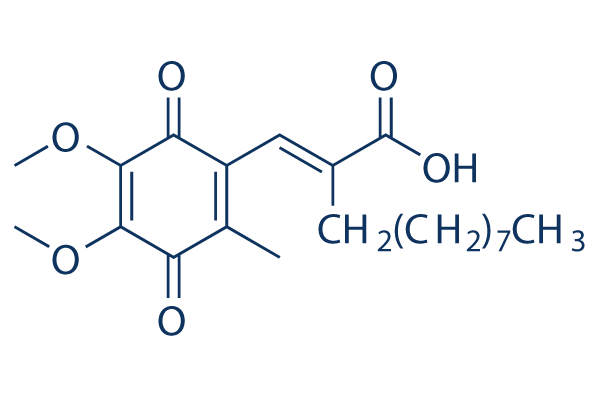
APX-3330 DNA/RNA Synthesis inhibitor
Cat.No.S7445
Quality Control
| Related Targets | HDAC PARP ATM/ATR DNA-PK WRN Topoisomerase PPAR Sirtuin Casein Kinase eIF |
|---|---|
| Other DNA/RNA Synthesis Inhibitors | CX-5461 (Pidnarulex) SCR7 Favipiravir (T-705) RK-33 EED226 BMH-21 Carmofur Triapine (3-AP) YK-4-279 Halofuginone |
Cell Culture, Treatment & Working Concentration
| Cell Lines | Assay Type | Concentration | Incubation Time | Formulation | Activity Description | PMID |
|---|---|---|---|---|---|---|
| Hey-C2 cells | Function assay | Inhibition of Ape1/ref-1 redox activity in presence of 0.02 mM DTT and human Hey-C2 cells nuclear extracts by EMSA, IC50=10μM. | 20067291 | |||
| Hey-C2 cells | Growth inhibition assay | 72 hrs | Growth inhibition of human Hey-C2 cells after 72 hrs by MTS assay, GI50=35μM. | 20067291 | ||
| Click to View More Cell Line Experimental Data | ||||||
Solubility
|
In vitro |
DMSO
: 100 mg/mL
(264.22 mM)
Ethanol : 75 mg/mL Water : Insoluble |
Molarity Calculator
|
In vivo |
|||||
In vivo Formulation Calculator (Clear solution)
Step 1: Enter information below (Recommended: An additional animal making an allowance for loss during the experiment)
Step 2: Enter the in vivo formulation (This is only the calculator, not formulation. Please contact us first if there is no in vivo formulation at the solubility Section.)
Calculation results:
Working concentration: mg/ml;
Method for preparing DMSO master liquid: mg drug pre-dissolved in μL DMSO ( Master liquid concentration mg/mL, Please contact us first if the concentration exceeds the DMSO solubility of the batch of drug. )
Method for preparing in vivo formulation: Take μL DMSO master liquid, next addμL PEG300, mix and clarify, next addμL Tween 80, mix and clarify, next add μL ddH2O, mix and clarify.
Method for preparing in vivo formulation: Take μL DMSO master liquid, next add μL Corn oil, mix and clarify.
Note: 1. Please make sure the liquid is clear before adding the next solvent.
2. Be sure to add the solvent(s) in order. You must ensure that the solution obtained, in the previous addition, is a clear solution before proceeding to add the next solvent. Physical methods such
as vortex, ultrasound or hot water bath can be used to aid dissolving.
Chemical Information, Storage & Stability
| Molecular Weight | 378.46 | Formula | C21H30O6 |
Storage (From the date of receipt) | |
|---|---|---|---|---|---|
| CAS No. | 136164-66-4 | Download SDF | Storage of Stock Solutions |
|
|
| Synonyms | E3330 | SMILES | CCCCCCCCCC(=CC1=C(C(=O)C(=C(C1=O)OC)OC)C)C(=O)O | ||
Read more about storage stability stock solution CAS number SMILES
Mechanism of Action
| Targets/IC50/Ki |
NF-κB
APE1(Ref-1)
|
|---|---|
| In vitro |
E3330 affects hemangioblast development in vitro via inhibition of Ape1 redox activity. E3330 inhibits the growth of human pancreatic cancer cell line PANC1, XPA1, MIAPACA, BxPC3, and PK9. E3330 also promotes exit of cell cycle in PANC1 cells, inhibits the DNA-Binding activity of HIF-1α and migration of pancreatic cancer cells. In JHH6 cells, E3330 prevents the functional activation of NF-κB via the alteration of APE1 subcellular trafficking and reduces IL-6 and IL-8 expression induced by TNF-α and FAs accumulation through blockage of the redox-mediated activation of NF-κB.
|
| In vivo |
In mice with endotoxin-mediated hepatitis, E3330 (300 mg/kg, p.o.) attenuates the elevation of plasma tumor necrosis factor activity and protectes mice from liver injury. In Rat model, E3330 (100 mg/kg, p.o.) also protectes rats from severe liver injury induced with endotoxin plus galactosamine.
|
References |
|
Clinical Trial Information
(data from https://clinicaltrials.gov, updated on 2026-06-08)
| NCT Number | Recruitment | Conditions | Sponsor/Collaborators | Start Date | Phases |
|---|---|---|---|---|---|
| NCT04692688 | COMPLETED | Diabetic Retinopathy; Diabetic Macular Edema; NPDR - Non Proliferative Diabetic Retinopathy; PDR - Proliferative Diabetic Retinopathy |
Ocuphire Pharma, Inc. |
2021-04-08 | PHASE2 |
| NCT03375086 | COMPLETED | Cancer |
Apexian Pharmaceuticals, Inc. |
2018-01-30 | PHASE1 |
| NCT03375086 | Completed | Cancer |
Apexian Pharmaceuticals Inc. |
2018-01-30 | Phase 1 |
Read more about Clinical Trials
Tech Support
Tel: +1-832-582-8158 Ext:3
If you have any other enquiries, please leave a message.
Signaling Pathway Map

Products are for research use only. Not for human use. We do not sell to patients.
©Copyright 2013 Selleck Chemicals. All Rights Reserved.