Janus kinases (JAKs) are non-receptor tyrosine kinases which play the key role in JAK-STAT signaling pathway. A large number of cytokines depend on JAK including interleukin (IL)-2, IL-4, IL-7, IL-9, IL-15 and IL-21. Jak kinases are involved in malignant cell growth and survival. Jak kinases have been shown to modulate activation of Ras-Raf-MAP kinase pathways which are implicated in malignant transformation. The function of Jak kinases is also related to Abl. Jak kinases have been also implicated in the regulation of p53-dependent cell-cycle arrest and apoptosis, for example, Jak kinases can regulate the levels of Bcl-XL, Bcl-2 and Bax expression by their effects on Stats and other receptor linked pathways such as the PI-3 kinase and the Ras-MAPK pathways.

-
 Argentina
-
 Australia
-
 Austria
-
 Belgium
-
 Brazil
-
 Canada
-
 China
China
-
 Czech Republic
-
 Denmark
-
 Finland
-
 France
-
 Germany
-
 Greece
-
 Hong Kong
-
 Hungary
-
 Iceland
-
 India
India
-
 Ireland
-
 Israel
-
 Italy
Italy
-
 Japan
Japan
-
 Korea
Korea
-
 Luxembourg
-
 Malaysia
-
 Netherlands
-
 New Zealand
-
 Norway
-
 Poland
-
 Portugal
-
 Qatar
Qatar
-
 Romania
-
 Saudi Arabia
-
 Singapore
-
 Spain
Spain
-
 Sweden
-
 Switzerland
-
 Taiwan
-
 Turkey
-
 United Kingdom
-
 United States
JAK Inhibitors
| Cat.No. | Product Name | Information | Product Use Citations | Product Validations |
|---|---|---|---|---|
| S1378 | Ruxolitinib (INCB18424) | Ruxolitinib (INCB18424) is the first potent, selective, JAK1/2 inhibitor to enter the clinic with IC50 of 3.3 nM/2.8 nM in cell-free assays, >130-fold selectivity for JAK1/2 versus JAK3. This compound kills tumor cells through toxic mitophagy. It induces autophagy and enhances apoptosis. |
|
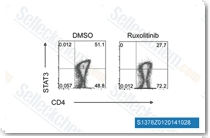
|
| S8879 | BMS-986165 (Deucravacitinib) | Deucravacitinib (BMS-986165) is a highly potent and selective allosteric inhibitor of Tyk2 with a Ki value of 0.02 nM for binding to the Tyk2 pseudokinase domain. It is highly selective against a panel of 265 kinases and pseudokinases. |
|
|
| S5001 | CP-690550 (Tofacitinib) Citrate | Tofacitinib citrate (CP-690550, Tasocitinib) is a novel JAK inhibitor with IC50 of 1 nM, 20 nM and 112 nM against JAK3, JAK2, and JAK1, respectively. It also has anti-infection activity. |
|
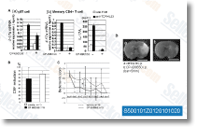
|
| S5243 | Ruxolitinib (INCB18424) Phosphate | Ruxolitinib Phosphate (INCB018424, INC424) is the phosphate salt form of Ruxolitinib. Ruxolitinib is the first potent, selective, JAK1/2 inhibitor to enter the clinic with IC50 of 3.3 nM/2.8 nM in cell-free assays, >130-fold selectivity for JAK1/2 versus JAK3. Ruxolitinib kills tumor cells through toxic mitophagy. Ruxolitinib induces autophagy and enhances apoptosis. |
|
|
| S2851 | Baricitinib (LY3009104) | Baricitinib (LY3009104) is a selective JAK1 and JAK2 inhibitor with IC50 of 5.9 nM and 5.7 nM in cell-free assays, ~70 and ~10-fold selective versus JAK3 and Tyk2, no inhibition to c-Met and Chk2. It is found to reduce or interrupt the passage of the virus into target cells and is used in the treatment research for COVID-19. Phase 3. |
|
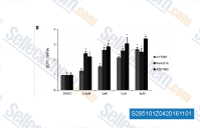
|
| S8162 | ABT-494 (Upadacitinib) | Upadacitinib is a selective JAK1 inhibitor which demonstrates activity against JAK1 (0.045 μM) and JAK2 (0.109 μM), with > 40 fold selectivity over JAK3 (2.1 μM) and 100 fold selectivity over TYK2 (4.7 μM) as compared to JAK1. |
|
|
| S2789 | Tofacitinib (CP-690550) | Tofacitinib is a novel inhibitor of JAK3 with IC50 of 1 nM in cell-free assays, 20- to 100-fold less potent against JAK2 and JAK1. This compound inhibits the expression of antiapoptotic BCL-A1 and BCL-XL in human plasmacytoid dendritic cells (PDC) and induced PDC apoptosis. |
|
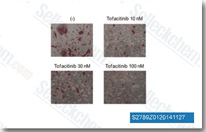
|
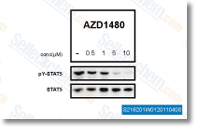
| S2162 | AZD1480 | AZD1480 is a novel ATP-competitive JAK2 inhibitor with IC50 of 0.26 nM in a cell-free assay, selectivity against JAK3 and Tyk2, and to a smaller extent against JAK1. Phase 1. |
|
|
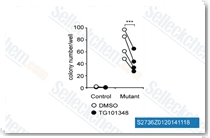
| S2736 | Fedratinib (TG101348) | Fedratinib (SAR302503, TG101348) is a selective inhibitor of JAK2 with IC50 of 3 nM in cell-free assays, 35- and 334-fold more selective for JAK2 versus JAK1 and JAK3. Fedratinib also inhibits FMS-like tyrosine kinase 3 (FLT3) and RET (c-RET) with IC50 of 15 nM and 48 nM, respectively. Fedratinib has potential antineoplastic activity. Fedratinib inhibits proliferation and induces apoptosis. Phase 2. |
|
|
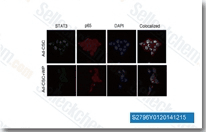
| S2796 | WP1066 | WP1066 is a novel inhibitor of JAK2 and STAT3 with IC50 of 2.30 μM and 2.43 μM in HEL cells; shows activity to JAK2, STAT3, STAT5, and ERK1/2 not JAK1 and JAK3. WP1066 induces apoptosis. Phase 1. |
|
|
Signaling Pathway Map

Products are for research use only. Not for human use. We do not sell to patients.
©Copyright 2013 Selleck Chemicals. All Rights Reserved.