
-
 Argentina
-
 Australia
-
 Austria
-
 Belgium
-
 Brazil
-
 Canada
-
 China
China
-
 Czech Republic
-
 Denmark
-
 Finland
-
 France
-
 Germany
-
 Greece
-
 Hong Kong
-
 Hungary
-
 Iceland
-
 India
India
-
 Ireland
-
 Israel
-
 Italy
Italy
-
 Japan
Japan
-
 Korea
Korea
-
 Luxembourg
-
 Malaysia
-
 Netherlands
-
 New Zealand
-
 Norway
-
 Poland
-
 Portugal
-
 Qatar
Qatar
-
 Romania
-
 Saudi Arabia
-
 Singapore
-
 Spain
Spain
-
 Sweden
-
 Switzerland
-
 Taiwan
-
 Turkey
-
 United Kingdom
-
 United States
research use only
AT9283 Multikinase Inhibitor
Cat.No.S1134
Quality Control
| Related Targets | EGFR STAT Pim |
|---|---|
| Other JAK Inhibitors | BMS-986165 (Deucravacitinib) AZD1480 WP1066 Filgotinib (GLPG0634) Momelotinib (CYT387) Gandotinib (LY2784544) Pacritinib (SB1518) NVP-BSK805 2HCl TG101209 Cerdulatinib (PRT062070) hydrochloride |
Cell Culture, Treatment & Working Concentration
| Cell Lines | Assay Type | Concentration | Incubation Time | Formulation | Activity Description | PMID |
|---|---|---|---|---|---|---|
| HCT116 | Cytotoxicity assay | 10 to 14 days | Cytotoxicity against human HCT116 cells assessed as number of colonies after 10 to 14 days by colony forming assay, IC50=0.012μM | 19143567 | ||
| HCT116 | Function assay | 10 mg/kg | Cmax in BALB/c mouse bearing human HCT116 cells at 10 mg/kg, po, Cmax=0.45μM | 19143567 | ||
| HCT116 | Function assay | 5 mg/kg | Cmax in BALB/c mouse bearing human HCT116 cells at 5 mg/kg, iv, Cmax=4.9μM | 19143567 | ||
| HCT116 | Function assay | 20 mg/kg | Cmax in BALB/c mouse bearing human HCT116 cells at 20 mg/kg, ip, Cmax=8.4μM | 19143567 | ||
| HT-29 | Antitumor assay | 72 hrs | Antitumor activity against human HT-29 cells after 72 hrs by MTT assay, IC50=0.383μM | 23664099 | ||
| A549 | Antitumor assay | 72 hrs | Antitumor activity against human A549 cells after 72 hrs by MTT assay, IC50=0.512μM | 23664099 | ||
| LoVo | Antitumor assay | 72 hrs | Antitumor activity against human LoVo cells after 72 hrs by MTT assay, IC50=0.553μM | 23664099 | ||
| K562 | Antitumor assay | 72 hrs | Antitumor activity against human K562 cells after 72 hrs by MTT assay, IC50=1.6μM | 23664099 | ||
| U937 | Antitumor assay | 72 hrs | Antitumor activity against human U937 cells after 72 hrs by MTT assay, IC50=6.7μM | 23664099 | ||
| BL21 (DE3) | Function assay | 30 mins | Inhibition of His6-tagged MELK catalytic domain (1 to 340 residues) (unknown origin) expressed in Escherichia coli BL21 (DE3) cells using Bcl-GL as substrate measured after 30 mins in presence of [gamma32P]ATP by liquid scintillation counting method, IC50=0.685μM | 28351607 | ||
| Sf9 | Function assay | Binding affinity to N-terminal TEV-cleavable hexa-histidine tagged human JAK2 JH1 domain (840 to 1132 residues) expressed in baculovirus-infected Sf9 cells by ITC assay, Kd=0.011μM | 28626521 | |||
| Sf9 | Function assay | Binding affinity to C-terminal thrombin-cleavable hexa-histidine tagged human JAK2 JH2 pseudokinase domain (536 to 812 residues) W659A/W777A/F794H mutant expressed in baculovirus-infected Sf9 cells by ITC assay, Kd=1.323μM | 28626521 | |||
| Sf9 | Function assay | 10 uM | 60 mins | Displacement of BODIPY-ATP from C-terminal thrombin-cleavable hexa-histidine tagged human JAK2 JH2 pseudokinase domain (536 to 812 residues) W659A/W777A/F794H mutant expressed in baculovirus-infected Sf9 cells at 10 uM after 60 mins by high-throughput flu | 28626521 | |
| HCT116 | Function assay | Inhibition of Aurora B kinase in human HCT116 cells assessed as reduction in polyploid phenotype, IC50=0.03μM | 28918096 | |||
| DAOY | qHTS assay | qHTS of pediatric cancer cell lines to identify multiple opportunities for drug repurposing: Primary screen for DAOY cells | 29435139 | |||
| SJ-GBM2 | qHTS assay | qHTS of pediatric cancer cell lines to identify multiple opportunities for drug repurposing: Primary screen for SJ-GBM2 cells | 29435139 | |||
| A673 | qHTS assay | qHTS of pediatric cancer cell lines to identify multiple opportunities for drug repurposing: Primary screen for A673 cells | 29435139 | |||
| SK-N-MC | qHTS assay | qHTS of pediatric cancer cell lines to identify multiple opportunities for drug repurposing: Primary screen for SK-N-MC cells | 29435139 | |||
| BT-37 | qHTS assay | qHTS of pediatric cancer cell lines to identify multiple opportunities for drug repurposing: Primary screen for BT-37 cells | 29435139 | |||
| NB-EBc1 | qHTS assay | qHTS of pediatric cancer cell lines to identify multiple opportunities for drug repurposing: Primary screen for NB-EBc1 cells | 29435139 | |||
| U-2 OS | qHTS assay | qHTS of pediatric cancer cell lines to identify multiple opportunities for drug repurposing: Primary screen for U-2 OS cells | 29435139 | |||
| Saos-2 | qHTS assay | qHTS of pediatric cancer cell lines to identify multiple opportunities for drug repurposing: Primary screen for Saos-2 cells | 29435139 | |||
| SK-N-SH | qHTS assay | qHTS of pediatric cancer cell lines to identify multiple opportunities for drug repurposing: Primary screen for SK-N-SH cells | 29435139 | |||
| NB1643 | qHTS assay | qHTS of pediatric cancer cell lines to identify multiple opportunities for drug repurposing: Primary screen for NB1643 cells | 29435139 | |||
| LAN-5 | qHTS assay | qHTS of pediatric cancer cell lines to identify multiple opportunities for drug repurposing: Primary screen for LAN-5 cells | 29435139 | |||
| BT-12 | qHTS assay | qHTS of pediatric cancer cell lines to identify multiple opportunities for drug repurposing: Primary screen for BT-12 cells | 29435139 | |||
| Rh18 | qHTS assay | qHTS of pediatric cancer cell lines to identify multiple opportunities for drug repurposing: Primary screen for Rh18 cells | 29435139 | |||
| OHS-50 | qHTS assay | qHTS of pediatric cancer cell lines to identify multiple opportunities for drug repurposing: Primary screen for OHS-50 cells | 29435139 | |||
| RD | qHTS assay | qHTS of pediatric cancer cell lines to identify multiple opportunities for drug repurposing: Primary screen for RD cells | 29435139 | |||
| MG 63 (6-TG R) | qHTS assay | qHTS of pediatric cancer cell lines to identify multiple opportunities for drug repurposing: Primary screen for MG 63 (6-TG R) cells | 29435139 | |||
| fibroblast cells | qHTS assay | qHTS of pediatric cancer cell lines to identify multiple opportunities for drug repurposing: Primary screen for control Hh wild type fibroblast cells | 29435139 | |||
| Rh41 | qHTS assay | qHTS of pediatric cancer cell lines to identify multiple opportunities for drug repurposing: Primary screen for Rh41 cells | 29435139 | |||
| SK-N-MC | qHTS assay | qHTS of pediatric cancer cell lines to identify multiple opportunities for drug repurposing: Confirmatory screen for SK-N-MC cells | 29435139 | |||
| Click to View More Cell Line Experimental Data | ||||||
Solubility
|
In vitro |
DMSO
: 76 mg/mL
(199.25 mM)
Ethanol : 25 mg/mL Water : Insoluble |
Molarity Calculator
|
In vivo |
|||||
In vivo Formulation Calculator (Clear solution)
Step 1: Enter information below (Recommended: An additional animal making an allowance for loss during the experiment)
Step 2: Enter the in vivo formulation (This is only the calculator, not formulation. Please contact us first if there is no in vivo formulation at the solubility Section.)
Calculation results:
Working concentration: mg/ml;
Method for preparing DMSO master liquid: mg drug pre-dissolved in μL DMSO ( Master liquid concentration mg/mL, Please contact us first if the concentration exceeds the DMSO solubility of the batch of drug. )
Method for preparing in vivo formulation: Take μL DMSO master liquid, next addμL PEG300, mix and clarify, next addμL Tween 80, mix and clarify, next add μL ddH2O, mix and clarify.
Method for preparing in vivo formulation: Take μL DMSO master liquid, next add μL Corn oil, mix and clarify.
Note: 1. Please make sure the liquid is clear before adding the next solvent.
2. Be sure to add the solvent(s) in order. You must ensure that the solution obtained, in the previous addition, is a clear solution before proceeding to add the next solvent. Physical methods such
as vortex, ultrasound or hot water bath can be used to aid dissolving.
Chemical Information, Storage & Stability
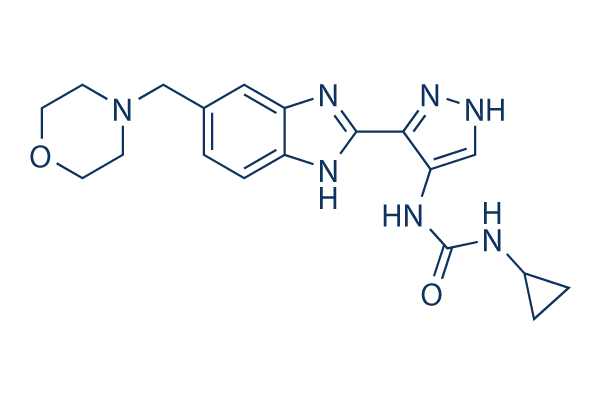
| Molecular Weight | 381.43 | Formula | C19H23N7O2 |
Storage (From the date of receipt) | |
|---|---|---|---|---|---|
| CAS No. | 896466-04-9 | Download SDF | Storage of Stock Solutions |
|
|
| Synonyms | N/A | SMILES | C1CC1NC(=O)NC2=C(NN=C2)C3=NC4=C(N3)C=C(C=C4)CN5CCOCC5 | ||
Read more about storage stability stock solution CAS number SMILES
Mechanism of Action
| Targets/IC50/Ki |
JAK3
(Cell-free assay) 1.1 nM
JAK2
(Cell-free assay) 1.2 nM
Aurora A
(Cell-free assay) ~3.0 nM
Aurora B
(Cell-free assay) ~3.0 nM
Abl1 (T315I)
(Cell-free assay) 4 nM
GSK-3β
(Cell-free assay) 1 nM-10 nM
FGFR2
(Cell-free assay) 1-10 nM
VEGFR3/FLT4
(Cell-free assay) 1 nM-10 nM
Mer
(Cell-free assay) 1 nM-10 nM
RET
(Cell-free assay) 1 nM-10 nM
RSK2
(Cell-free assay) 1 nM-10 nM
RSK3
(Cell-free assay) 1 nM-10 nM
TYK2
(Cell-free assay) 1 nM-10 nM
YES
(Cell-free assay) 1 nM-10 nM
Abl (Q252H)
(Cell-free assay) 10 nM-30 nM
DRAK1
(Cell-free assay) 10 nM-30 nM
FGFR1
(Cell-free assay) 10 nM-30 nM
FGFR1 (V561M)
(Cell-free assay) 10 nM-30 nM
FGFR2 (N549H)
(Cell-free assay) 10 nM-30 nM
FGFR3
(Cell-free assay) 10 nM-30 nM
VEGFR1/FLT1
(Cell-free assay) 10 nM-30 nM
FLT3
(Cell-free assay) 10 nM-30 nM
PDGFRα (D842V)
(Cell-free assay) 10 nM-30 nM
PDK-1
(Cell-free assay) 10 nM-30 nM
PKCμ
(Cell-free assay) 10 nM-30 nM
RSK4
(Cell-free assay) 10 nM-30 nM
Src (T341M)
(Cell-free assay) 10 nM-30 nM
VEGFR2
(Cell-free assay) 10 nM-30 nM
|
|---|---|
| In vitro |
AT9283 leads to a clear polyploid phenotype by inhibiting the activity of Aurora B kinase in HCT116 cells with IC50 of 30 nM. Furthermore, this compound also produces the potent inhibition on HCT116 colony formation. |
| Kinase Assay |
Aurora A and Aurora B Kinase Assays
|
|
Assays for Aurora A and B are performed in a DELFIA format. Aurora A enzyme is incubated with AT9283 and 3 μM cross-tide substrate (biotin-CGPKGPGRRGRRRTSSFAEG) in 10 mM MOPS, pH 7, 0.1 mg/mL BSA, 0.001% Brij-35, 0.5% glycerol, 0.2 mM EDTA, 10 mM MgCl2, 0.01% β-mercaptoethanol, 15 μM ATP, and 2.5% DMSO. Aurora B enzyme is incubated with this compound, 3 μM of the above substrate in 25 mM Tris, pH 8.5, 5 mM MgCl2, 0.1 mg/mL BSA, 0.025% Tween-20, 1 mM DTT, 15 μM ATP, and 2.5% DMSO. Reactions are allowed to proceed for 60 minutes and 45-90 minutes for Aurora A and Aurora B, respectively, before quenching with EDTA. The reaction mixtures are then transferred to a neutravidin-coated plate, and phosphorylated peptide is quantified by means of a phospho-specific antibody and a europium labeled secondary antibody using time-resolved fluorescence (excitation, 337 nm; emission, 620 nm). IC50 values for the control compounds are 92 nM (Aurora A assay) and 17 nM (Aurora B).
|
|
| In vivo |
In HCT116 human colon carcinoma xenograft bearing mice, AT9283 treatment (15 mg/kg and 20 mg/kg) for 16 days results in a significant tumor growth inhibition of 67% and 76%, respectively. In addition, this compound also exhibits a significantly longer half-life in tumors(2.5 hours) compared with plasma (0.5 hour) and modest oral bioavailability in mice (Fp.o. = 24%). |
References |
|
Applications
| Methods | Biomarkers | Images | PMID |
|---|---|---|---|
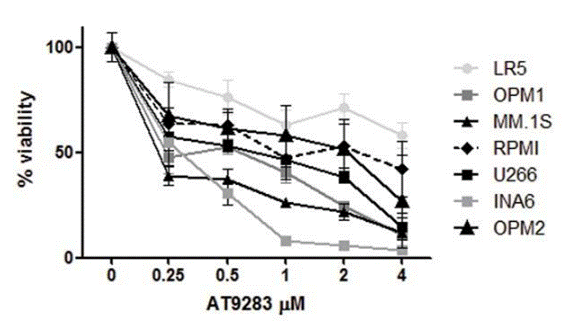
| Growth inhibition assay | Cell viability |
|
21430070 |
Clinical Trial Information
(data from https://clinicaltrials.gov, updated on 2019-11-29)
| NCT Number | Recruitment | Conditions | Sponsor/Collaborators | Start Date | Phases |
|---|---|---|---|---|---|
| NCT00985868 | COMPLETED | Unspecified Childhood Solid Tumor, Protocol Specific |
Cancer Research UK |
2009-09 | PHASE1 |
| NCT01145989 | COMPLETED | Multiple Myeloma |
NCIC Clinical Trials Group |
2011-02-15 | PHASE2 |
| NCT01431664 | COMPLETED | Leukemia |
Cancer Research UK |
2011-09 | PHASE1 |
| NCT01145989 | Completed | Multiple Myeloma |
NCIC Clinical Trials Group|Astex Pharmaceuticals Inc.|Canadian Cancer Trials Group |
2011-02-15 | Phase 2 |
| NCT00443976 | COMPLETED | Non-Hodgkins Lymphoma; Unspecified Adult Solid Tumor, Protocol Specific |
NCIC Clinical Trials Group |
2007-01-30 | PHASE1 |
| NCT00522990 | TERMINATED | Acute Myeloid Leukemia; Acute Lymphoblastic Leukemia; Chronic Myeloid Leukemia; Myelodysplastic Syndromes; Myelofibrosis |
Astex Pharmaceuticals, Inc. |
2006-09 | PHASE1; PHASE2 |
Read more about Clinical Trials
Tech Support
Tel: +1-832-582-8158 Ext:3
If you have any other enquiries, please leave a message.
Signaling Pathway Map

Products are for research use only. Not for human use. We do not sell to patients.
©Copyright 2013 Selleck Chemicals. All Rights Reserved.