
-
 Argentina
-
 Australia
-
 Austria
-
 Belgium
-
 Brazil
-
 Canada
-
 China
China
-
 Czech Republic
-
 Denmark
-
 Finland
-
 France
-
 Germany
-
 Greece
-
 Hong Kong
-
 Hungary
-
 Iceland
-
 India
India
-
 Ireland
-
 Israel
-
 Italy
Italy
-
 Japan
Japan
-
 Korea
Korea
-
 Luxembourg
-
 Malaysia
-
 Netherlands
-
 New Zealand
-
 Norway
-
 Poland
-
 Portugal
-
 Qatar
Qatar
-
 Romania
-
 Saudi Arabia
-
 Singapore
-
 Spain
Spain
-
 Sweden
-
 Switzerland
-
 Taiwan
-
 Turkey
-
 United Kingdom
-
 United States
research use only
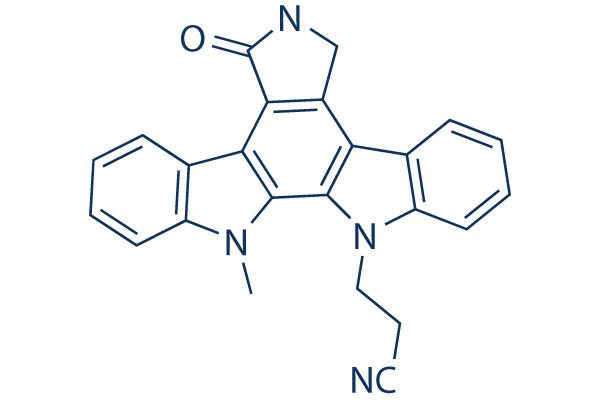
Go 6976 PKC inhibitor
Cat.No.S7119
Quality Control
Cell Culture, Treatment & Working Concentration
| Cell Lines | Assay Type | Concentration | Incubation Time | Formulation | Activity Description | PMID |
|---|---|---|---|---|---|---|
| Vero | Cytotoxicity assay | Cytotoxicity against African green monkey Vero cells assessed as reduction in cell viability measured on day 5 post dose by MTS/PMS based microscopic analysis, CC50=6μM. | 28689975 | |||
| primary microglial cells | Function assay | Inhibition of IFN-gamma-induced IFN-gamma regulatory factor levels in Sprague-Dawley rat primary microglial cells by Western blotting | 17395590 | |||
| primary microglial cells | Function assay | 1.3 uM | Suppression of IFN-gamma-induced PKCalpha/beta2 nuclear translocation in Sprague-Dawley rat primary microglial cells at 1.3 uM by Western blotting | 17395590 | ||
| primary microglial cells | Function assay | 1.3 uM | Suppression of IFN-gamma-induced IFN-gamma regulatory factor 1 nuclear translocation in Sprague-Dawley rat primary microglial cells at 1.3 uM by Western blotting | 17395590 | ||
| DAOY | qHTS assay | qHTS of pediatric cancer cell lines to identify multiple opportunities for drug repurposing: Primary screen for DAOY cells | 29435139 | |||
| SJ-GBM2 | qHTS assay | qHTS of pediatric cancer cell lines to identify multiple opportunities for drug repurposing: Primary screen for SJ-GBM2 cells | 29435139 | |||
| A673 | qHTS assay | qHTS of pediatric cancer cell lines to identify multiple opportunities for drug repurposing: Primary screen for A673 cells | 29435139 | |||
| SK-N-MC | qHTS assay | qHTS of pediatric cancer cell lines to identify multiple opportunities for drug repurposing: Primary screen for SK-N-MC cells | 29435139 | |||
| BT-37 | qHTS assay | qHTS of pediatric cancer cell lines to identify multiple opportunities for drug repurposing: Primary screen for BT-37 cells | 29435139 | |||
| NB-EBc1 | qHTS assay | qHTS of pediatric cancer cell lines to identify multiple opportunities for drug repurposing: Primary screen for NB-EBc1 cells | 29435139 | |||
| Saos-2 | qHTS assay | qHTS of pediatric cancer cell lines to identify multiple opportunities for drug repurposing: Primary screen for Saos-2 cells | 29435139 | |||
| SK-N-SH | qHTS assay | qHTS of pediatric cancer cell lines to identify multiple opportunities for drug repurposing: Primary screen for SK-N-SH cells | 29435139 | |||
| NB1643 | qHTS assay | qHTS of pediatric cancer cell lines to identify multiple opportunities for drug repurposing: Primary screen for NB1643 cells | 29435139 | |||
| LAN-5 | qHTS assay | qHTS of pediatric cancer cell lines to identify multiple opportunities for drug repurposing: Primary screen for LAN-5 cells | 29435139 | |||
| OHS-50 | qHTS assay | qHTS of pediatric cancer cell lines to identify multiple opportunities for drug repurposing: Primary screen for OHS-50 cells | 29435139 | |||
| MG 63 (6-TG R) | qHTS assay | qHTS of pediatric cancer cell lines to identify multiple opportunities for drug repurposing: Primary screen for MG 63 (6-TG R) cells | 29435139 | |||
| NB1643 | qHTS assay | qHTS of pediatric cancer cell lines to identify multiple opportunities for drug repurposing: Confirmatory screen for NB1643 cells | 29435139 | |||
| A673 | qHTS assay | qHTS of pediatric cancer cell lines to identify multiple opportunities for drug repurposing: Confirmatory screen for A673 cells) | 29435139 | |||
| SK-N-MC | qHTS assay | qHTS of pediatric cancer cell lines to identify multiple opportunities for drug repurposing: Confirmatory screen for SK-N-MC cells | 29435139 | |||
| NB-EBc1 | qHTS assay | qHTS of pediatric cancer cell lines to identify multiple opportunities for drug repurposing: Confirmatory screen for NB-EBc1 cells | 29435139 | |||
| BT-37 | qHTS assay | qHTS of pediatric cancer cell lines to identify multiple opportunities for drug repurposing: Confirmatory screen for BT-37 cells | 29435139 | |||
| TC32 | qHTS assay | qHTS of pediatric cancer cell lines to identify multiple opportunities for drug repurposing: Confirmatory screen for TC32 cells | 29435139 | |||
| U-2 OS | qHTS assay | qHTS of pediatric cancer cell lines to identify multiple opportunities for drug repurposing: Confirmatory screen for U-2 OS cells | 29435139 | |||
| Rh41 | qHTS assay | qHTS of pediatric cancer cell lines to identify multiple opportunities for drug repurposing: Confirmatory screen for Rh41 cells | 29435139 | |||
| Saos-2 | qHTS assay | qHTS of pediatric cancer cell lines to identify multiple opportunities for drug repurposing: Confirmatory screen for Saos-2 cells | 29435139 | |||
| OHS-50 | qHTS assay | qHTS of pediatric cancer cell lines to identify multiple opportunities for drug repurposing: Confirmatory screen for OHS-50 cells | 29435139 | |||
| SK-N-SH | qHTS assay | qHTS of pediatric cancer cell lines to identify multiple opportunities for drug repurposing: Confirmatory screen for SK-N-SH cells | 29435139 | |||
| Click to View More Cell Line Experimental Data | ||||||
Solubility
|
In vitro |
DMSO
: 44.7 mg/mL
(118.43 mM)
Water : Insoluble Ethanol : Insoluble |
Molarity Calculator
|
In vivo |
|||||
In vivo Formulation Calculator (Clear solution)
Step 1: Enter information below (Recommended: An additional animal making an allowance for loss during the experiment)
Step 2: Enter the in vivo formulation (This is only the calculator, not formulation. Please contact us first if there is no in vivo formulation at the solubility Section.)
Calculation results:
Working concentration: mg/ml;
Method for preparing DMSO master liquid: mg drug pre-dissolved in μL DMSO ( Master liquid concentration mg/mL, Please contact us first if the concentration exceeds the DMSO solubility of the batch of drug. )
Method for preparing in vivo formulation: Take μL DMSO master liquid, next addμL PEG300, mix and clarify, next addμL Tween 80, mix and clarify, next add μL ddH2O, mix and clarify.
Method for preparing in vivo formulation: Take μL DMSO master liquid, next add μL Corn oil, mix and clarify.
Note: 1. Please make sure the liquid is clear before adding the next solvent.
2. Be sure to add the solvent(s) in order. You must ensure that the solution obtained, in the previous addition, is a clear solution before proceeding to add the next solvent. Physical methods such
as vortex, ultrasound or hot water bath can be used to aid dissolving.
Chemical Information, Storage & Stability
| Molecular Weight | 377.42 | Formula | C24H18N4O |
Storage (From the date of receipt) | |
|---|---|---|---|---|---|
| CAS No. | 136194-77-9 | Download SDF | Storage of Stock Solutions |
|
|
| Synonyms | PD406976 | SMILES | CN1C2=CC=CC=C2C3=C4C(=C5C6=CC=CC=C6N(C5=C31)CCC#N)CNC4=O | ||
Read more about storage stability stock solution CAS number SMILES
Mechanism of Action
| Targets/IC50/Ki |
JAK2
(Cell-free assay) FLT3
(Cell-free assay) PKCα
(Cell-free assay) 2.3 nM
PKCβ1
(Cell-free assay) 6.2 nM
PKC
(Rat brain) 7.9 nM
|
|---|---|
| In vitro |
Go6976 have no effect on the kinase activity of the Ca(2+)-independent PKC subtypes delta, epsilon, and zeta. Beside WT JAK2, this compound also inhibits the mutant forms (JAK2 V617F and TEL-JAK2) found in haematological malignancies, and has activity against mutant forms of FLT3. In AML cells, this chemical reduces the survival to 55% of control in FLT3-ITD cases and to 69% in FLT3-WT samples. It potently inhibits HIV-1 induction by Bryostatin 1, tumor necrosis factor alpha, and interleukin 6.
|
| Kinase Assay |
PKC Activity Assay
|
|
In brief, for measuring PKCα, and PKCβ1 and PKC from rat brain, the assay mixture of 200 μl contains 50 mM HEPES (pH7.5), 5 mM MgCl2, 1 mM EDTA, 1.25 mM EGTA, 1.32 mM CaC12, 1 mM dithiothreitol, 1 μg of phosphatidylserine, 0.2 μg of diolein, 40 μg of histone Hi, 10 μM [γ-32P]ATP (1 μCi/ml), and 5-10 units (pmol of Pi/min) of PKC. Assays are started by the addition of [γ-32P]ATP, incubated for 5 min at 30 °C, stopped by the addition of 2 ml of 8.5% H3PO4, filtered through 0.45-μm nitrocellulose filters, and evaluated by scintillation counting.
|
|
| In vivo |
Go6976 (2.5 mg/kg i.p.), as a PKD inhibitor, effectively prevents LPS/D: -GalN-induced acute liver injury by inhibition of MAPKs activation to reduce TNF-α production, and significantly improves the survival of LPS/D-GalN-challenged mice.
|
References |
|
Applications
| Methods | Biomarkers | Images | PMID |
|---|---|---|---|
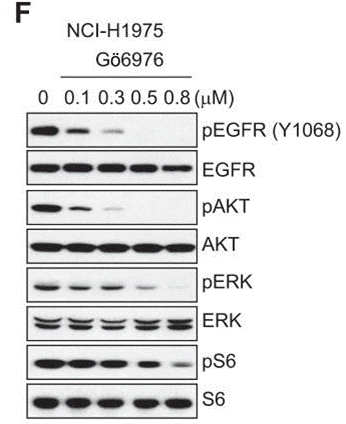
| Western blot | p-EGFR / EGFR / p-AKT / AKT / p-ERK / ERK / p-S6 / S6 |
|
23229345 |
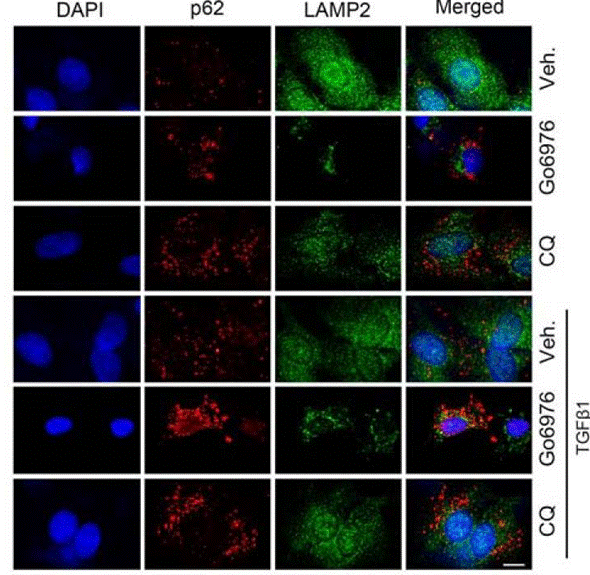
| Immunofluorescence | p62 / LAMP2 |
|
29794026 |
Tech Support
Tel: +1-832-582-8158 Ext:3
If you have any other enquiries, please leave a message.
Signaling Pathway Map

Products are for research use only. Not for human use. We do not sell to patients.
©Copyright 2013 Selleck Chemicals. All Rights Reserved.