
-
 Argentina
-
 Australia
-
 Austria
-
 Belgium
-
 Brazil
-
 Canada
-
 China
China
-
 Czech Republic
-
 Denmark
-
 Finland
-
 France
-
 Germany
-
 Greece
-
 Hong Kong
-
 Hungary
-
 Iceland
-
 India
India
-
 Ireland
-
 Israel
-
 Italy
Italy
-
 Japan
Japan
-
 Korea
Korea
-
 Luxembourg
-
 Malaysia
-
 Netherlands
-
 New Zealand
-
 Norway
-
 Poland
-
 Portugal
-
 Qatar
Qatar
-
 Romania
-
 Saudi Arabia
-
 Singapore
-
 Spain
Spain
-
 Sweden
-
 Switzerland
-
 Taiwan
-
 Turkey
-
 United Kingdom
-
 United States
research use only
BMS-911543 JAK inhibitor
Cat.No.S7144
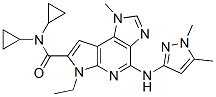
Quality Control
| Related Targets | EGFR STAT Pim |
|---|---|
| Other JAK Inhibitors | BMS-986165 (Deucravacitinib) AZD1480 WP1066 Filgotinib (GLPG0634) Momelotinib (CYT387) AT9283 Gandotinib (LY2784544) Pacritinib (SB1518) NVP-BSK805 2HCl TG101209 |
Solubility
|
In vitro |
DMSO
: 35 mg/mL
(80.92 mM)
Ethanol : 33 mg/mL Water : Insoluble |
Molarity Calculator
|
In vivo |
|||||
In vivo Formulation Calculator (Clear solution)
Step 1: Enter information below (Recommended: An additional animal making an allowance for loss during the experiment)
Step 2: Enter the in vivo formulation (This is only the calculator, not formulation. Please contact us first if there is no in vivo formulation at the solubility Section.)
Calculation results:
Working concentration: mg/ml;
Method for preparing DMSO master liquid: mg drug pre-dissolved in μL DMSO ( Master liquid concentration mg/mL, Please contact us first if the concentration exceeds the DMSO solubility of the batch of drug. )
Method for preparing in vivo formulation: Take μL DMSO master liquid, next addμL PEG300, mix and clarify, next addμL Tween 80, mix and clarify, next add μL ddH2O, mix and clarify.
Method for preparing in vivo formulation: Take μL DMSO master liquid, next add μL Corn oil, mix and clarify.
Note: 1. Please make sure the liquid is clear before adding the next solvent.
2. Be sure to add the solvent(s) in order. You must ensure that the solution obtained, in the previous addition, is a clear solution before proceeding to add the next solvent. Physical methods such
as vortex, ultrasound or hot water bath can be used to aid dissolving.
Chemical Information, Storage & Stability
| Molecular Weight | 432.52 | Formula | C23H28N8O |
Storage (From the date of receipt) | |
|---|---|---|---|---|---|
| CAS No. | 1271022-90-2 | Download SDF | Storage of Stock Solutions |
|
|
Read more about storage stability stock solution CAS number SMILES
Mechanism of Action
| Targets/IC50/Ki |
JAK2
(Cell-free assay) 1.1 nM
SET-2
(Cell-free assay) 60 nM
TYK2
(Cell-free assay) 66 nM
JAK3
(Cell-free assay) 75 nM
|
|---|---|
| In vitro |
BMS-911543 shows potent antiproliferative activity in the SET-2 as well as BaF3-V617F engineered cell lines (both dependent upon JAK2 pathway), with IC50 values of 60 and 70 nM, respectively. The antiproliferative activity of this compound in SET-2 and BaF3-V617F cells correlates with similar activity on constitutively active pSTAT5 (IC50 80 and 65 nM, respectively). In contrast, non-JAK2-dependent cell lines (A549, MDA-MB-231, MiaPaCa-2) are significantly less sensitive to the inhibitor treatment. The excellent biochemical selectivity versus JAK1/3 translates to good cellular and functional selectivity in an IL-2 mediated T-cell proliferation assay (IC50 990 nM). Also, cell lines that rely on other JAK family members, including CTLL2 and parental BaF3 cells stimulated with IL-3, shows weak antiproliferative activity for this chemical (IC50 2.9 and 3.5 μM, respectively).
|
| In vivo |
BMS-911543 suppresses the pSTAT5 levels (mediated by wild type JAK2) relative to vehicle control when stimulated with thrombopoetin (TPO) in a mouse pharmacodynamic model. The responses are dose dependent and results in nearly complete normalization of pSTAT5 levels for 18 h at the highest oral dose of 30 mg/kg. At an intermediate 10 mg/kg oral dose, ∼65% reduction is observed up to 18 h, whereas at the 5 mg/kg dose, approximately 50% reduction in pSTAT5 for 8 h is achieved. Observed pSTAT5 reductions correlates with exposures of this compound, with AUC0–8h values of 23, 41, and 109 μM·h, respectively, for dose levels of 5, 10, and 30 mg/kg. In addition, this chemical demonstrates a potent and sustained (2 mg/kg up to 7 h) PD effect in blocking pSTAT5 formation in mice grafted with human SET-2 cells harboring JAK2-V617F mutation. The absolute oral bioavailability in solution is >50% in mice, rats, dogs, and monkeys. In addition, the absorption of this compound is not significantly impacted by particle dissolution (suspension formulation), with a relative bioavailability (vs solution) of ∼60% in rats and ∼100% in dogs.
|
References |
Clinical Trial Information
(data from https://clinicaltrials.gov, updated on 2019-07-31)
| NCT Number | Recruitment | Conditions | Sponsor/Collaborators | Start Date | Phases |
|---|---|---|---|---|---|
| NCT01236352 | TERMINATED | Cancer |
Bristol-Myers Squibb |
2011-04-07 | PHASE1; PHASE2 |
| NCT01236352 | Terminated | Cancer |
Bristol-Myers Squibb |
2011-04-07 | Phase 1|Phase 2 |
Read more about Clinical Trials
Tech Support
Tel: +1-832-582-8158 Ext:3
If you have any other enquiries, please leave a message.
Signaling Pathway Map

Products are for research use only. Not for human use. We do not sell to patients.
©Copyright 2013 Selleck Chemicals. All Rights Reserved.