
-
 Argentina
-
 Australia
-
 Austria
-
 Belgium
-
 Brazil
-
 Canada
-
 China
China
-
 Czech Republic
-
 Denmark
-
 Finland
-
 France
-
 Germany
-
 Greece
-
 Hong Kong
-
 Hungary
-
 Iceland
-
 India
India
-
 Ireland
-
 Israel
-
 Italy
Italy
-
 Japan
Japan
-
 Korea
Korea
-
 Luxembourg
-
 Malaysia
-
 Netherlands
-
 New Zealand
-
 Norway
-
 Poland
-
 Qatar
Qatar
-
 Romania
-
 Saudi Arabia
-
 Singapore
-
 Spain
Spain
-
 Sweden
-
 Switzerland
-
 Taiwan
-
 Turkey
-
 United Kingdom
-
 United States
research use only
Fenoprofen calcium hydrate Immunology & Inflammation related chemical
Cat.No.S3027
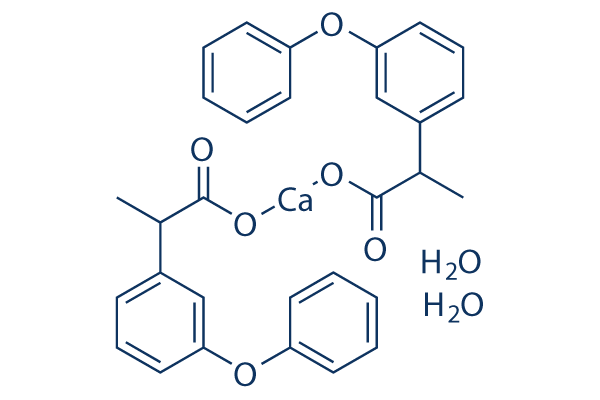
Chemical Structure
Molecular Weight: 558.63
Quality Control
| Related Targets | PD-1/PD-L1 CXCR STING AhR CD markers Interleukins Anti-infection Antioxidant COX Histamine Receptor |
|---|---|
| Other Immunology & Inflammation related Inhibitors | Cl-amidine Bestatin (Ubenimex) Bindarit (AF 2838) Tempol Tranilast GI254023X (GI4023) Sinomenine Geniposidic acid CORM-3 Germacrone |
Solubility
|
In vitro |
DMSO
: 48 mg/mL
(85.92 mM)
Ethanol : 18 mg/mL Water : Insoluble |
Molarity Calculator
|
In vivo |
|||||
In vivo Formulation Calculator (Clear solution)
Step 1: Enter information below (Recommended: An additional animal making an allowance for loss during the experiment)
Step 2: Enter the in vivo formulation (This is only the calculator, not formulation. Please contact us first if there is no in vivo formulation at the solubility Section.)
Calculation results:
Working concentration: mg/ml;
Method for preparing DMSO master liquid: mg drug pre-dissolved in μL DMSO ( Master liquid concentration mg/mL, Please contact us first if the concentration exceeds the DMSO solubility of the batch of drug. )
Method for preparing in vivo formulation: Take μL DMSO master liquid, next addμL PEG300, mix and clarify, next addμL Tween 80, mix and clarify, next add μL ddH2O, mix and clarify.
Method for preparing in vivo formulation: Take μL DMSO master liquid, next add μL Corn oil, mix and clarify.
Note: 1. Please make sure the liquid is clear before adding the next solvent.
2. Be sure to add the solvent(s) in order. You must ensure that the solution obtained, in the previous addition, is a clear solution before proceeding to add the next solvent. Physical methods such
as vortex, ultrasound or hot water bath can be used to aid dissolving.
Chemical Information, Storage & Stability
| Molecular Weight | 558.63 | Formula | C30H30CaO8 |
Storage (From the date of receipt) | |
|---|---|---|---|---|---|
| CAS No. | 71720-56-4, 53746-45-5 | Download SDF | Storage of Stock Solutions |
|
|
| Synonyms | Fenoprofen calcium salt dihydrate,Feprona dihydrate,Progesic dihydrate | Smiles | CC(C1=CC(=CC=C1)OC2=CC=CC=C2)C(=O)[O-].CC(C1=CC(=CC=C1)OC2=CC=CC=C2)C(=O)[O-].O.O.[Ca+2] | ||
Mechanism of Action
| In vitro |
Fenoprofen is a more potent inhibitor of collagen-induced platelet aggregation than either aspirin or phenylbutazone. Fenoprofen inhibits the formation of palmitoyl-CoA in both microsomal and peroxisomal fractions, and inhibits the beta-oxidation of lignoceric acid and cerotic acid in rat hepatocytes. Fenoprofen exhibits modest antiproliferative activity against HT-29, DID-1, and SW480 cells with IC50 of 240 μM, 300 μM, and 360 μM, respectively. Fenoprofen (0.1 mM) is an efficient activator of peroxisome proliferator-activated receptor gamma (PPARγ), activating the receptor to a degree comparable to that obtained with the PPARγ ligands BRL49653 and 15-deoxy-D12,14-PGJ2 and the peroxisome proliferator Wy14643. Fenoprofen is also an efficacious activator of PPARα, activating the receptor to a degree comparable to that obtained with the strong peroxisome proliferator Wy14643. Consistently, Fenoprofen treatment promotes lipogenesis in C3H10T1/2 cells. Although Fenoprofen displays only modest antiproliferative activity, Fenoprofen amides can potently induce cell cycle arrest at the G1 phase, as well as apoptosis, probably because of a greater lipophilicity and/or better cell uptake. |
|---|---|
| In vivo |
Oral administration of Fenoprofen at 50 mg/kg potently inhibits thrombus formation by 47%, whereas a dose of 200 mg/kg of aspirin is required to reduce thrombus formation 21 %. Similar to indomethacin, adminstration of Fenoprofen inhibits prostaglandin synthesis. In rats with type II collagen-induced arthritis, Fenoprofen treatment at 40 mg/kg/day partially suppresses the paw swelling, but has no significant effect on humoral and cellular responses. Administration of Fenoprofen depresses the rebound contraction, thus transforming the brisk relaxant response, elicited by vagal stimulation or ATP, into long-lasting relaxation. Administration of Fenoprofen causes a strong and dose-related induction of peroxisomal palmitoyl-CoA oxidase, and of carnitine acyltransferase and acyl-CoA hydrolase activities in liver homogenates of mice fed diets. Hepatic catalase activity is significantly increased in mice fed the diet with 0.05 and 0.1% fenoprofen but not the 1% fenoprofen-containing diet. |
References |
|
Tech Support
Tel: +1-832-582-8158 Ext:3
If you have any other enquiries, please leave a message.

Products are for research use only. Not for human use. We do not sell to patients.
©Copyright 2013 Selleck Chemicals. All Rights Reserved.