
-
 Argentina
-
 Australia
-
 Austria
-
 Belgium
-
 Brazil
-
 Canada
-
 China
China
-
 Czech Republic
-
 Denmark
-
 Finland
-
 France
-
 Germany
-
 Greece
-
 Hong Kong
-
 Hungary
-
 Iceland
-
 India
India
-
 Ireland
-
 Israel
-
 Italy
Italy
-
 Japan
Japan
-
 Korea
Korea
-
 Luxembourg
-
 Malaysia
-
 Netherlands
-
 New Zealand
-
 Norway
-
 Poland
-
 Portugal
-
 Qatar
Qatar
-
 Romania
-
 Saudi Arabia
-
 Singapore
-
 Spain
Spain
-
 Sweden
-
 Switzerland
-
 Taiwan
-
 Turkey
-
 United Kingdom
-
 United States
research use only
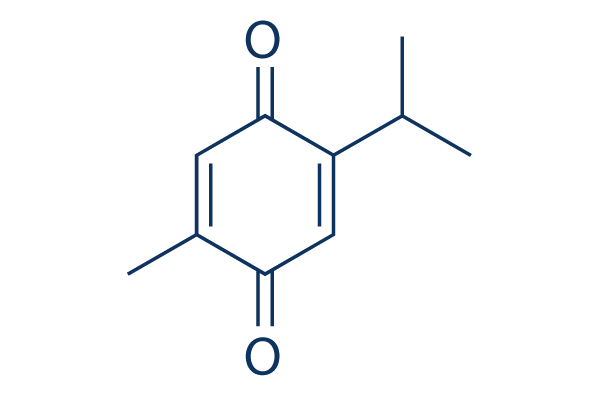
Thymoquinone Immunology & Inflammation related chemical
Cat.No.S4761
Quality Control
| Related Targets | PD-1/PD-L1 CXCR STING AhR CD markers Interleukins Anti-infection Antioxidant COX Histamine Receptor |
|---|---|
| Other Immunology & Inflammation related Inhibitors | Cl-amidine Bestatin (Ubenimex) Bindarit (AF 2838) Tempol Tranilast GI254023X (GI4023) Sinomenine Geniposidic acid CORM-3 Germacrone |
Solubility
|
In vitro |
DMSO
: 32 mg/mL
(194.88 mM)
|
Molarity Calculator
|
In vivo |
|||||
In vivo Formulation Calculator (Clear solution)
Step 1: Enter information below (Recommended: An additional animal making an allowance for loss during the experiment)
Step 2: Enter the in vivo formulation (This is only the calculator, not formulation. Please contact us first if there is no in vivo formulation at the solubility Section.)
Calculation results:
Working concentration: mg/ml;
Method for preparing DMSO master liquid: mg drug pre-dissolved in μL DMSO ( Master liquid concentration mg/mL, Please contact us first if the concentration exceeds the DMSO solubility of the batch of drug. )
Method for preparing in vivo formulation: Take μL DMSO master liquid, next addμL PEG300, mix and clarify, next addμL Tween 80, mix and clarify, next add μL ddH2O, mix and clarify.
Method for preparing in vivo formulation: Take μL DMSO master liquid, next add μL Corn oil, mix and clarify.
Note: 1. Please make sure the liquid is clear before adding the next solvent.
2. Be sure to add the solvent(s) in order. You must ensure that the solution obtained, in the previous addition, is a clear solution before proceeding to add the next solvent. Physical methods such
as vortex, ultrasound or hot water bath can be used to aid dissolving.
Chemical Information, Storage & Stability
| Molecular Weight | 164.20 | Formula | C10H12O2 |
Storage (From the date of receipt) | |
|---|---|---|---|---|---|
| CAS No. | 490-91-5 | Download SDF | Storage of Stock Solutions |
|
|
| Synonyms | N/A | SMILES | CC1=CC(=O)C(=CC1=O)C(C)C | ||
Read more about storage stability stock solution CAS number SMILES
Mechanism of Action
| In vitro |
Thymoquinone (TQ) strongly inhibits the production of nitric oxide (NO) and repressed NO synthase (iNOS), tumor necrosis factor (TNF)-α, cyclooxygenase (COX)−2, interleukin (IL)−6, and IL-1β expression in LPS-activated RAW264.7 cells. TQ acts as a radical scavenger and thereby preserves the enzymatic activity of antioxidants like catalase, glutathione peroxidase, and glutathione-S-transferase. TQ abolishes the activity of IRAK1, but not IRAK4, thereby reducing the activity of downstream NF-κB and AP-1. Treatment with TQ significantly decreases cell viability in COLO205 and HCT116 cells in a dose-dependent manner. TQ treatment significantly decreases the level of phosphorylated p65 in the nucleus, which indicates the inhibition of NF-κB activation by TQ treatment. Treatment with TQ also decreases the expression levels of VEGF, c-Myc and Bcl-2.
|
|---|---|
| In vivo |
Treatment of LPS/D-GalN–induced hepatitis and EtOH/HCl–induced gastritis mouse models with TQ significantly ameliorates disease symptoms.
|
References |
|
Clinical Trial Information
(data from https://clinicaltrials.gov, updated on 2026-08-14)
| NCT Number | Recruitment | Conditions | Sponsor/Collaborators | Start Date | Phases |
|---|---|---|---|---|---|
| NCT07765745 | RECRUITING | Radiographic Evaluation; Bone Density; Bone Width; Socket Preservation; Tooth Extraction; Thymoquinone |
Kafrelsheikh University |
2026-02-01 | |
| NCT07391384 | NOT_YET_RECRUITING | Immediate Dental Implant Placement; Jumping Gap; Primary Stability of the Implants |
shaimaa hamdy |
2026-01-21 | |
| NCT07013058 | COMPLETED | Metabolic Syndrome; Elevated Blood Pressure |
Liaquat University of Medical & Health Sciences |
2025-06-15 | |
| NCT07313111 | COMPLETED | Diabetic Peripheral Neuropathy (DPN) |
Hawler Medical University |
2024-07-01 | PHASE4 |
| NCT06070311 | UNKNOWN | Nasal Polyps; Chronic Sinusitis |
Assiut University |
2023-10 | |
| NCT07450807 | COMPLETED | Changes in Human Gut Microbiome in Healthy Adults |
Aysun Tekbaş |
2024-04-02 |
Read more about Clinical Trials
Tech Support
Tel: +1-832-582-8158 Ext:3
If you have any other enquiries, please leave a message.

Products are for research use only. Not for human use. We do not sell to patients.
©Copyright 2013 Selleck Chemicals. All Rights Reserved.